
Thinking Process
PHASE 1: VISUAL DECONSTRUCTION
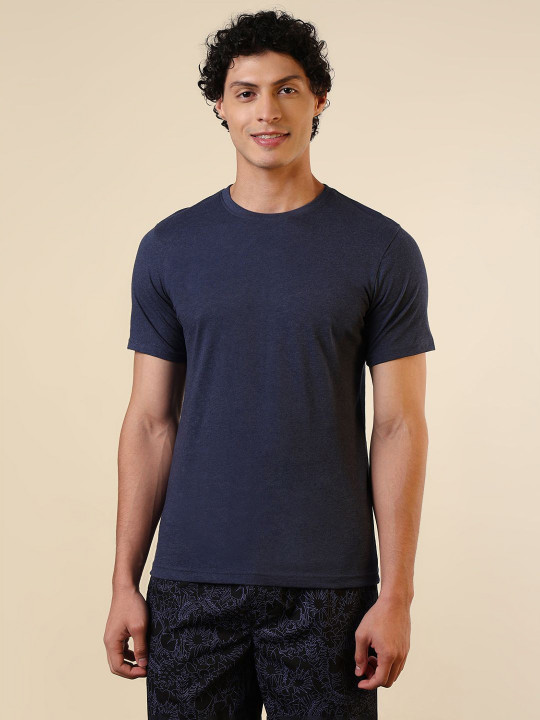
- **Fabric Physics:** The source garment is a lightweight cotton or cotton-blend jersey. Unlike the target's current heavy knit sweater, the new material has low bending resistance and high pliability. It should exhibit a matte finish with very low specular reflection, absorbing the ambient light rather than shining. The texture must show a fine, heathered grain, distinct from the coarse ribbing of the current sweater.
- **Key Features:** The crew neck collar (ribbed trim), the specific navy/dark heather blue hue, and the standard-fit hemline must be preserved. The short sleeve length is a critical geometric feature that differs from the target's long sleeves.
PHASE 2: FIT & DRAPE SIMULATION
- **Body Mapping:** Due to the user's leaning pose, the t-shirt must exhibit tension across the upper back and shoulders. Gravity will pull the fabric vertically, but the contact with the railing will cause horizontal compression folds (bunching) around the lower abdomen/waist area. The sleeve openings should sit loosely around the mid-bicep, hanging vertically relative to gravity, not sticking to the arm. *Note: Since the source is short-sleeved and target is long-sleeved, skin texture generation is required for the forearms.*
- **Occlusion Handling:**
1. **Right Hand:** The user's right hand (resting on hip) must be segmented and layered *over* the new t-shirt.
2. **Railing:** The black metal railing in the foreground must act as a hard occlusion layer; the t-shirt must terminate or appear behind this object.
3. **Left Arm/Elbow:** The contact point between the left arm and the railing requires the fabric (if long enough) or the arm itself to compress slightly against the metal.
PHASE 3: ENVIRONMENT & LIGHTING
- **Light Match:** The target environment utilizes soft, diffused daylight (likely shaded outdoor), coming primarily from the upper-left. The source garment, currently under flat studio lighting, must be relit to cast soft shadows under the pectoral muscles and inside the sleeve openings. The right side of the torso (viewer's right) should be slightly shaded to match the facial lighting gradient.
- **Color Calibration:** The source garment's cool studio blue must be warmed slightly to harmonize with the greenery and natural outdoor ambient light of the target image. Desaturate the blue slightly to match the lower contrast profile of the user image.
PHASE 4: IDENTITY PROTECTION
- **Facial Lock:** The user's entire head (hair, forehead, eyes, nose, mouth, beard, ears) and neck above the collar line must be frozen and pixel-preserved.
- **Body Integrity:** While the silhouette will naturally reduce in volume by replacing a thick wool sweater with a thin t-shirt, the underlying anatomical shoulder width and torso breadth must remain unaltered. Do not slim the waist or change the user's bone structure.