Thinking Process
PHASE 1: VISUAL DECONSTRUCTION
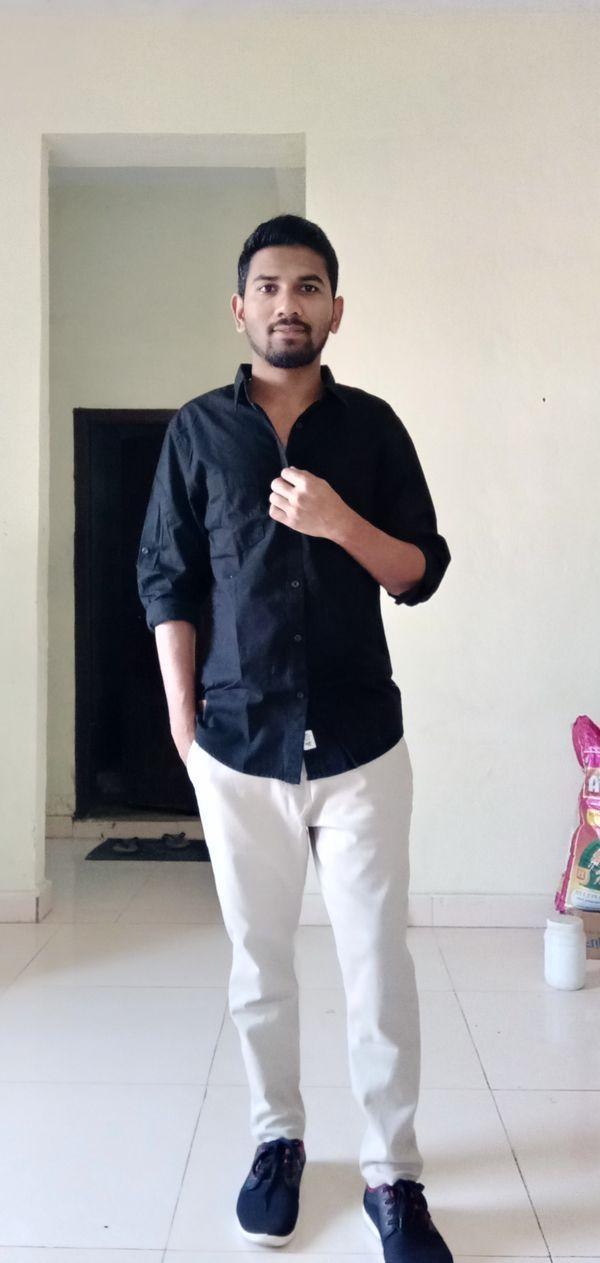
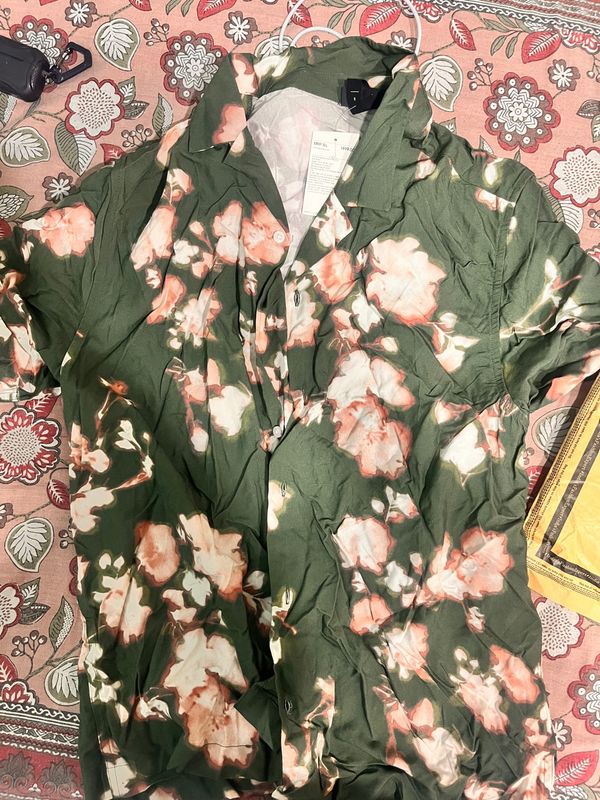
- **Fabric Physics:** The source garment appears to be a lightweight, soft-woven fabric, likely Viscose, Rayon, or a soft Cotton blend. It lacks the rigidity of the user's current black shirt. Simulation must account for a "flowy" drape with low structural stiffness. Surface properties should exhibit a matte finish with very subtle, broad specular highlights, avoiding a plastic or synthetic shine.
- **Key Features:** The large-scale floral pattern (white and peach blooms on olive green) is the primary visual anchor and must retain high resolution without warping. The collar appears to be a relaxed camp-collar style, distinct from the stiffer dress collar currently worn. White/pearlescent buttons and the front placket alignment must be preserved.
PHASE 2: FIT & DRAPE SIMULATION
- **Body Mapping:**
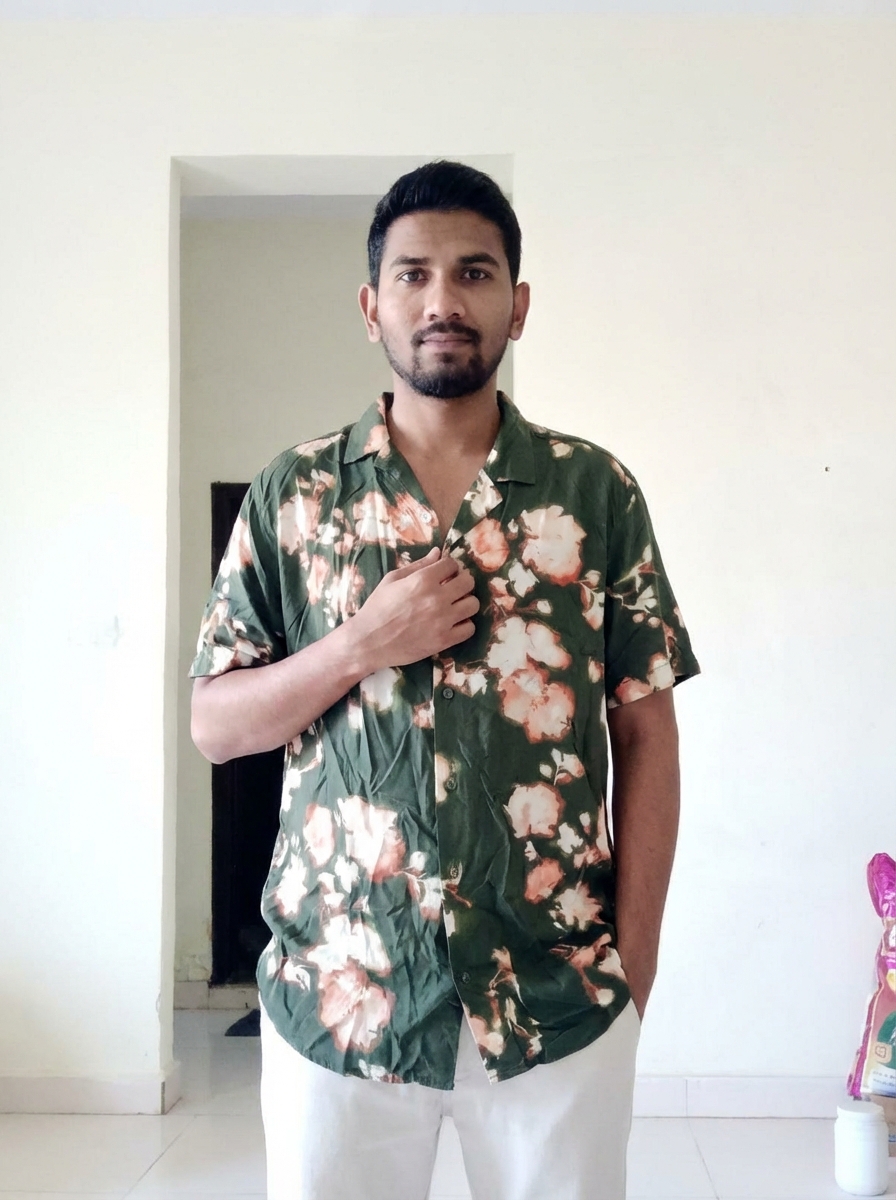
- **Shoulders & Chest:** The garment must settle naturally on the shoulders. Due to the raised left arm, the fabric tension must pull slightly upward and diagonally across the left pectoral towards the armpit.
- **Right Side:** Since the user's right hand is in the trouser pocket, the garment's hemline on this side must either bunch slightly above the wrist/pocket entry or drape behind the forearm, causing a "stacking" of folds at the hip.
- **Sleeve Logic:** The source garment appears to be short-sleeved or loosely cuffed. If applying as short sleeves, the system must generate skin texture for the currently covered forearms.
- **Occlusion Handling:**
- **Left Hand:** The user's left hand is actively touching the center chest. This is a critical occlusion zone. The new garment must appear *under* the fingers and palm, with shadow cast by the hand onto the floral fabric.
- **Waistline:** The current shirt is untucked but shaped; the new shirt is looser. The simulation must decide on a hemline—ideally untucked—falling naturally over the white trousers.
PHASE 3: ENVIRONMENT & LIGHTING
- **Light Match:** The user is in a room with diffuse daylight entering from the left (viewer's perspective), indicated by the shadow on the right side of the face and floor. The new garment must be rendered with the primary light source from the left, casting self-shadows into the folds on the right side of the torso.
- **Color Calibration:** The source cloth image has a warm/yellow tint (likely bedroom lighting). The user image is cool/neutral (white walls, daylight). The green of the shirt must be color-corrected to cool down the temperature so it integrates seamlessly into the white-walled environment.
PHASE 4: IDENTITY PROTECTION
- **Facial Lock:** Absolute pixel-freeze on the entire head region, extending from the top of the hair down to the mid-neck. The jawline and beard texture must remain untouched.
- **Body Integrity:** Maintain the user's specific torso width and shoulder slope. Do not apply athletic tapering or slimming algorithms. The silhouette change should come solely from the looser fit of the rayon shirt, not a change in the user's anatomy.