Thinking Process
PHASE 1: VISUAL DECONSTRUCTION
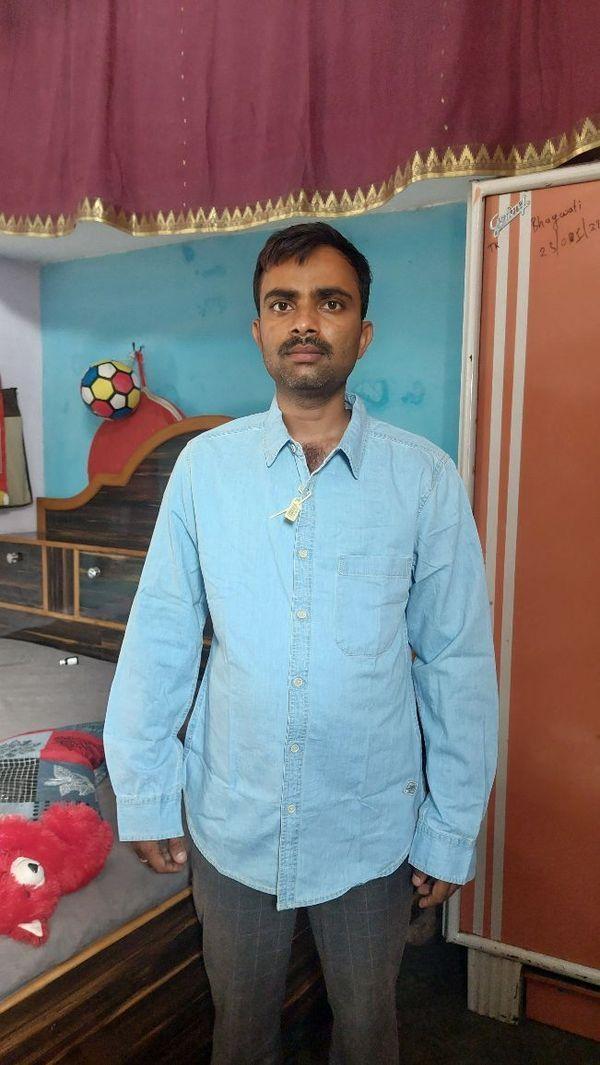
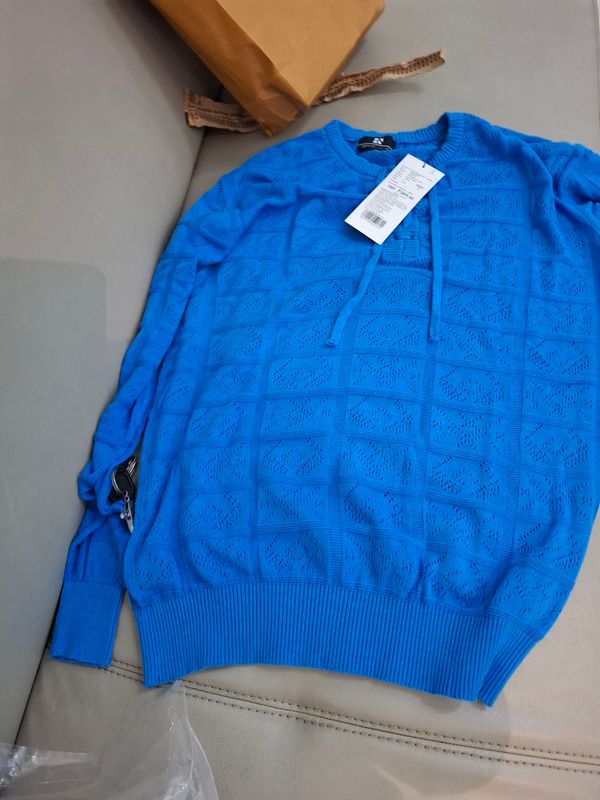
- **Fabric Physics:** The source garment is a textured knit (waffle or basket weave pattern) with significant volumetric depth. Unlike the user's current stiff denim/chambray shirt, this material has high elasticity and heavy drape. It demands a matte finish with high roughness; light should scatter rather than reflect, accentuating the micro-shadows within the square knit grid.
- **Key Features:** The distinct square-grid knit pattern must remain sharp and uniform. The ribbed knitting at the waistband and cuffs is structural and must be preserved. The drawstrings hanging from the neckline are dynamic elements and must be transferred. The white tag attached to the collar should be computationally removed to simulate a worn state, while the tag hanging on the user's *current* shirt must be fully erased.
PHASE 2: FIT & DRAPE SIMULATION
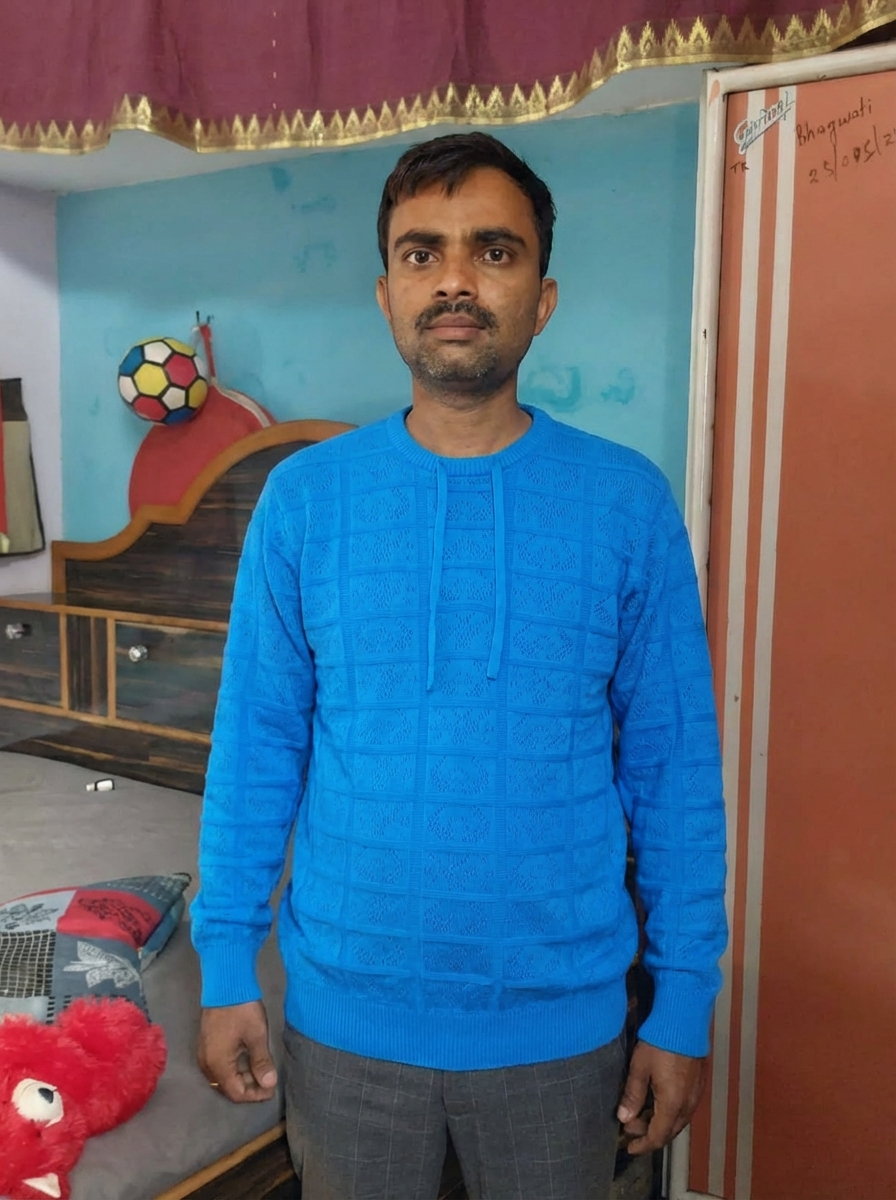
- **Body Mapping:** Due to gravity and the user's standing pose, the sweater will hang vertically but with more weight than the current shirt. The ribbed hem will likely sit tighter around the hips/waist, causing a slight "blousing" or folding of the fabric just above the waistband (unlike the straight fall of the current button-down). The shoulders should round off softly, losing the sharp seam definition of the current shirt.
- **Occlusion Handling:** The user has short hair, so neck occlusion is minimal. The transition point lies at the clavicle/neck base. The user's hands are positioned low at the hips; the sweater sleeves must terminate naturally at the wrists without overlapping the fingers. The background (bed frame and blue wall) currently visible through the gap between the arms and torso must be preserved or accurately reconstructed if the bulkier sweater fills that gap.
PHASE 3: ENVIRONMENT & LIGHTING
- **Light Match:** The user image features diffuse indoor lighting, likely from a ceiling source slightly to the user's right (indicated by the shadow on the left side of the nose and the highlight on the forehead). The new garment must cast self-shadows into the knit texture consistent with this overhead-right direction.
- **Color Calibration:** The source image is under bright, neutral retail lighting, making the blue very vibrant. The user's room has a cooler, somewhat dimmer ambient cast (blue walls). The new garment's saturation must be slightly reduced and the white point shifted towards cool cyan to integrate indistinguishably with the room's atmosphere.
PHASE 4: IDENTITY PROTECTION
- **Facial Lock:** Absolute pixel preservation required for the head, including the hairline, ears, eyes, mustache, and skin tone above the neck. The neck connection point must be blended seamlessly.
- **Body Integrity:** Strict prohibition on body warping. The user's shoulder width and torso length must dictate the garment size. The bulk of the knit fabric will naturally add slight volume to the silhouette; do not artificially slim the user to compensate. The trousers and background furniture must remain untouched.