Thinking Process
PHASE 1: VISUAL DECONSTRUCTION
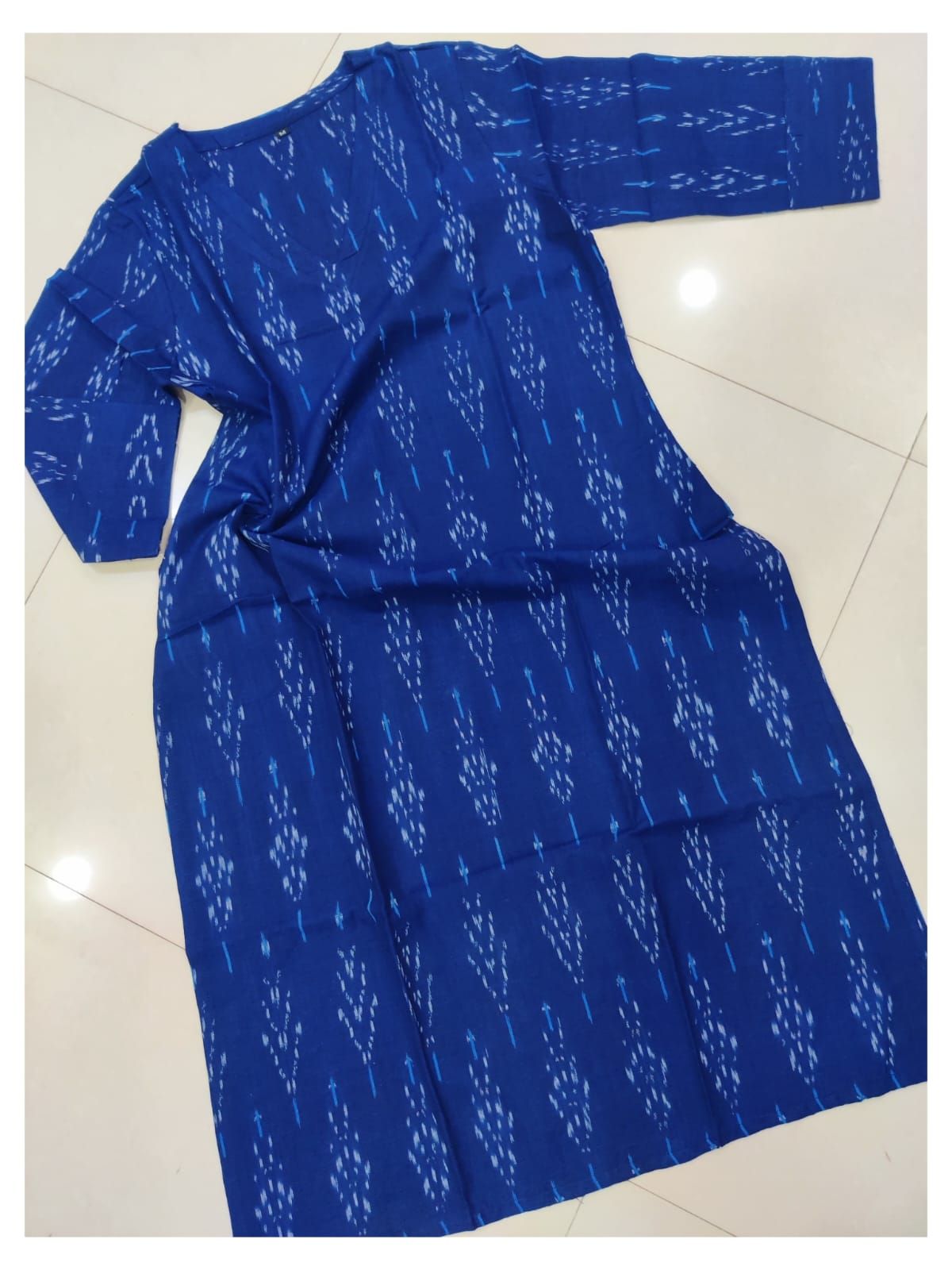
- **Fabric Physics:** The source garment appears to be a cotton or cotton-blend Ikat fabric. It has a matte finish with low specularity (will not shine under lights). The material has a medium weight—heavier than chiffon but lighter than denim—meaning it should hold its structure slightly at the shoulders but drape softly towards the hem without rigid creasing.
- **Key Features:** The specific white "arrowhead/dash" Ikat weave pattern is non-negotiable and must maintain high frequency resolution. The V-neckline shape must be preserved. The sleeve cuffs and the straight hemline of the tunic need to be rendered clearly.
PHASE 2: FIT & DRAPE SIMULATION
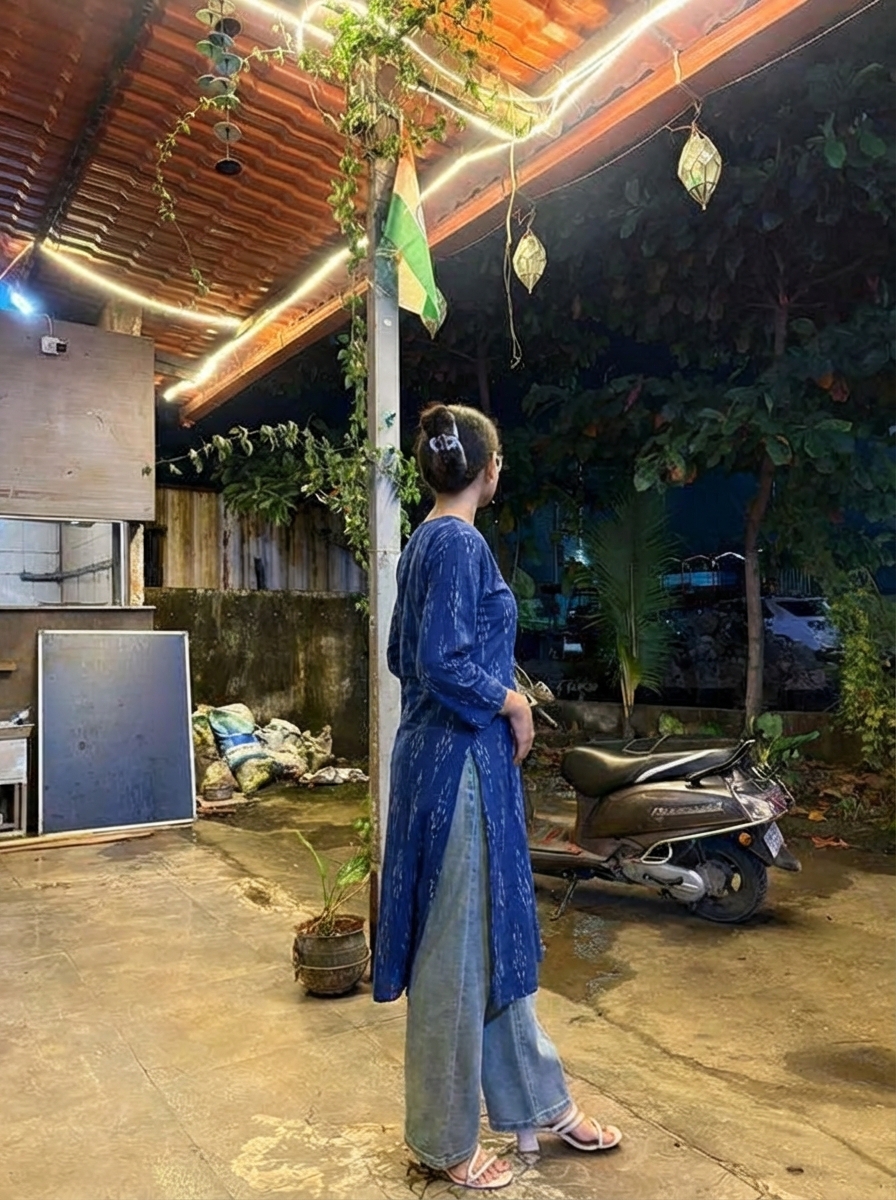
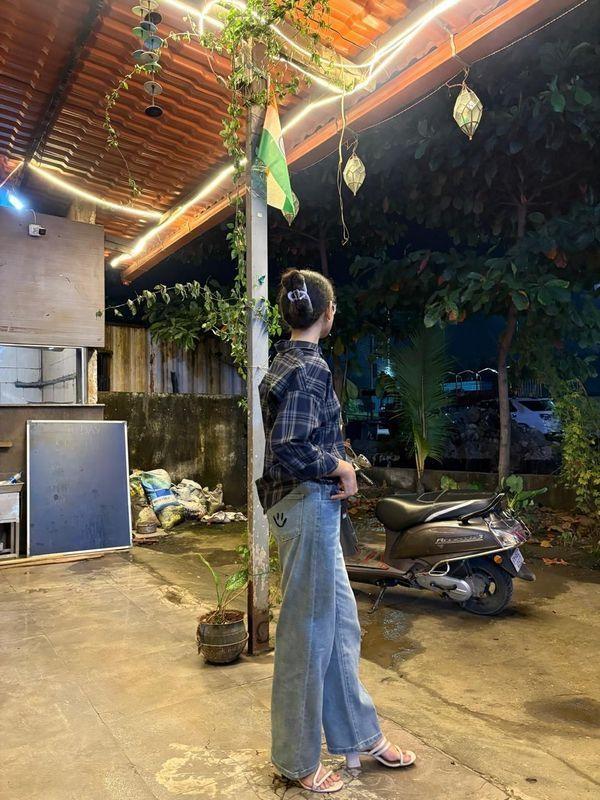
- **Body Mapping:** This is a long-line garment (Kurti/tunic). Unlike the user's current tucked-in shirt, the simulation must drape the Kurti *over* the waistline of the jeans, extending down to the mid-thigh or knee area. The fabric must follow the curvature of the user's back and buttocks (due to the side/rear angle) and hang vertically due to gravity, breaking away from the body at the lower back. There should be compression wrinkles at the inner elbow of the visible arm.
- **Occlusion Handling:** The user's hair (bun and loose strands at the nape) is the primary occlusion layer and must be segmented to sit *on top* of the new garment's collar area. The user's left hand is visible; the sleeve length must stop at the wrist/forearm, ensuring the hand remains uncovered. The upper portion of the wide-leg jeans will be occluded by the new top; the transition from Kurti hem to jeans leg must be physically accurate.
PHASE 3: ENVIRONMENT & LIGHTING
- **Light Match:** The scene is lit by overhead warm-toned string lights (tungsten/orange hue) with a steep top-down angle, creating strong highlights on the shoulders and hair. The new blue garment must receive this warm highlight on the shoulder ridge and upper back, while casting a self-shadow downwards towards the hem. The "flat studio lighting" of the source cloth must be completely neutralized.
- **Color Calibration:** The source blue is too cool and bright for the target scene. The blue must be color-graded to a deeper, darker navy to match the nighttime exposure. A warm amber filter must be applied to the highlights of the fabric to integrate it with the environmental string lighting.
PHASE 4: IDENTITY PROTECTION
- **Facial Lock:** The user's ear, jawline, neck, and entire hair structure (messy bun with clip) must be frozen and masked out of the generation area.
- **Body Integrity:** Strict prohibition on slimming the figure. The user's shoulder width and posture (relaxed, slightly turned) must remain exact. The wide-leg silhouette of the jeans at the bottom must not be altered, even though the top changes.