Thinking Process
PHASE 1: VISUAL DECONSTRUCTION
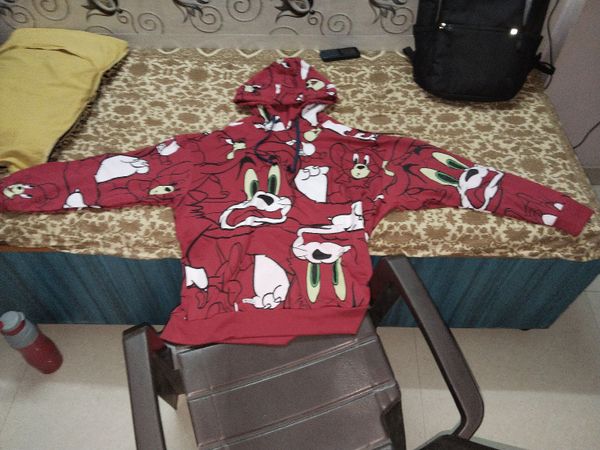
- **Fabric Physics:** The source garment is a cotton-fleece blend hoodie. Unlike the user's current thin, clinging t-shirt, this material has substantial weight and loft. It has a matte finish with low specularity. The simulation must account for material thickness (approx. 300-350 gsm), meaning it will bridge over minor body contours rather than cling to them, creating softer, larger folds.
- **Key Features:** The chaotic "Tom & Jerry" all-over print pattern must remain crisp and continuous across seams. Critical structural elements include the attached hood (which must rest bunched at the nape of the neck), dark drawstrings, ribbed wrist cuffs, and the ribbed bottom hem. The red base color must remain consistent.
PHASE 2: FIT & DRAPE SIMULATION
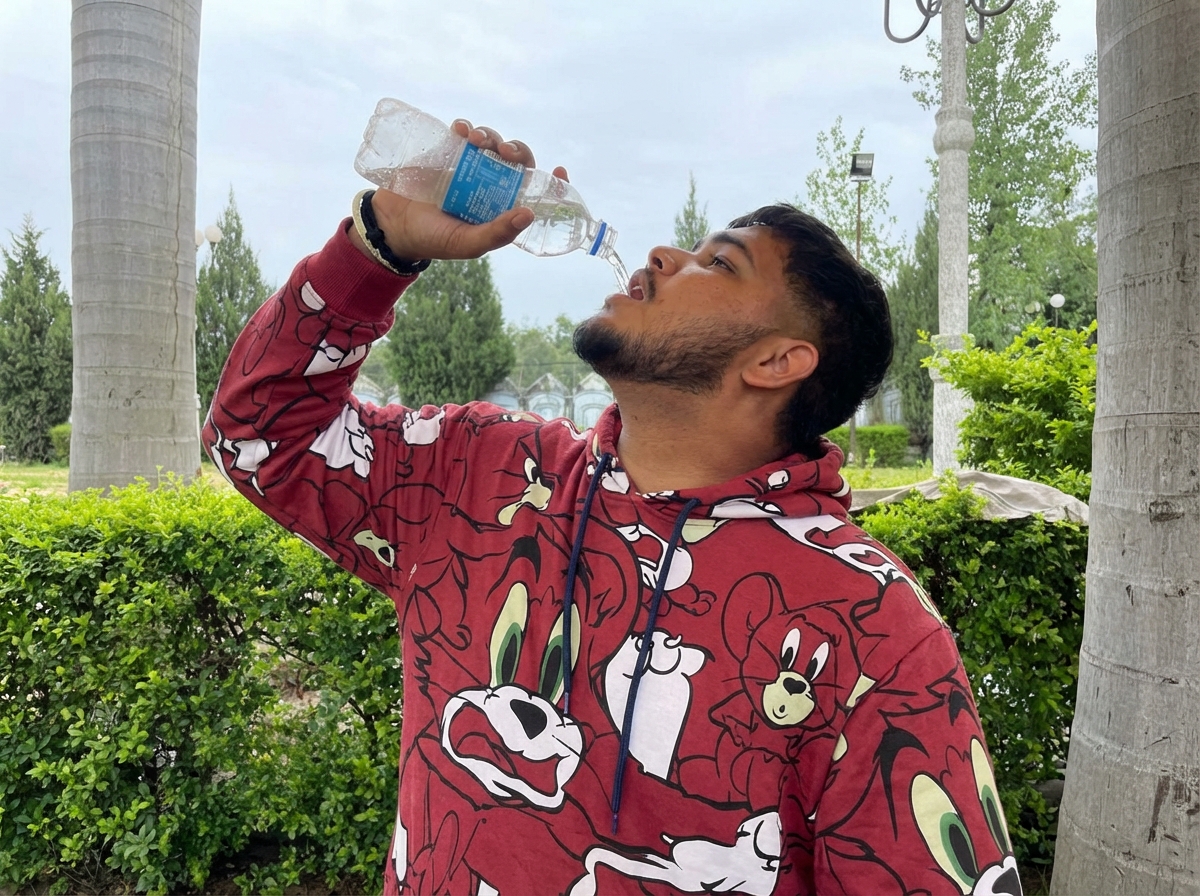
- **Body Mapping:** Due to the user's raised right arm (drinking pose), the hoodie requires complex dynamic deformation. The heavy fabric will bunch significantly at the inner right elbow and shoulder joint. The hemline on the right side will naturally pull upward, exposing the waistline if not anchored. The sleeve must slide down slightly from the wrist due to gravity, accumulating volume at the forearm. The hood structure must settle behind the head, unaffected by the tilt of the neck.
- **Occlusion Handling:** The user's right hand and the water bottle are the primary occlusion layers; the cuff of the hoodie must terminate *under* the wrist watch/bracelet area or interact naturally with the wrist. The beard and jawline must layer *over* the collar/neckline of the hoodie.
PHASE 3: ENVIRONMENT & LIGHTING
- **Light Match:** The target environment is outdoors under an overcast sky, producing soft, diffuse, cool-toned lighting from above. There are no harsh directional shadows. The source garment (photographed indoors under warm/yellow artificial light) must be neutralized. Shadows on the hoodie folds must be soft and congruent with the ambient occlusion seen under the user's chin and arm.
- **Color Calibration:** The source hoodie's warm red tone must be color-corrected to match the cooler white balance of the outdoor scene. The brightness levels must be lowered slightly to match the exposure of the user's current t-shirt, ensuring the red doesn't look "glowing" or artificially superimposed.
PHASE 4: IDENTITY PROTECTION
- **Facial Lock:** The user's side profile, specifically the eye, ear, beard texture, and the unique geometry of the neck while swallowing, must be strictly frozen and masked out of the generation area.
- **Body Integrity:** The simulation must respect the user's arm volume and torso width. While the hoodie adds bulk (positive displacement), the underlying skeletal structure must not be slimmed or warped. The specific angle of the bent elbow must remain anatomically accurate.