Thinking Process
PHASE 1: VISUAL DECONSTRUCTION
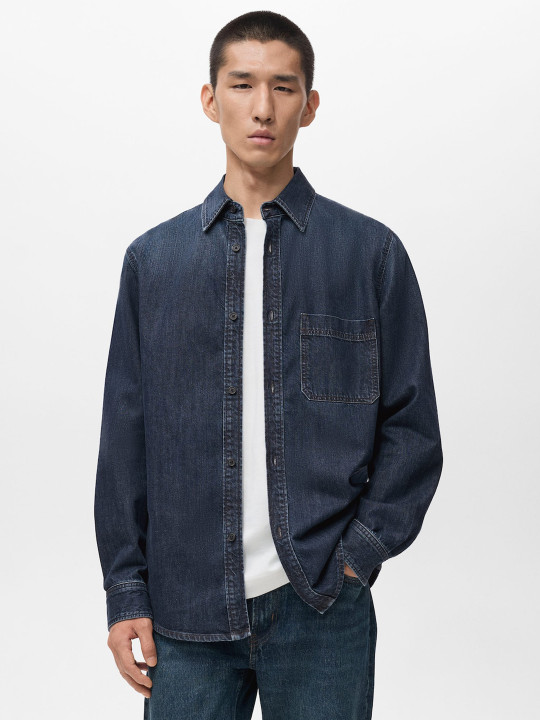
- **Fabric Physics:** The source garment is a heavyweight indigo denim. Unlike the user's current lightweight cotton shirt, the denim has high structural rigidity and shear resistance. It should not cling tightly to muscle definition but rather create angular, structural folds. Light reflection should be largely matte with low specular highlights only on the rigid edges (collar, cuffs, placket) to indicate the "twill" texture.
- **Key Features:** The dark indigo wash with subtle vertical fading along the button placket must be preserved. Key details include the single left chest pocket with visible stitching, the stiff spread collar, the copper/brass finish shank buttons, and the distinct "pucker" texture on the seams.
PHASE 2: FIT & DRAPE SIMULATION
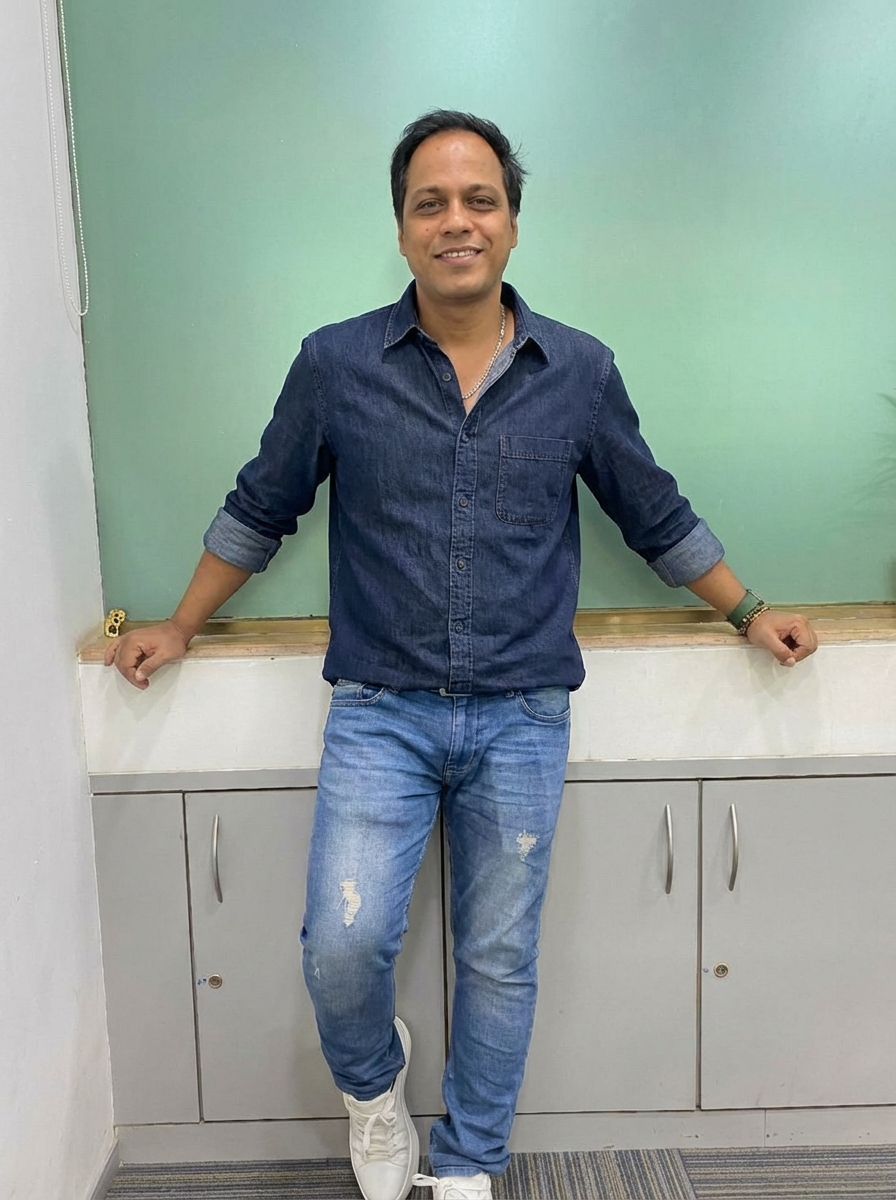
- **Body Mapping:** Due to the user's "leaning back" pose with arms spread on the ledge, the garment must exhibit tensile stress across the pectorals and clavicle area. The denim should lift slightly off the trapezius muscles as the shoulders are shrugged upward. The hemline needs to interact with the user's hip rotation; the stiffness of the denim means it will not tuck as softly as the current shirt, potentially bunching more bulkily at the waistband if tucked, or hanging straight and colliding with the ledge if untucked.
- **Occlusion Handling:** The silver chain necklace is a critical occlusion layer and must be segmented to lay *over* the new denim fabric. The user's left wrist watch/green band serves as a hard boundary; if the denim sleeves are fully extended, the cuff must terminate *before* or sit *under* the watch, or the sleeves must be rendered rolled up (matching the user's current state) to avoid complex wrist collisions.
PHASE 3: ENVIRONMENT & LIGHTING
- **Light Match:** The user is in an environment with diffuse, overhead fluorescent office lighting, casting soft, downward-facing shadows. The source garment's studio lighting (high contrast) must be neutralized. The dark indigo denim must accept the ambient ambient occlusion of the room and pick up a subtle greenish color bleed from the large green wall behind the user.
- **Color Calibration:** The deep blue of the source denim needs to be desaturated slightly and shifted warmer to match the indoor white balance of the user image. The black point of the denim must not be crushed; texture details in the shadows must remain visible despite the darker room lighting.
PHASE 4: IDENTITY PROTECTION
- **Facial Lock:** Absolute pixel preservation is required for the user's face (from chin to hairline), the specific hairstyle, and the skin tone of the neck area.
- **Body Integrity:** The volumetric shape of the user's torso must remain constant. The simulation must fit the garment to the user's existing BMI and posture, strictly forbidding the slimming of the waist or broadening of shoulders to match the source model's physique. The user's legs (jeans and sneakers) must remain pixel-perfectly untouched.