Thinking Process
PHASE 1: VISUAL DECONSTRUCTION
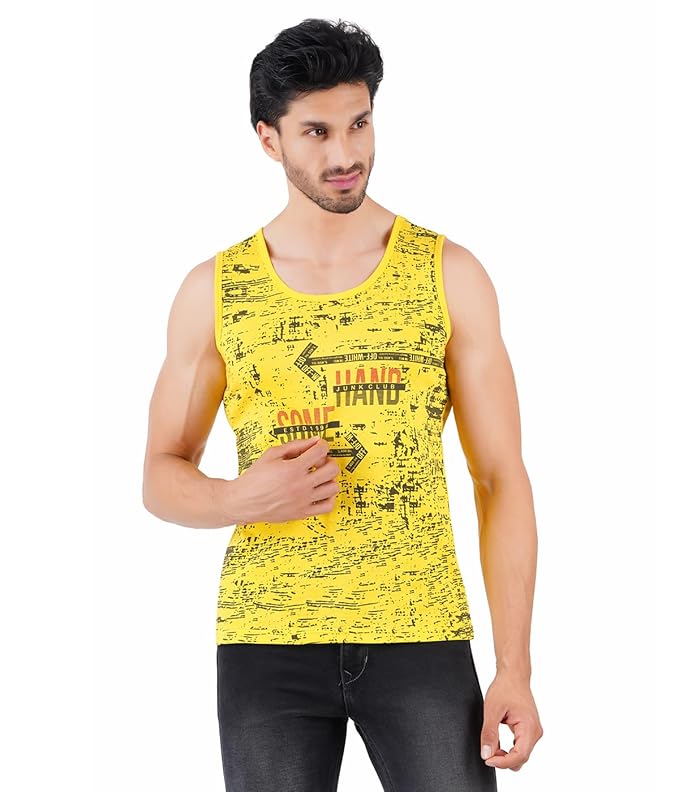
- **Fabric Physics:** The source garment is a cotton jersey blend typical of athletic undershirts or tank tops. It possesses high flexibility and low structural rigidity, meaning it will drape softly rather than stand stiffly. It has a matte finish with very low specularity; it should not reflect light sharply like satin or leather.
- **Key Features:**
- **Graphic Alignment:** The central "HAND JUNK CLUB" typography and "OFF-WHITE" style hazard tape graphic elements must remain centered on the sternum.
- **Pattern Continuity:** The all-over black grunge/distress pattern must wrap naturally around the torso without stretching into low-resolution blurs.
- **Trim:** The ribbed yellow binding (piping) on the neckline and armholes is a structural boundary that must be rendered with slightly more thickness than the main body fabric.
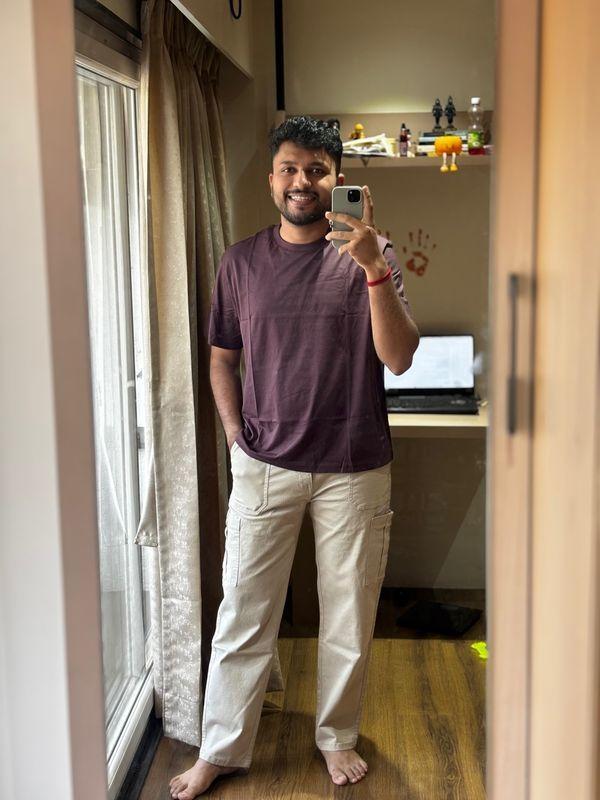
- **Cut:** This is a deep scoop-neck tank top (sleeveless). This differs significantly from the user's current crew-neck t-shirt.
PHASE 2: FIT & DRAPE SIMULATION
- **Body Mapping:**
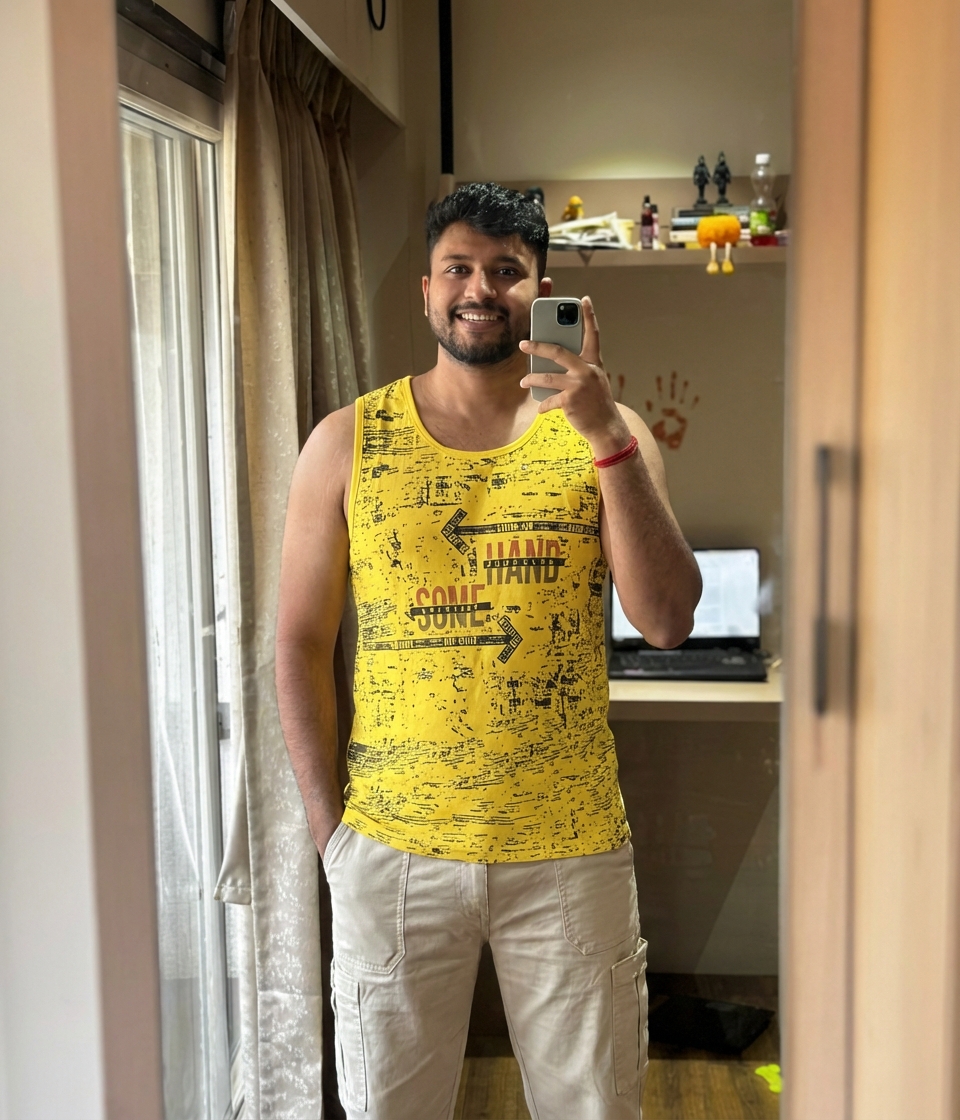
- **Sleeve Transition:** The user is currently wearing a short-sleeved t-shirt. The target garment is sleeveless. The simulation must expose the user's deltoids and biceps. The tank top straps must sit flush against the trapezius muscles.
- **Torso Drape:** The user has a slight lean to their right (screen left). The fabric must follow gravity, hanging straighter on the user's left side (holding phone) and bunching slightly at the waist on the right side where the hip is cocked.
- **Chest Volume:** The graphics must curve subtly around the pectorals to indicate 3D volume, preventing a flat "sticker" effect.
- **Occlusion Handling:**
- **Primary Occlusion (Phone & Hand):** The user's left hand and the iPhone are positioned directly over the center-left chest. The target tank top must be masked strictly *behind* the fingers and the device.
- **Secondary Occlusion (Pocket):** The user's right hand is in their pocket. The hem of the tank top must interact here—either draping slightly over the wrist or bunching up if the fit is long. It cannot simply disappear; it must show interaction with the forearm entry point.
PHASE 3: ENVIRONMENT & LIGHTING
- **Light Match:**
- **Source:** The user's room has warm, overhead artificial lighting (tungsten/yellow hue), casting soft shadows downwards.
- **Target Application:** The bright, studio-lit yellow of the source garment must be color-graded. It requires a warm amber wash to match the ambient room temperature. Shadows must be generated under the pectoral muscles and inside the folds created by the right-side waist bend.
- **Color Calibration:**
- Decrease the exposure of the source garment slightly to match the indoor exposure.
- Apply a subtle noise grain to the yellow fabric to match the ISO grain visible in the user's mirror selfie (evident on the walls and pants).
PHASE 4: IDENTITY PROTECTION
- **Facial Lock:** The user's face (beard, smile, eyes, hair) is strictly off-limits for modification. The neckline of the tank top is lower than the current shirt, so the neck area must be seamlessly blended, preserving the user's skin tone and beard line.
- **Body Integrity:** Do not slim the user's waist or alter the width of the shoulders. The transfer must respect the user's natural silhouette. Crucially, the generation of the exposed skin on the shoulders (where the old sleeves were) must match the user's existing skin tone found on the face and forearms.