Thinking Process
PHASE 1: VISUAL DECONSTRUCTION
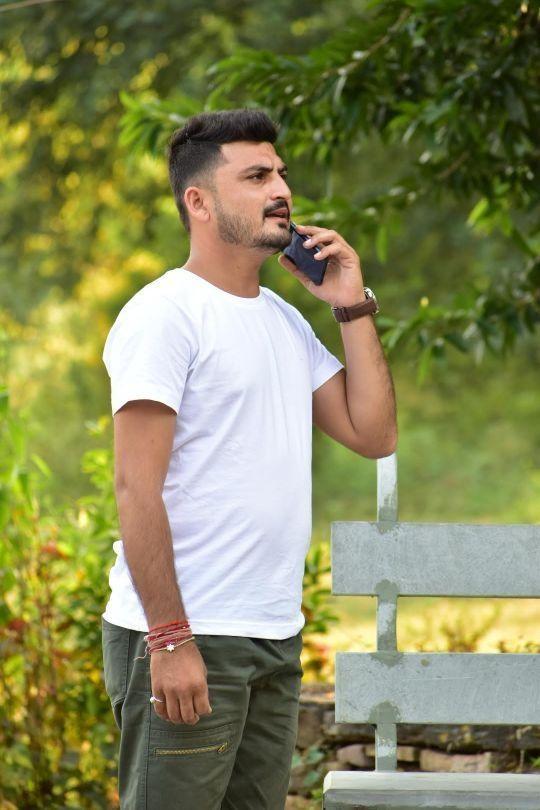
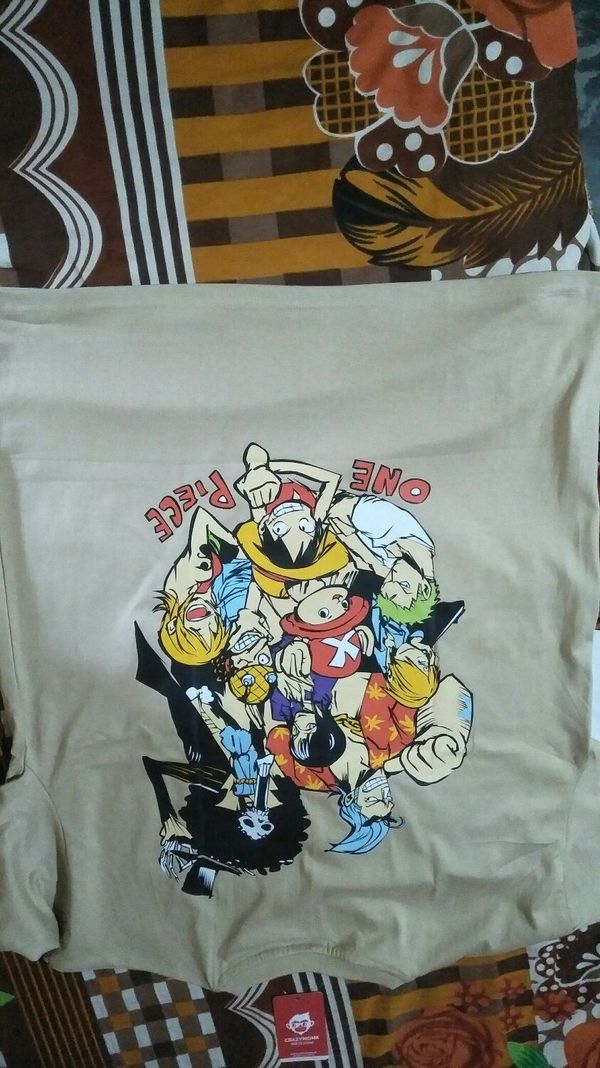
- **Fabric Physics:** The source garment is a cotton jersey knit (standard t-shirt material). It is matte, medium-weight, and has high flexibility. It should not shine; instead, it should absorb light with a soft fall-off. The drape must mimic the behavior of soft cotton, showing micro-wrinkles where tension occurs rather than sharp, rigid folds.
- **Key Features:** The central "One Piece" circular character graphic is the critical visual anchor and must be centered on the chest (warped to perspective). The beige/tan base color must replace the white. The ribbed crew neckline and the specific tag (visible near the neckline in the source) should be positioned correctly at the nape/throat.
PHASE 2: FIT & DRAPE SIMULATION
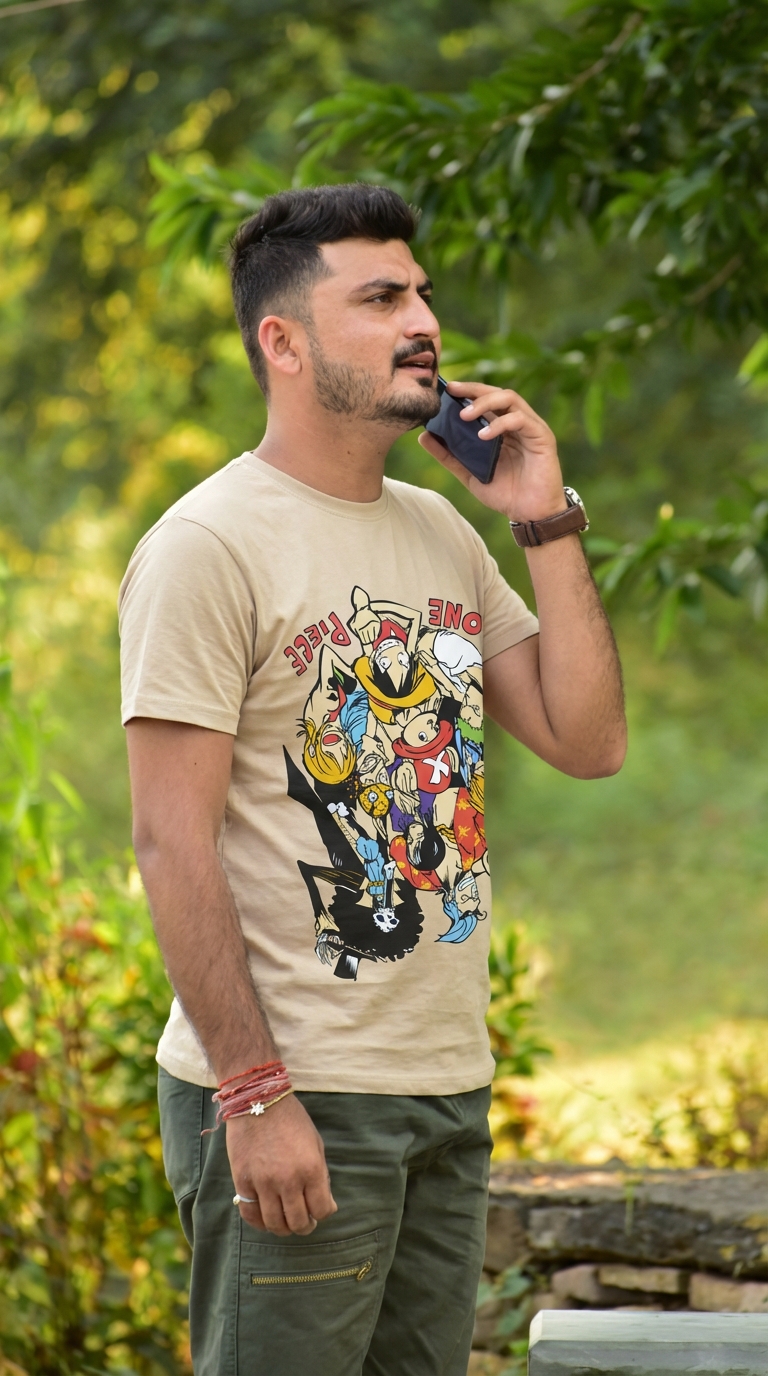
- **Body Mapping:** The user is in a three-quarter profile pose with the left arm raised. The simulation must calculate heavy tension/stretching across the left pectoral and shoulder due to the lifted arm. The fabric must bunch significantly at the top of the left shoulder and the left armpit. On the right side (lowered arm), the fabric should hang looser, following gravity with vertical drag lines. The graphic must wrap around the curvature of the torso, distorting naturally with the body's rotation.
- **Occlusion Handling:** The user's left hand, wrist, and the smartphone are positioned high and do not overlap the torso fabric, but the **watch on the left wrist** and **bracelets on the right wrist** define the boundary of the sleeves. The user's beard creates a contact shadow on the collar but does not heavily occlude it. The critical boundary is the waistline where the shirt meets the green cargo pants; the shirt must appear tucked or naturally falling over the waistband, maintaining the current "untucked" vibe.
PHASE 3: ENVIRONMENT & LIGHTING
- **Light Match:** The user is in an outdoor environment with soft, diffused natural daylight (likely shaded by trees). The lighting is soft with no harsh directional sun. The source cloth has indoor, yellow-cast artificial lighting. The new garment must be color-corrected to remove the yellow tint and accept the cool, slightly green-tinted ambient light from the foliage. Shadows should be soft and diffuse, appearing primarily under the chin, the raised left arm, and within natural fabric folds.
- **Color Calibration:** The beige tone of the source shirt must be desaturated slightly to match the outdoor white balance. The vibrant colors of the anime print (reds, yellows, blues) must be slightly muted to match the contrast levels of the user's skin and pants, ensuring they don't look like a "sticker" overlay.
PHASE 4: IDENTITY PROTECTION
- **Facial Lock:** The user's entire head, including the specific hairstyle, facial hair (beard/mustache), and ear structure, must remain pixel-perfectly frozen. The left hand and the smartphone must be preserved as a foreground layer.
- **Body Integrity:** Strictly forbidden to slim the torso or alter the user's posture. The volume of the user's stomach and chest must remain identical to the original image to ensure the fit looks realistic. The arm thickness (biceps/forearms) must not be warped by the cloth transfer.