
Thinking Process
PHASE 1: VISUAL DECONSTRUCTION
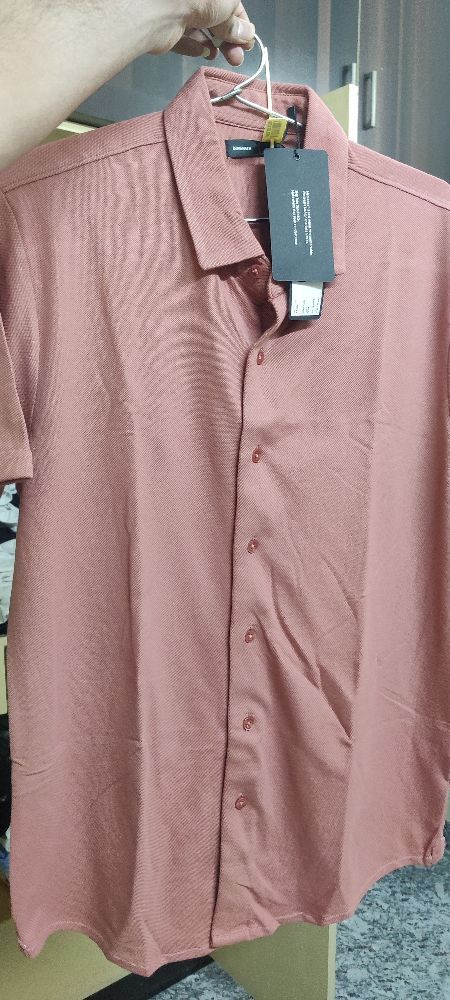
- **Fabric Physics:** The source garment appears to be a textured, knit-blend fabric (likely a pique or waffle knit structure) with a matte finish. It possesses medium weight and pliability—heavier than a standard cotton tee but lighter than denim. It should exhibit diffuse light scattering with no specular highlights (shininess).
- **Key Features:** The structured collar and the vertical button placket are critical geometry that must replace the current crew neck. The distinct "dusty pink/salmon" color and the visible fabric grain texture must be preserved. **Crucial:** The black retail tags hanging from the button and the white hanger must be digitally removed during the transfer.
PHASE 2: FIT & DRAPE SIMULATION
- **Body Mapping:** Due to the user's pose (right arm extended to the railing), the fabric must stretch slightly across the right pectoral and right deltoid. The right sleeve aperture will lift and rotate outward. On the left side, the sleeve should hang vertically with gravity. The shirt should drape loosely over the midsection, simulating a "regular fit," avoiding the vacuum-sealed look of the current white undershirt.
- **Occlusion Handling:** **High Priority:** The green metal railing passing in front of the user's lower right abdomen and right hand MUST be segmented and layered *over* the new pink shirt. The user's watch on the left wrist is below the short sleeve line, but verify the sleeve hem does not intersect the watch face.
PHASE 3: ENVIRONMENT & LIGHTING
- **Light Match:** The target environment features harsh, high-contrast outdoor sunlight coming from above and slightly to the viewer's left. The source shirt (currently flat-lit indoors) requires the generation of hard shadows, particularly under the new collar, under the pectoral muscles, and deep folds in the axilla (armpit) regions.
- **Color Calibration:** The source image has indoor warm lighting. The shirt's pink hue must be desaturated slightly and brightened to match the high-exposure outdoor setting. Ambient occlusion from the green water and foliage needs to tint the shadow areas of the shirt slightly green/teal to ground it in the scene.
PHASE 4: IDENTITY PROTECTION
- **Facial Lock:** The user's face, beard, sunglasses, and baseball cap must remain completely frozen. The neck transition area needs careful blending where the new collar sits to ensure the beard is not cropped.
- **Body Integrity:** Strict preservation of the user's shoulder width and torso volume is required. The simulation must not slim the user or alter the arm musculature; the garment must adapt to the body, not the body to the garment.