Thinking Process
PHASE 1: VISUAL DECONSTRUCTION
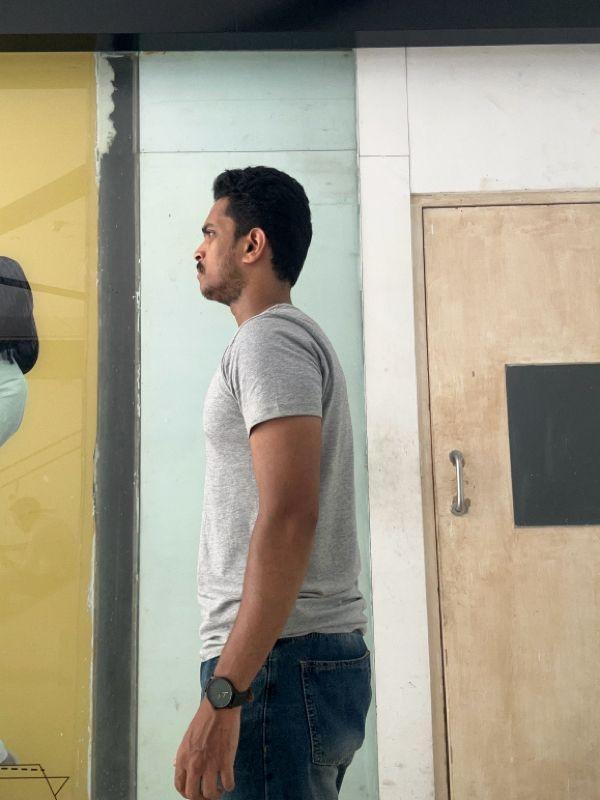
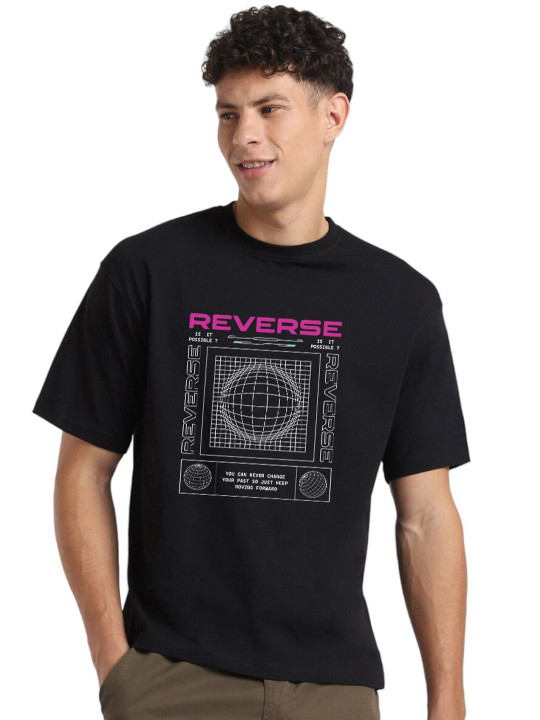
- **Fabric Physics:** The source garment is a medium-weight cotton jersey. It has a matte finish with low reflectivity/specularity. The physics simulation must account for a "relaxed fit" drape, meaning it will not cling tightly to the muscles like the user's current grey undershirt but will instead hang with vertical gravity lines.
- **Key Features:** The central chest graphic ("REVERSE" text in pink with white grid/wireframe spheres) is the critical anchor point. The simulation must preserve the crew neckline ribbing and the double-stitched hem on the sleeves and bottom edge.
PHASE 2: FIT & DRAPE SIMULATION
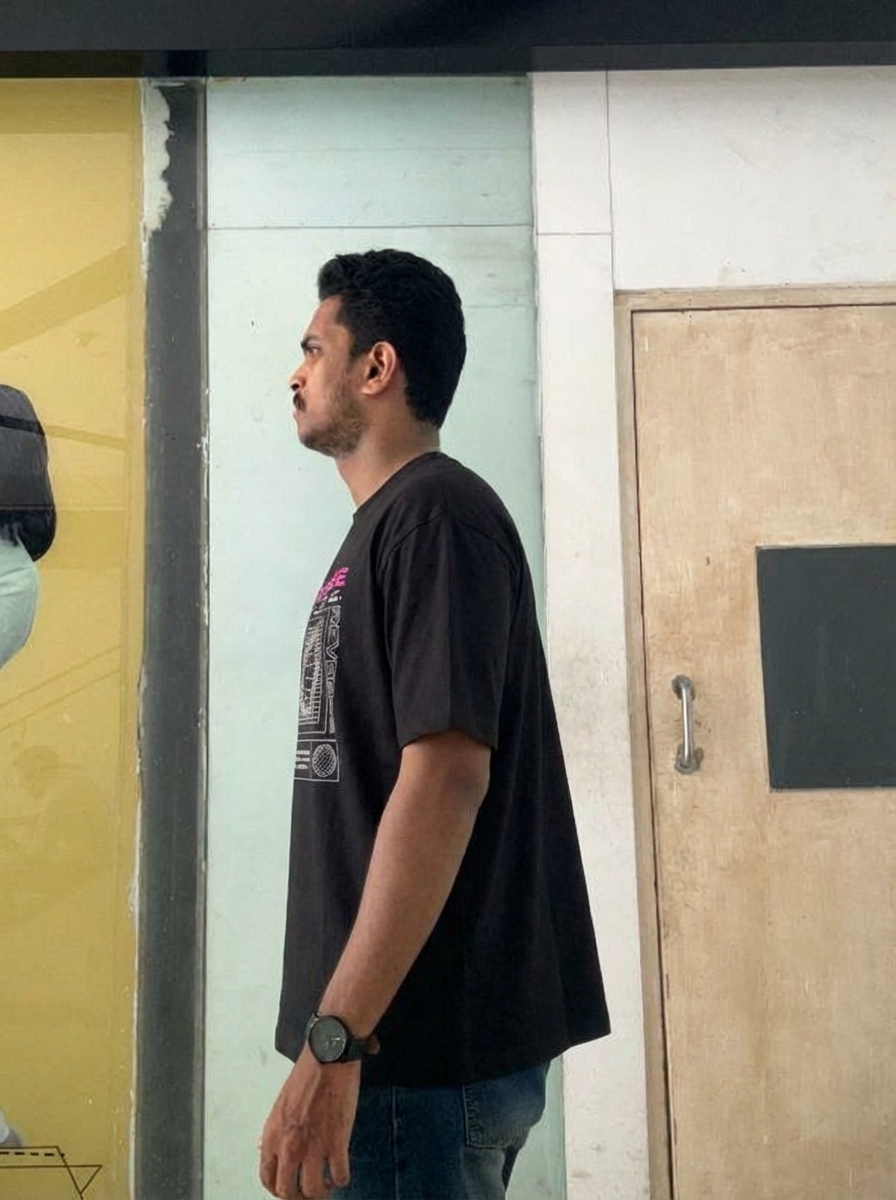
- **Body Mapping:** This is a high-complexity projection because the Source is **Front-Facing** and the Target is **Side-Profile**.
- The chest graphic must be geometrically wrapped around the convex curvature of the user's pectorals; only the left half of the graphic may be visible due to the profile angle.
- The sleeve must be generated to show the "armhole gap" typical of a relaxed t-shirt, rather than the tight bind of the current grey shirt.
- The back hem needs to hang straight down, creating a separation from the lower back (lumbar arch), unlike the current shirt which hugs the spine.
- **Occlusion Handling:**
- The user's left arm overlaps the torso side seam. The new garment must be layered *behind* the forearm/wrist but *over* the upper deltoid/shoulder.
- The wristwatch on the left wrist is a hard occlusion layer; no fabric pixel can overlap the watch or hand.
- The hem of the new shirt must layer *over* the waistband of the blue jeans.
PHASE 3: ENVIRONMENT & LIGHTING
- **Light Match:** The user image features soft, diffused daylight entering from the left (facing the user). Consequently, the new black garment must feature a luminance gradient: lighter/highlighted on the chest and front of the sleeve, transitioning to deep shadows under the armpit and along the back (latissimus dorsi area).
- **Color Calibration:** The "black" of the source shirt is studio-lit and sharp. It must be graded to match the user's environment (slightly desaturated and prone to noise/grain matching the user photo) to avoid looking like a "stuck-on" sticker. The pink text should react to the ambient light, appearing slightly less neon than the source image.
PHASE 4: IDENTITY PROTECTION
- **Facial Lock:** The user's profile silhouette, including the specific jawline definition, ear structure, hair texture, and neck musculature (sternocleidomastoid), must be frozen and masked out of any generation.
- **Body Integrity:** The simulation is strictly forbidden from altering the user's arm thickness or torso depth. The "relaxed fit" of the new shirt must be achieved by expanding the garment volume outward, *not* by shrinking the user's body underneath. The position of the jeans waistband must remain static.