Thinking Process
PHASE 1: VISUAL DECONSTRUCTION
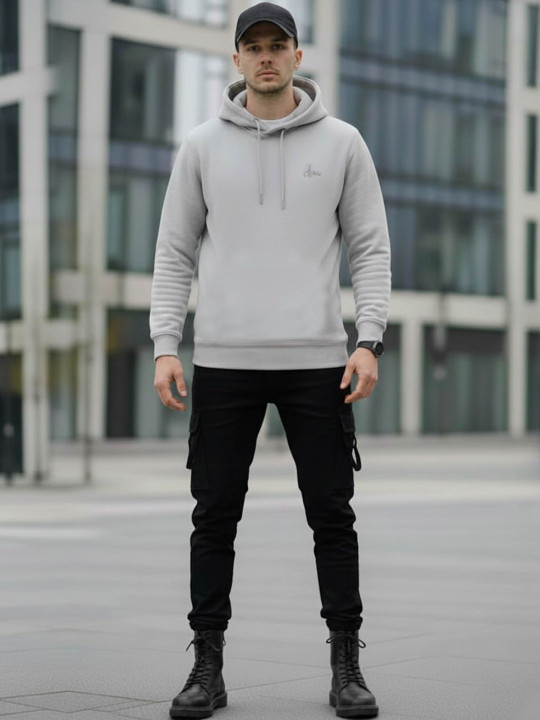
- **Fabric Physics:** The source garment is a medium-to-heavyweight cotton-poly fleece blend. It has a matte finish with high light absorption and low specularity. The physics simulation must account for a "structured drape"—it is thicker than the user's current knit sweater and will not cling as tightly to the skin, creating softer, larger folds rather than micro-wrinkles.
- **Key Features:** The structured hood geometry (which must settle around the neck/shoulders), the flat woven drawstrings, the ribbed wrist cuffs, the kangaroo pocket structure (creating thickness at the stomach), and the small cursive logo on the left chest must be preserved and warped correctly to the user's perspective.
PHASE 2: FIT & DRAPE SIMULATION
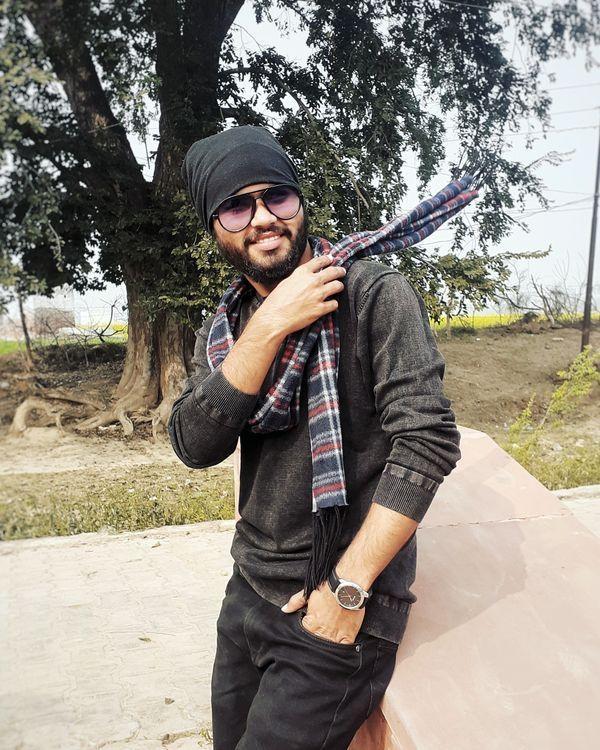
- **Body Mapping:** The user is leaning back and to his right. The hoodie must bunch and compress at the right waistline due to the torso bend. The sleeves require significant volume adjustments: the user's right arm is fully flexed across the chest, requiring the hoodie sleeve to stretch at the elbow and bunch heavily at the inner crook. The left arm is relaxed but bent, requiring moderate fabric pooling above the ribbed cuff.
- **Occlusion Handling:**
1. **The Scarf:** The existing scarf is a major occlusion. It must be digitally removed to visualize the hoodie's chest logo and drawstrings.
2. **Right Hand:** The user's right hand (fingers curled) is currently holding the scarf. Since the scarf is being removed, the hand must be segmented and layered *over* the new hoodie, appearing to press against the fabric of the chest.
3. **Left Wrist/Watch:** The watch and left hand must be masked and composited strictly on top of the new sleeve cuff.
4. **Beanie:** The hoodie's hood should be simulated in a "down" position, resting on the shoulders *below* the existing beanie, not over it.
PHASE 3: ENVIRONMENT & LIGHTING
- **Light Match:** The user is in a high-contrast outdoor environment with harsh, directional sunlight coming from above and slightly to the right. The flat studio lighting of the source hoodie must be replaced with hard shadows. Deep cast shadows are required under the chin (from the beanie), under the new hood rolls, and specifically under the crossed right arm onto the torso.
- **Color Calibration:** The source hoodie is cool grey. It must be color-graded to accept the warm, yellow-tinted ambient bounce from the surrounding foliage and ground. The white point of the hoodie must match the white point of the user's teeth/eyes or scene highlights to integrate realistically.
PHASE 4: IDENTITY PROTECTION
- **Facial Lock:** The user's beard line, nose, sunglasses, and the beanie shape are strictly locked. No pixels above the neck line should be altered, except for the removal of the scarf tails near the jaw.
- **Body Integrity:** The volumetric simulation of the hoodie adds bulk, but the underlying skeletal structure (shoulder width and arm length) must remain unchanged. Do not slim the user's waist or alter the position of the leaning torso.