Thinking Process
PHASE 1: VISUAL DECONSTRUCTION
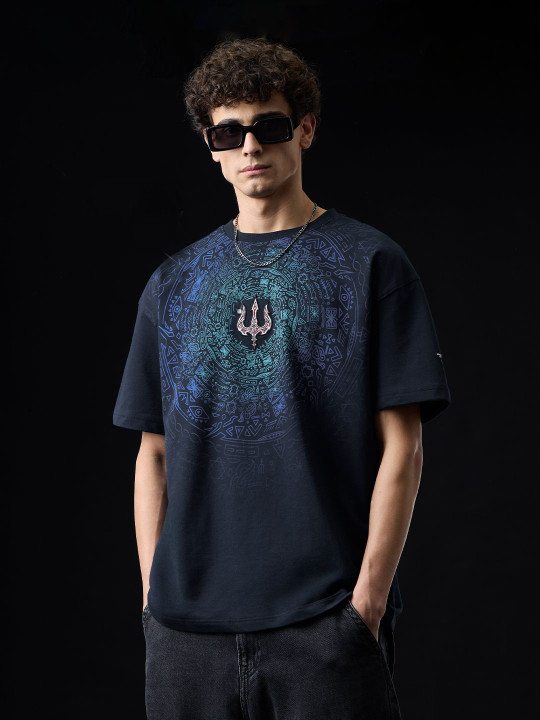
- **Fabric Physics:** The source garment is a heavyweight cotton jersey with a matte finish. It exhibits high structural integrity (low elasticity), meaning it holds a boxy shape rather than clinging to musculature. Light reflection should be diffuse with minimal specularity; it absorbs light rather than reflecting it. The drape should feel heavy, creating distinct, tubular folds rather than fine micro-wrinkles.
- **Key Features:**
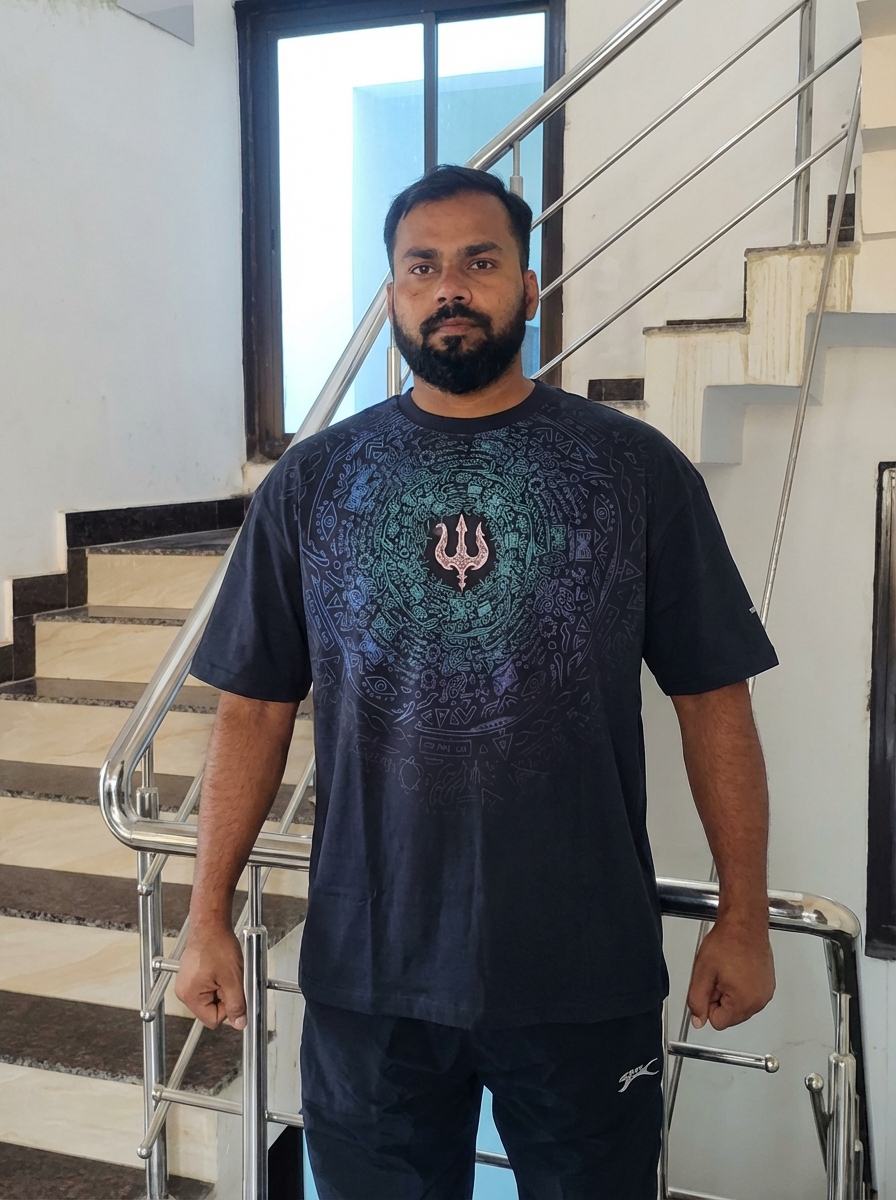
- The central "Trident" emblem (metallic/pinkish hue) and the surrounding complex cyan/purple mandala graphic are critical and must not be distorted by the warp.
- The ribbed crew neck collar.
- The drop-shoulder construction (seam falls below the natural shoulder point).
- The small white logo/text on the left sleeve edge.
- The double-stitched hemline at the waist and sleeves.
PHASE 2: FIT & DRAPE SIMULATION
- **Body Mapping:**
- **Shoulders:** The source garment is an "oversized/relaxed fit." On the target user, the shoulder seams must extend past his natural deltoids to maintain the intended streetwear silhouette.
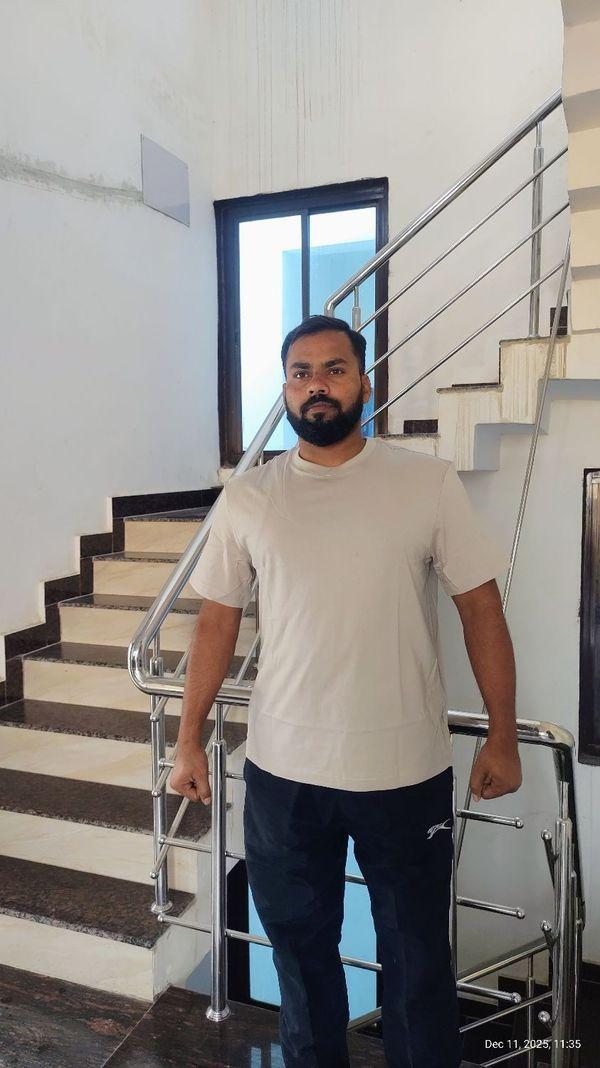
- **Torso:** The fabric should fall straight down from the chest (pectoralis major) without tapering at the waist, concealing the user's midsection shape more than his current beige shirt.
- **Axilla (Armpits):** Because the user's arms are slightly abducted (held away from the torso), create vertical tension folds dropping from the armpit to the hip.
- **Occlusion Handling:**
- **Hands/Arms:** The user's arms are clear of the torso; standard segmentation is sufficient.
- **Neck:** The user's beard and neck skin must be layered *over* the back of the new collar, but the front of the new collar must sit *over* the suprasternal notch, replacing the beige collar entirely.
- **Waist:** The new shirt hem must hang *over* the waistband of the dark track pants.
PHASE 3: ENVIRONMENT & LIGHTING
- **Light Match:**
- **Source:** The source is studio-lit with high contrast.
- **Target:** The user is in a backlit/side-lit indoor stairwell. Light is entering from the glass door behind him (creating rim lighting on his left shoulder) and general ambient fill from the front.
- **Simulation:** Apply a rim light to the user's left shoulder (image right) on the new fabric. The front of the shirt should be darker than the source image implies, relying on ambient fill light rather than a direct spotlight. Shadows should be soft and diffuse, not hard-edged.
- **Color Calibration:**
- The deep blacks of the source shirt must be lifted (lightened) slightly to match the dynamic range of the user's photo. Compare the black levels to the user's existing track pants—the shirt should match that black point, not the "pure black" of the source background.
- Apply a slight cool/blue tint to the highlights of the shirt to match the daylight color temperature coming from the window.
PHASE 4: IDENTITY PROTECTION
- **Facial Lock:** Absolute freeze on the user's face, including the beard, skin tone, and head shape. The hairline and ears must remain untouched.
- **Body Integrity:** The user has a broad, stocky build. Explicitly forbid any "slimming" or "tapering" algorithms. The volume of the user's chest and shoulders must remain constant; the shirt must expand to fit him, he must not shrink to fit the shirt. Do not alter the visible forearms or hands.