Thinking Process
PHASE 1: VISUAL DECONSTRUCTION
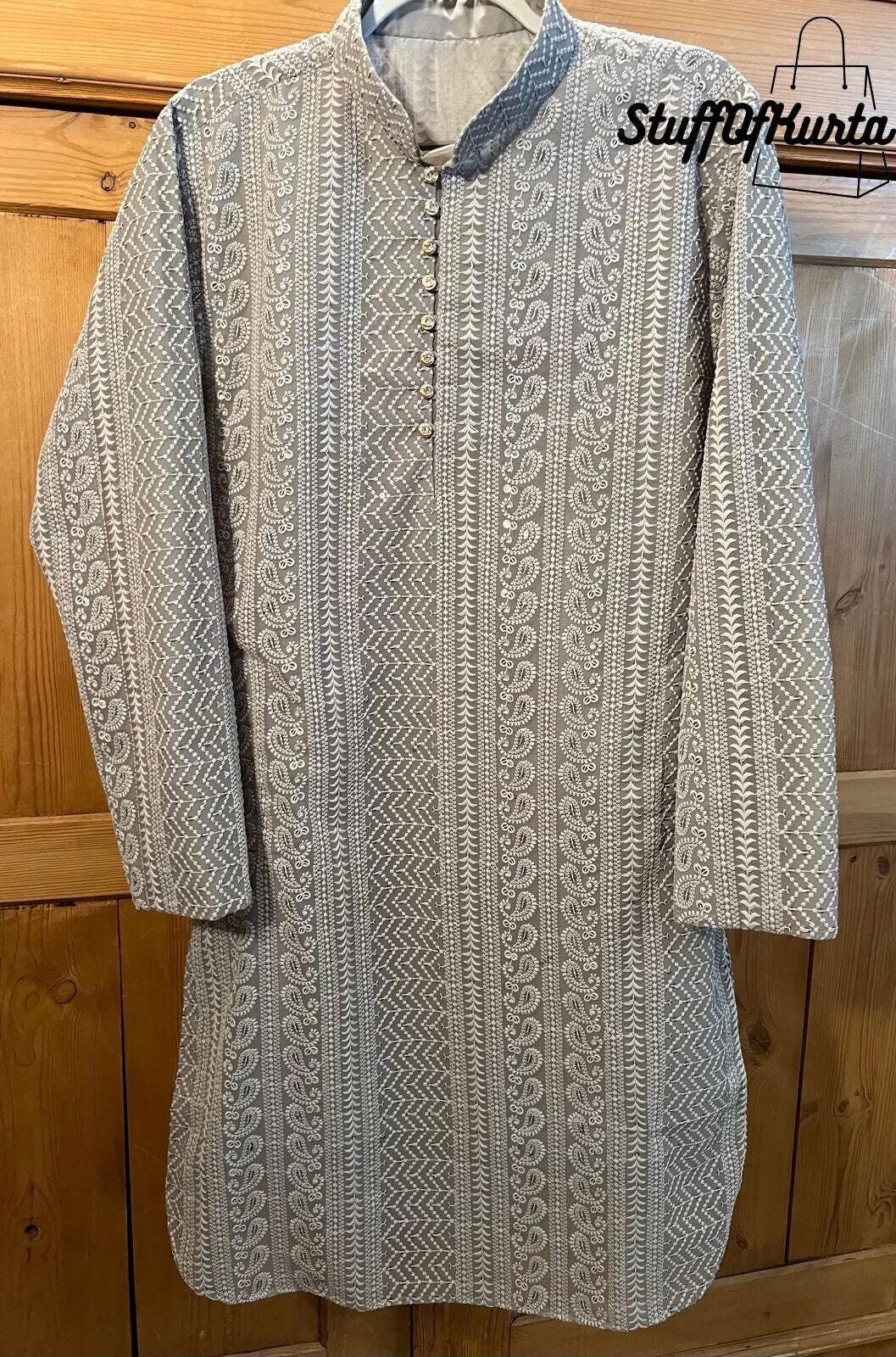
- **Fabric Physics:** The source garment is a woven fabric, likely cotton or linen blend, featuring intricate Chikankari-style embroidery. Unlike the user's current knit sweater, this fabric has low elasticity and medium stiffness. It should exhibit "crisp" folding rather than soft, rounded rolls. The embroidery threads have a slightly higher specularity (shine) than the matte base fabric, which needs to react to the ambient light.
- **Key Features:** The Mandarin collar (standing collar) must replace the current crew neck. The vertical geometric and paisley embroidered patterns must remain aligned vertically down the torso despite the user's leaning pose. The central button placket with approximately 8 visible buttons is a rigid anchor point. The cuff detailing on the sleeves must be preserved.
PHASE 2: FIT & DRAPE SIMULATION
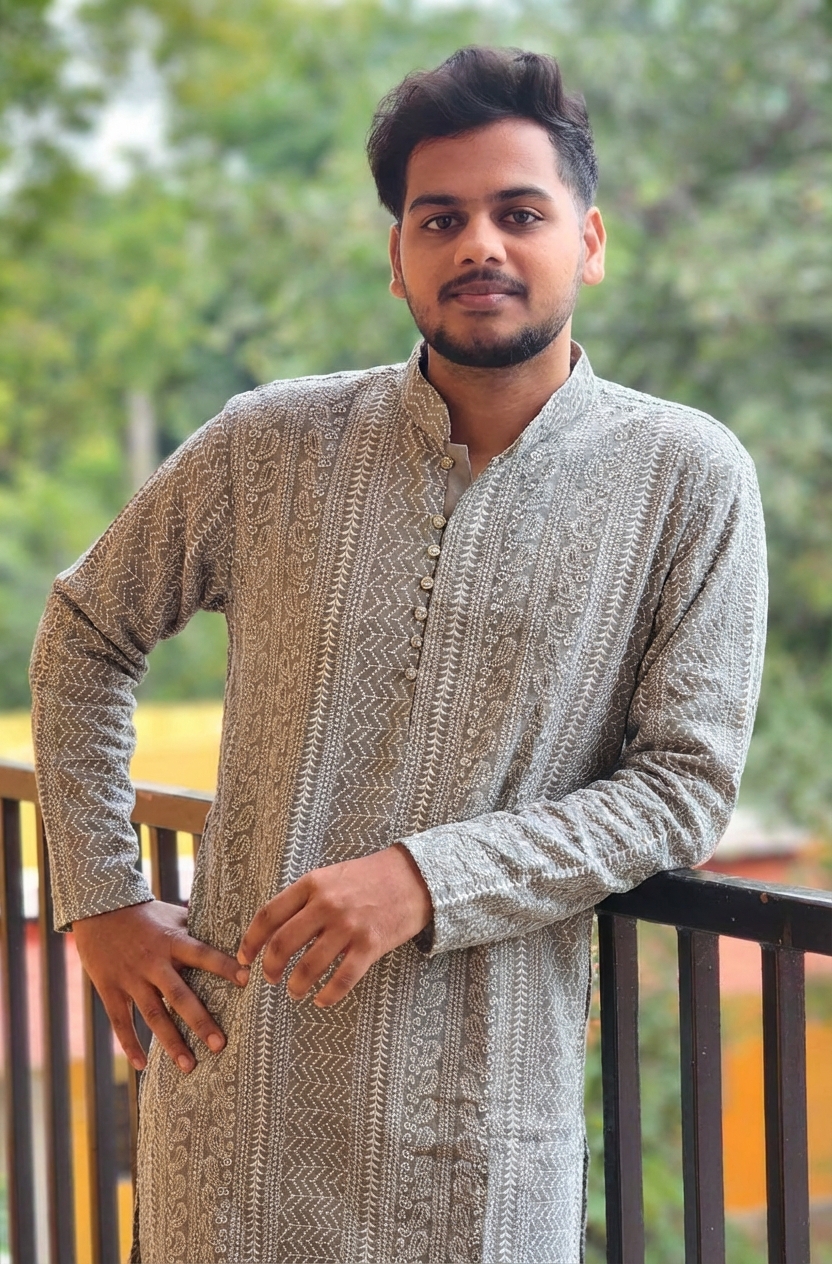
- **Body Mapping:** The current sweater adds artificial bulk to the user. The Kurta simulation must reduce the silhouette volume slightly to reflect a thinner woven fabric while maintaining the user's shoulder width. Due to the user leaning right, the Kurta should hang vertically due to gravity, creating a slight gap on the user's left side (image right) rather than clinging to the ribs. Sharp, angular compression folds are required at the left inner elbow (resting on the rail) and the right wrist.
- **Occlusion Handling:**
1. **Right Hand:** The user's fingers resting on the right hip must be segmented and layered *over* the Kurta.
2. **Railing:** The black metal railing under the left arm creates a hard collision point; the fabric must flatten and compress against this surface, not pass through it.
PHASE 3: ENVIRONMENT & LIGHTING
- **Light Match:** The user is in a soft, diffuse outdoor environment with cool/neutral daylight coming from the top/front. The source garment was photographed in warm, directional indoor light. The Kurta's lighting model must be switched to diffuse global illumination. Soft ambient occlusion shadows must be generated under the Mandarin collar, inside the elbow folds, and where the left arm presses against the torso.
- **Color Calibration:** Desaturate the warm/yellow tones from the source Kurta image to match the cooler color temperature of the user's outdoor setting. The silver/grey of the Kurta should appear neutral, not beige.
PHASE 4: IDENTITY PROTECTION
- **Facial Lock:** The user's hair structure, facial hair (beard/mustache), and skin tone from the neck up must be frozen. The transition from the neck to the new Mandarin collar requires precise masking to ensure the sweater's crew neck is fully removed without altering the neck anatomy.
- **Body Integrity:** Strict prohibition on slimming or altering the user's underlying skeletal structure. While the clothing volume reduces (thick knit to thin cotton), the user's shoulder span, arm thickness, and waist width must remain anatomically consistent.