Thinking Process
PHASE 1: VISUAL DECONSTRUCTION
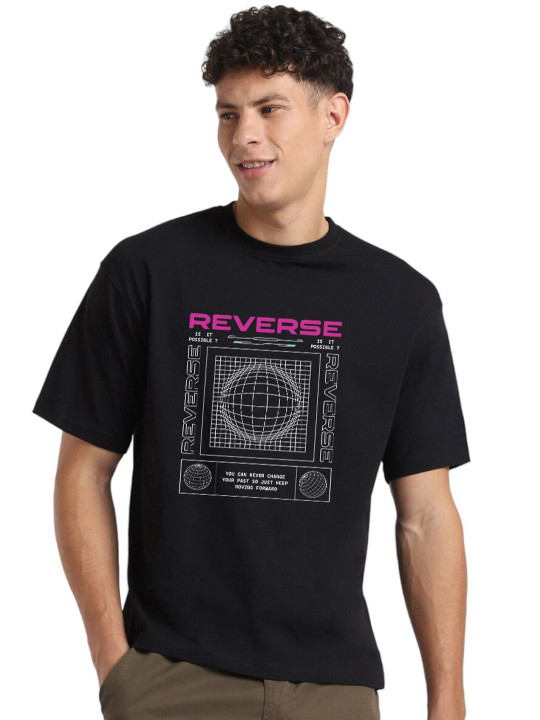
- **Fabric Physics:** The source garment is a standard mid-weight cotton jersey. It possesses low specular reflection (matte finish) but high light absorption due to the black colorway. Physically, it requires a "soft body" simulation with moderate tensile strength, meaning it will fold softly rather than crease sharply. In the target environment, the black fabric must exhibit slight diffuse washout where the direct sunlight hits, preventing it from looking like a flat black void.
- **Key Features:** The central graphic print is the primary asset. Specifically, the pink "REVERSE" typography and the white wireframe globe grid. The crew-neck collar ribbing and the standard double-stitched hemline must be preserved. The graphic's aspect ratio must be maintained even when warped by the body's curvature.
PHASE 2: FIT & DRAPE SIMULATION
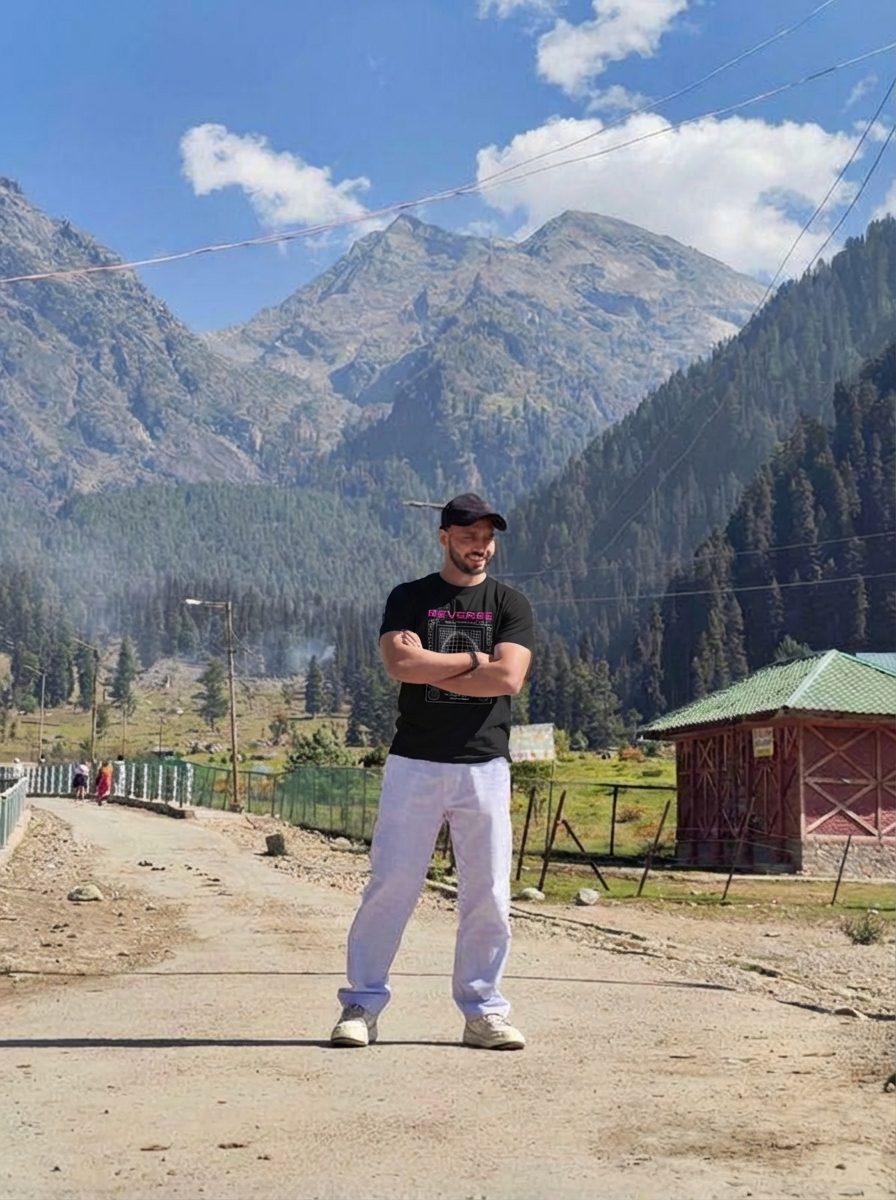
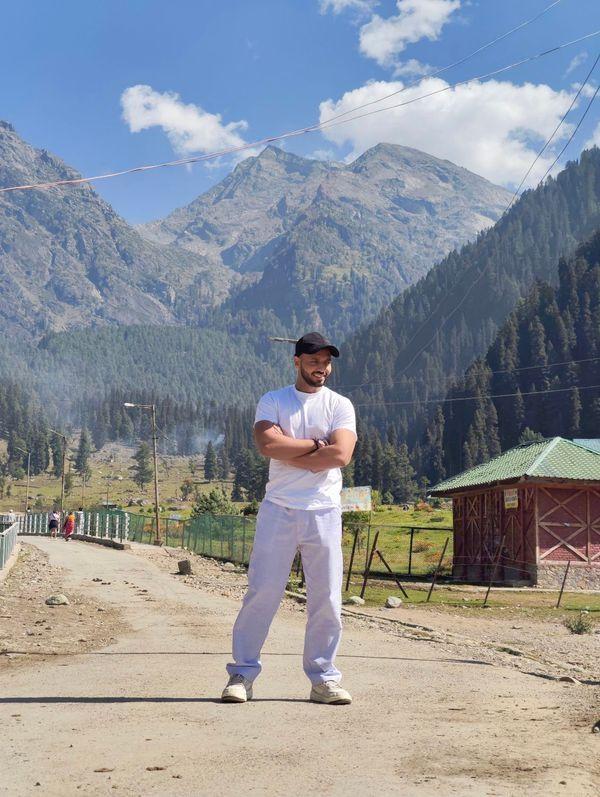
- **Body Mapping:** The user is in a "closed" pose with arms crossed. The simulation must account for significant tension across the upper back and shoulders. The fabric will not hang straight; it will bunch and compress heavily at the inner elbows and under the armpits. The chest graphic will undergo complex warping and partial masking; it must look as though it is wrapping around the pectorals and disappearing behind the crossed forearms, not pasted on top of them. The bottom hem should lift slightly at the front due to the raised arm position.
- **Occlusion Handling:** This is a high-complexity occlusion scenario. The user's left and right forearms and hands are crossing the torso. These limbs must generally be segmented as foreground layers. The new garment must be rendered *behind* the crossed arms. The transition between the sleeve cuff and the bicep must be tight, ensuring the skin of the upper arm emerges naturally from the new black sleeve.
PHASE 3: ENVIRONMENT & LIGHTING
- **Light Match:** The target environment is a high-altitude outdoor setting with hard, direct sunlight coming from the upper right (creating shadows to the left). The source garment is studio-lit. The new render must generate a high-contrast lighting map. The right side of the shirt (user's left) should be well-lit with potential desaturation from the sun, while the left side (user's right) and the areas beneath the crossed arms must cast deep, sharp ambient occlusion shadows consistent with the user's current pants and face shadows.
- **Color Calibration:** The source black is neutral. The target scene has a cool atmospheric tint (blue sky/mountains) but warm direct sunlight. The white grid graphic on the shirt should adopt a slight warm/yellow cast to match the sunlight temperature, avoiding a sterile #FFFFFF look. The black fabric should shift slightly towards a cool charcoal in the shadows to integrate with the ambient blue skylight.
PHASE 4: IDENTITY PROTECTION
- **Facial Lock:** The user's entire head region, including the beard, facial structure, ears, and the black cap, must be strictly frozen. The hairline and neck connection points must remain untouched.
- **Body Integrity:** The volumetric data of the user's biceps and forearms is critical. The transfer must not slim the arms or alter the shoulder width. The boundary where the shirt meets the pants (waistline) must respect the original body mass index; do not taper the waist artificially.