
Thinking Process
PHASE 1: VISUAL DECONSTRUCTION
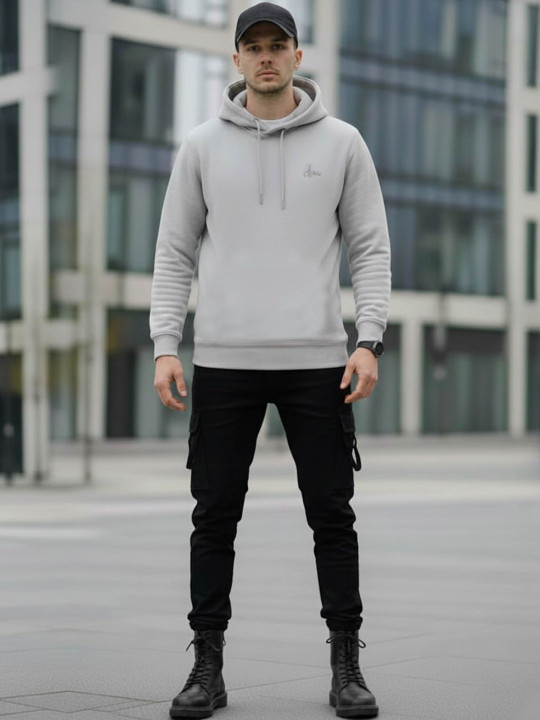
- **Fabric Physics:** The source garment is a heavy cotton-fleece blend jersey (hoodie). Unlike the user's current thin poplin shirt, this material is thick, matte, and light-absorbing. It has low elasticity but high volume. The simulation must account for significant thickness (approx. 300-400 gsm), resulting in softer, rounded folds rather than sharp creases.
- **Key Features:**
- **Hood & Neckline:** The structure of the hood around the neck is voluminous and must replace the sharp collar of the current shirt.
- **Drawstrings:** Two long drawstrings must respond to gravity and lie naturally against the chest, potentially interacting with the crossed arms.
- **Logo:** The cursive logo on the left chest must be preserved, though likely partially obscured by the user's right hand/bicep in this pose.
- **Ribbed Trim:** The ribbed hem at the waist and cuffs on the wrists (if visible) exert local compression.
PHASE 2: FIT & DRAPE SIMULATION
- **Body Mapping:**
- **Crossed Arms interaction:** This is a high-complexity pose. The hoodie sleeves must replace the shirt sleeves on the arms. The fabric must bulge and bunch significantly at the inner elbows (cubital fossa) due to the fabric thickness. The fabric across the chest will be compressed and flattened by the forearms pressing against it.
- **Shoulder Line:** The hoodie has a drop-shoulder or relaxed fit, creating a softer silhouette than the user's current fitted shirt.
- **Waist/Hem:** Unlike the tucked-in shirt, the hoodie has a ribbed band that typically sits *over* the trousers. The simulation should drape the hem over the belt line, likely obscuring the brown belt entirely unless the user specifically requested a tuck (uncommon for hoodies).
- **Occlusion Handling:**
- **Forearms & Hands:** The user's forearms and hands (crossed) are the primary occlusion layer. They must be segmented and layered *on top* of the chest panel of the hoodie.
- **Watch:** The watch on the left wrist is currently visible. The hoodie's ribbed cuff is thicker and longer than the rolled shirt sleeve. The simulation must determine if the cuff covers the watch or if the sleeve is pushed up; if the latter, the watch must overlay the garment.
PHASE 3: ENVIRONMENT & LIGHTING
- **Light Match:** The user is in a low-light, nighttime outdoor environment with artificial ambient lighting (likely streetlights) creating cool, purplish/blue tones and soft, diffuse shadows. The source garment is lit by flat, bright daylight. The hoodie's brightness must be drastically reduced. The lighting model must change from a top-down diffuse (source) to a directional side/ambient light matching the user's scene.
- **Color Calibration:** The light grey of the hoodie must be color-graded to reflect the ambient environment. It requires a "night mode" shift—introducing blue/cyan distinct undertones to the grey fabric to match the color temperature of the user's surroundings. The white point of the hoodie must be lowered to avoid it looking like a glowing cutout.
PHASE 4: IDENTITY PROTECTION
- **Facial Lock:** The user's face, including the jawline, facial hair (beard texture), and hair (quiff style), must remain completely frozen. The neck area needs careful blending where the hood meets the skin.
- **Body Integrity:** The user's pose (crossed arms) must not be altered. While the hoodie adds volume/bulk to the silhouette due to fabric thickness, the underlying skeletal structure and arm width must not be artificially slimmed or distorted.