Thinking Process
PHASE 1: VISUAL DECONSTRUCTION
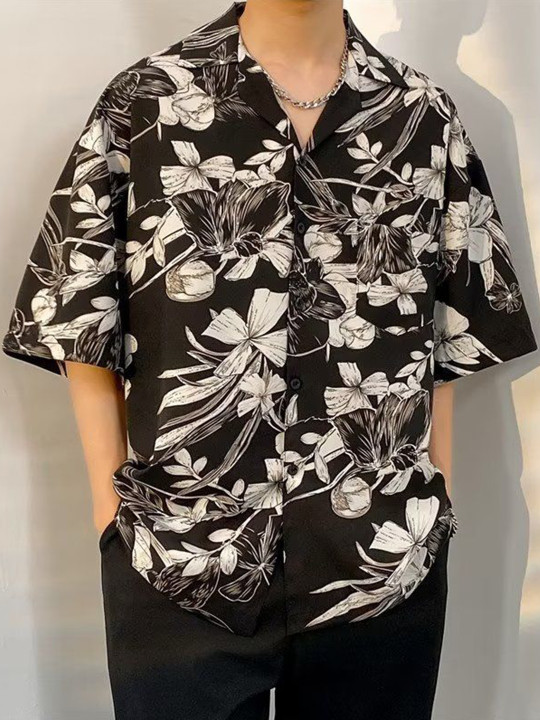
- **Fabric Physics:** The source garment appears to be a lightweight Rayon or Viscose blend with a "Cuban collar" cut. It possesses high drape and low stiffness, meaning it should not hold rigid shapes like the current sweater but rather flow over the body's contours. The material has a matte finish with very subtle specular highlights on the fold crests; it should not look glossy or synthetic like polyester.
- **Key Features:** The high-contrast white floral/botanical line art against the black background must remain crisp. The open V-neck collar structure, the black buttons, and the relaxed short-sleeve hemline are critical design elements to preserve. The pattern alignment across the front button placket must be maintained.
PHASE 2: FIT & DRAPE SIMULATION
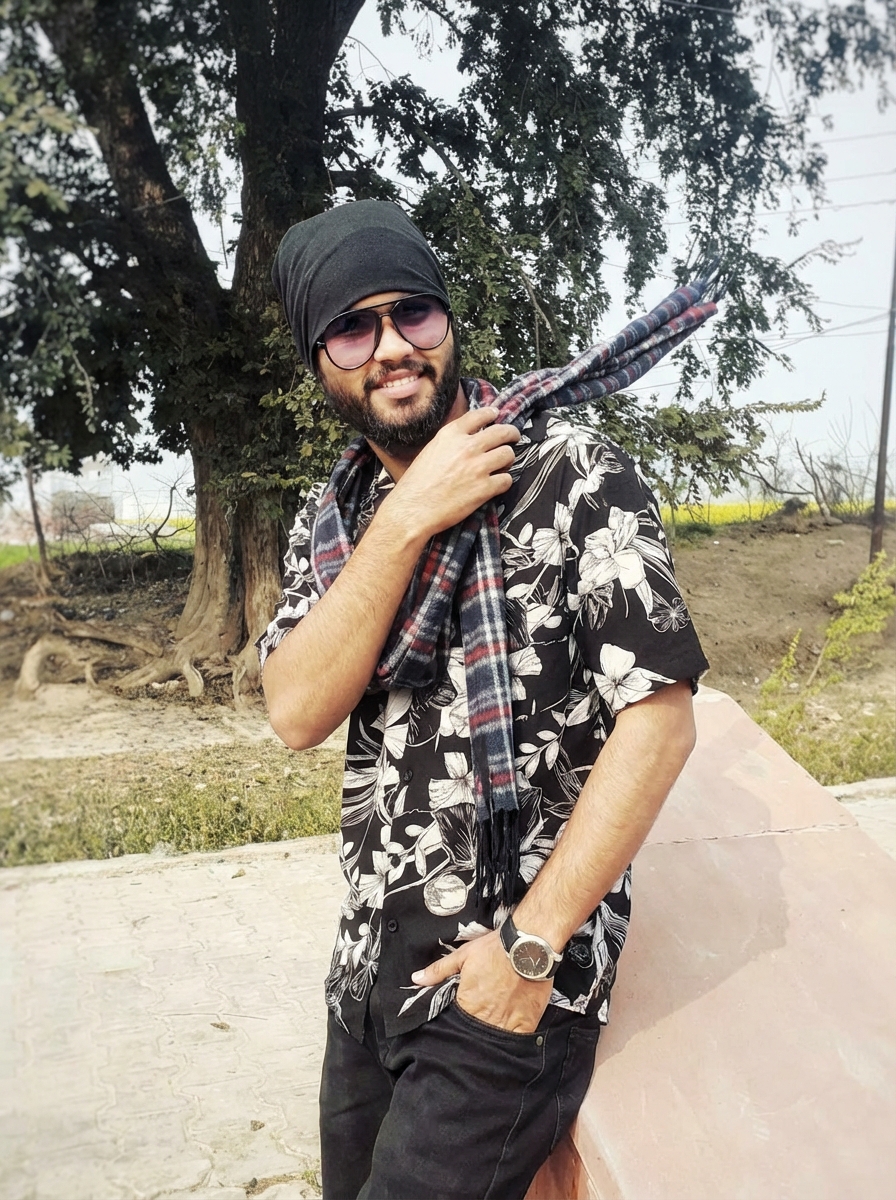
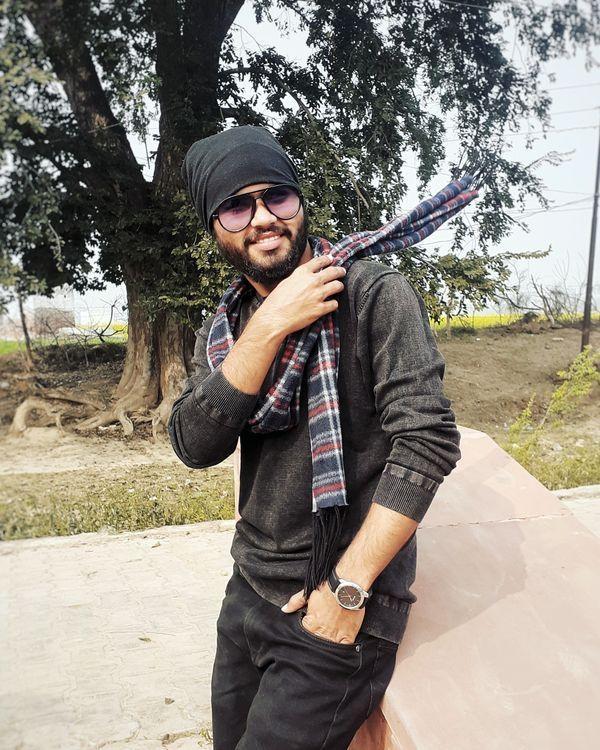
- **Body Mapping:** The target user has a bent right arm (acute angle at elbow) and a relaxed left arm. The new shirt is short-sleeved, while the user currently wears long sleeves. The simulation must generate natural skin textures for the exposed forearms to replace the sweater sleeves. The fabric on the right side must compress and fold realistically at the inner elbow due to the arm bend. The shirt should fit loosely around the midsection, simulating a relaxed resort fit rather than the tight knit of the current sweater.
- **Occlusion Handling:** This is a high-complexity occlusion scenario. The **checkered scarf** and the user's **right hand** (resting on the scarf) are the primary occlusion layers. The new shirt must be rendered *underneath* the scarf. The user's **watch** on the left wrist must be masked and preserved. The **beanie** and **sunglasses** are static top layers.
PHASE 3: ENVIRONMENT & LIGHTING
- **Light Match:** The target environment is outdoors with diffuse, overcast daylight. The lighting is soft with low-contrast shadows, coming generally from overhead. The source garment (photographed in studio lighting) must be relit to match this cooler, natural ambient light. The deep blacks of the shirt must be lifted slightly to match the atmospheric haze of the outdoor setting, preventing them from looking like "black holes."
- **Color Calibration:** The "white" of the floral print must be color-graded to a slightly cooler, natural off-white to match the outdoor color temperature, ensuring it doesn't look like a bright studio cut-out. The black tone of the shirt should be color-matched to harmonize with the black tones of the user's beanie to ensure visual consistency.
PHASE 4: IDENTITY PROTECTION
- **Facial Lock:** The user's entire head region—specifically the beard line, mouth, nose, sunglasses, and the positioning of the beanie—must be rigidly frozen. The skin tone generated for the arms (due to the sleeve length change) must perfectly match the user's facial skin tone.
- **Body Integrity:** The user's shoulder width and general torso volume must be preserved; do not slim the user down to match the source mannequin's frame. The generative fill for the arms must respect the user's muscular structure and wrist size, avoiding any warping around the watch area.