Thinking Process
PHASE 1: VISUAL DECONSTRUCTION
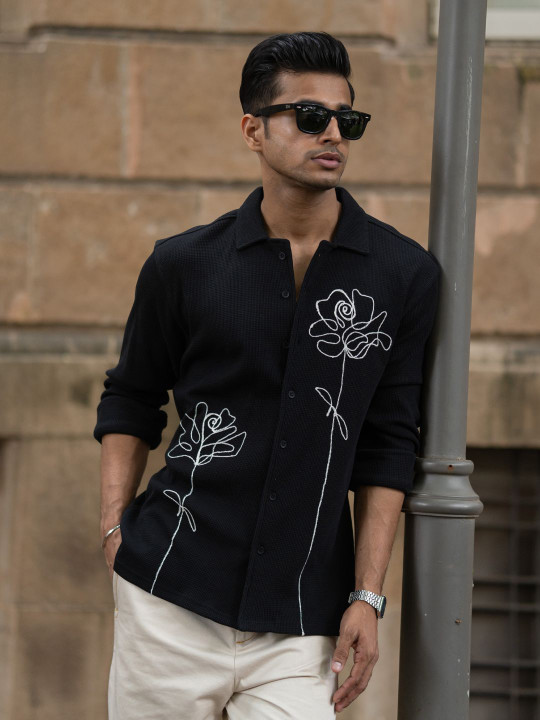
- **Fabric Physics:** The source garment appears to be a heavyweight waffle-knit or pique textured fabric, likely cotton or a cotton-blend. It possesses a matte finish with low reflectivity. The simulation must treat this as a semi-structured soft body—heavier than a standard t-shirt but softer than denim. It should exhibit high light absorption due to the black color, with highlights appearing only on the ridges of the fabric texture.
- **Key Features:** The two large, white line-art floral embroidery designs on the chest/abdomen are the primary visual anchor and must not be distorted beyond realistic drape limits. The spread collar, central button placket (with black buttons), and the specific textural "grid" pattern of the weave must be preserved.
PHASE 2: FIT & DRAPE SIMULATION
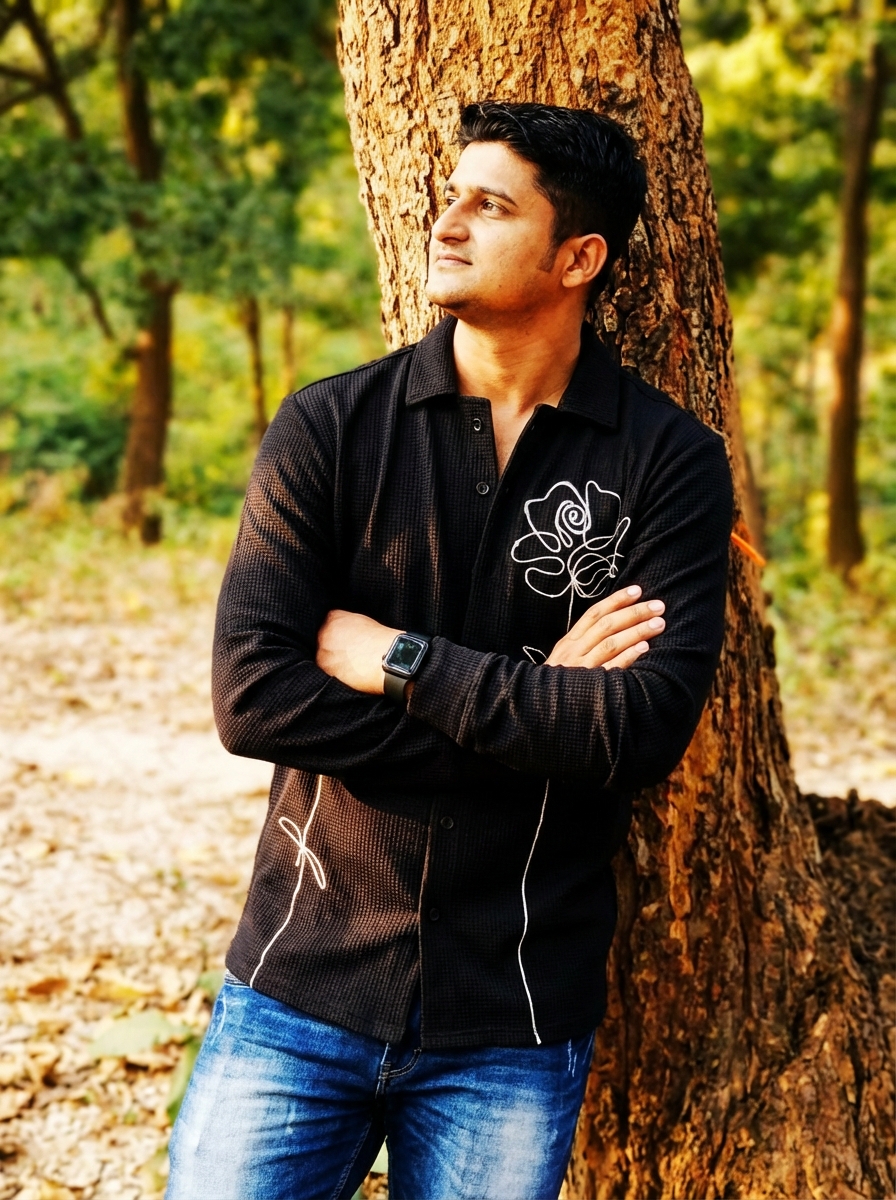
- **Body Mapping:** Due to the user's "arms crossed" pose, the fabric simulation requires complex tension mapping. The garment must stretch tightly across the upper back and shoulders. Significant compression folds and bunching must be generated at the inner elbows where the arms fold. The front of the shirt will be compressed under the forearms, causing the fabric—and the floral embroidery—to fold inward and contour around the bicep/forearm pressure points. The collar should sit higher on the neck than the user's current henley.
- **Occlusion Handling:** This is a high-occlusion scenario. The user's left and right hands, wrists, forearms, and the black smartwatch on the left wrist are strictly foreground elements. The new garment must pass *under* these limbs. Additionally, the tree trunk on the viewer's right creates a contact occlusion with the user's left shoulder/arm; the garment must interact with this hard surface boundary without clipping.
PHASE 3: ENVIRONMENT & LIGHTING
- **Light Match:** The target environment features dappled, directional sunlight (Golden Hour), likely filtering through tree canopy from the upper-left. The source garment is currently lit by flat, diffuse urban lighting. The black fabric must be re-lit to accept high-contrast, dappled light maps. Shadows should be cast downwards and to the right, deep into the fabric folds.
- **Color Calibration:** The source garment is neutral/cool black. To integrate, the black levels must be lifted slightly with a warm, golden-yellow bias to match the ambient forest temperature. The white floral embroidery must not remain stark white; it requires a warm tint to reflect the sunlight hitting the user's face.
PHASE 4: IDENTITY PROTECTION
- **Facial Lock:** The user's entire head, including hair, facial structure, skin tone, and expression, must be masked and frozen. The neck transition point must be carefully blended to accommodate the new collar height.
- **Body Integrity:** The volumetric shape of the user’s torso and arms must be preserved. The "crossed arms" pose creates a specific silhouette width that must not be slimmed or altered to match the source model's physique. The user's jeans and sneakers remain untouched.