Thinking Process
PHASE 1: VISUAL DECONSTRUCTION
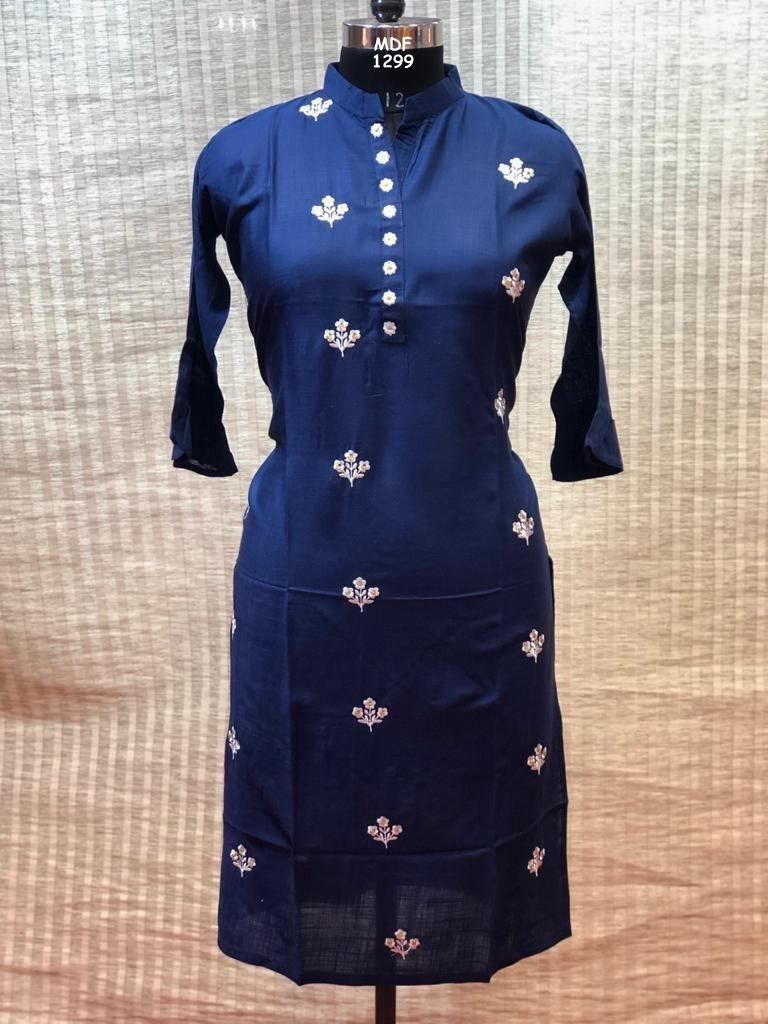
- **Fabric Physics:** The source garment is a woven cotton or cotton-blend Kurti. It possesses medium stiffness with low elasticity. It exhibits a matte finish but will show distinct, sharp drag lines rather than soft fluid ripples. The fold lines currently visible on the mannequin indicate the fabric holds creases, suggesting a structural drape that stands away from the body slightly rather than clinging.
- **Key Features:** The vertical button placket and mandarin collar must remain centered and rigid. The scattered floral embroidery placements (white motifs) must be preserved without distortion. The 3/4 sleeve length and the side-slit construction (typical of this silhouette) need to be generated, as the source image crops the bottom hem.
PHASE 2: FIT & DRAPE SIMULATION
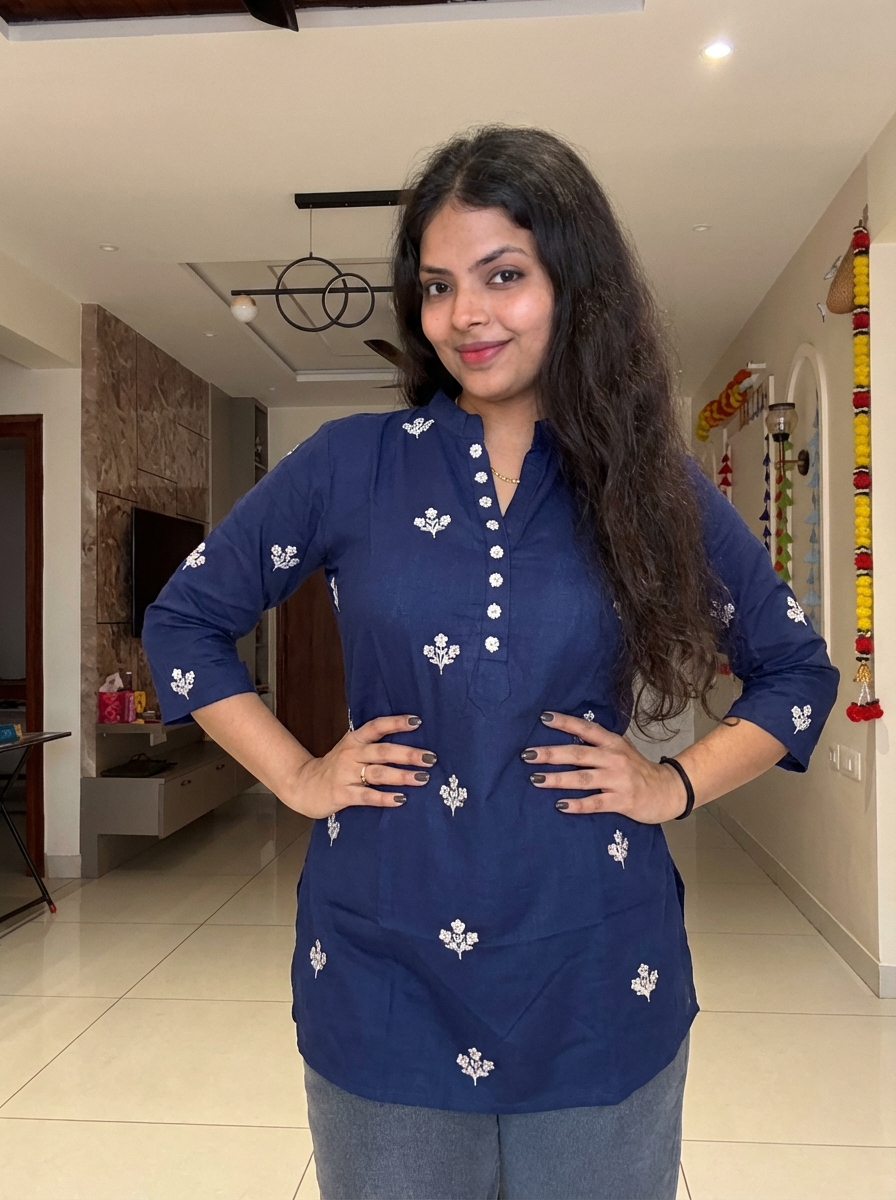
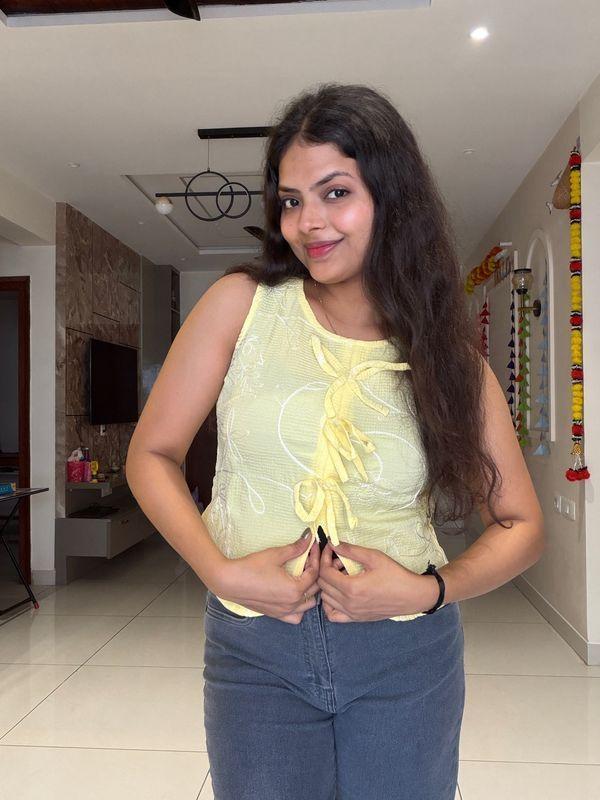
- **Body Mapping:** The source garment is significantly longer (tunic length) than the user's current crop top. The physics engine must generate the lower portion of the Kurti extending past the waistline to the upper thighs, covering the top portion of the jeans. The 3/4 sleeves must be generated to cover the currently bare arms, wrinkling slightly at the inner elbow due to the user's bent arm pose. The fabric must bunch horizontally around the waist area where the user's hands are pressing against her torso.
- **Occlusion Handling:**
1. **Hair:** The long, wavy hair falling over the user's left shoulder (viewer's right) is a high-priority occlusion layer; the Kurti fabric must pass *underneath* this hair volume.
2. **Hands:** The user's hands are positioned at the waist, gripping her current top. The new garment must be rendered *behind* the hands and wrist accessories (black wristband, ring).
3. **Necklace:** The gold chain must be layered *over* the new collar area.
PHASE 3: ENVIRONMENT & LIGHTING
- **Light Match:** The user is in an indoor environment with overhead, slightly warm artificial lighting (visible ceiling reflection). The source garment (currently under cool, flat studio light) must accept a top-down shadow map. Shadows should be cast under the bust and under the collar. The navy blue fabric needs to absorb the ambient warmth of the room to avoid looking too cool/blue compared to the surroundings.
- **Color Calibration:** The deep navy of the Kurti must be slightly desaturated and warmed to match the contrast levels of the user's jeans. The white embroidery must reflect the yellowish hue of the room lights rather than remaining stark white.
PHASE 4: IDENTITY PROTECTION
- **Facial Lock:** Absolute freeze required for the face, neck skin above the collar bone, and the specific volume and texture of the hair.
- **Body Integrity:** Strictly forbid any warping or slimming of the user's waist or hips. The Kurti usually has a straight cut; it should drape linearly over the user's curves without artificially cinching the waist, respecting her natural body measurements.