Thinking Process
PHASE 1: VISUAL DECONSTRUCTION
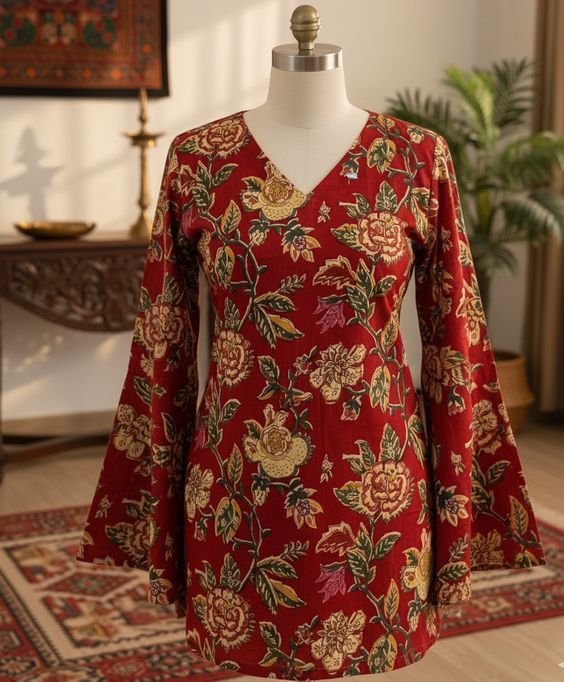
- **Fabric Physics:** The source garment is likely a medium-weight cotton or cotton-blend with a matte finish. It possesses low reflectivity (non-specular) and moderate stiffness, meaning it will hold the "bell" shape of the sleeves while draping vertically without excessive clinging. It should not appear glossy or wet.
- **Key Features:** The distinctive V-neckline, the flared "bell" silhouette of the long sleeves, and the intricate floral block-print pattern must be preserved. The garment appears to be a tunic length, meaning the simulation must generate fabric extending past the user's waistline, covering the top of her current black trousers.
PHASE 2: FIT & DRAPE SIMULATION
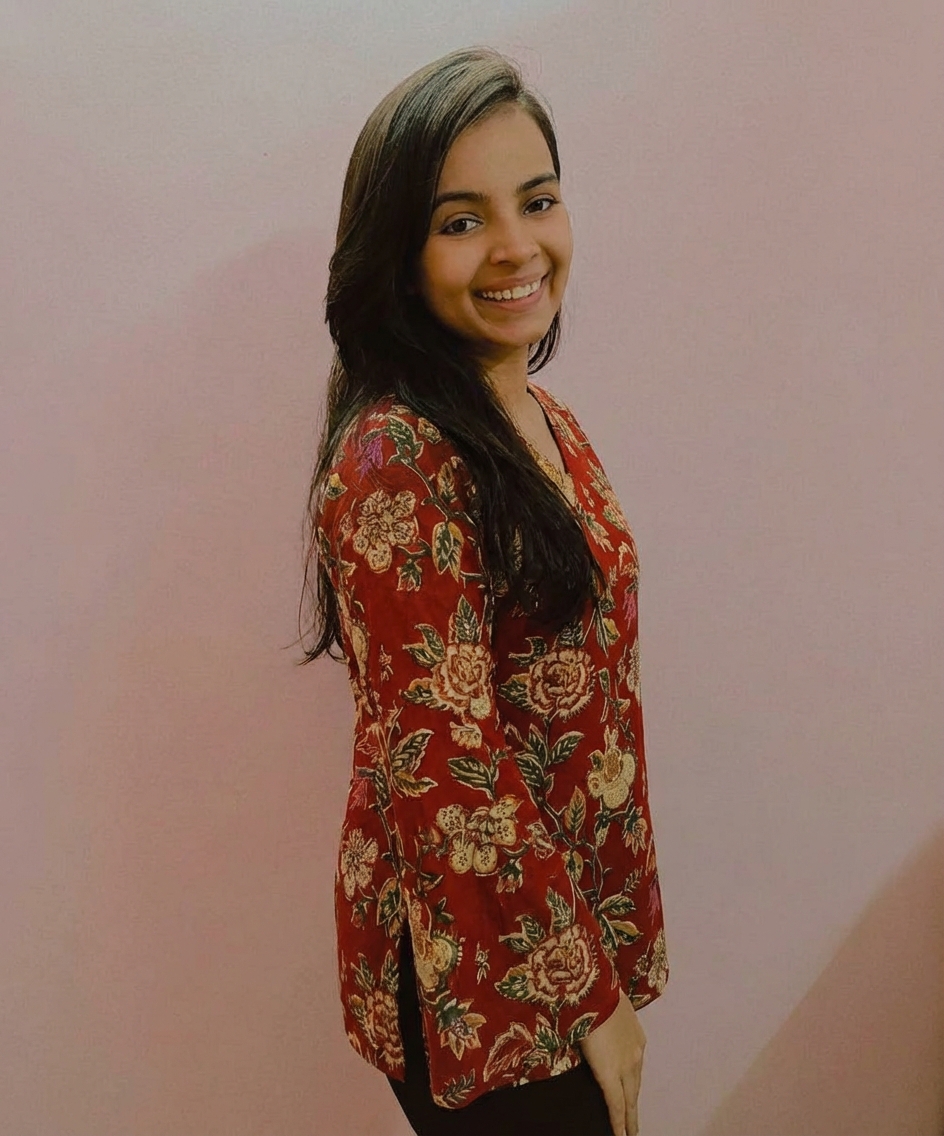
- **Body Mapping:** Given the user's side-angled pose, the V-neck must center on the sternum but rotate to match her torso's angle. The most complex mapping involves the sleeves: the system must extend the garment down the user's arm (currently bare/short-sleeved) to create the long bell sleeve. Gravity dictates that the flared cuff of the sleeve will hang vertically, likely covering part of the wrist/hand, rather than flaring outward stiffly.
- **Occlusion Handling:** Critical occlusion zones are the user's long dark hair. The hair falls over the front right shoulder and down the back. The new red tunic must be rendered *underneath* these hair layers. The hairline and hair volume must remain untouched, acting as a foreground mask over the generated fabric.
PHASE 3: ENVIRONMENT & LIGHTING
- **Light Match:** The user's environment has soft, diffused, warm lighting coming primarily from the front-left. There are no harsh directional shadows. The garment's shading must match this ambient occlusion—shadows should be soft and graduate gently around the curvature of the torso and under the sleeves.
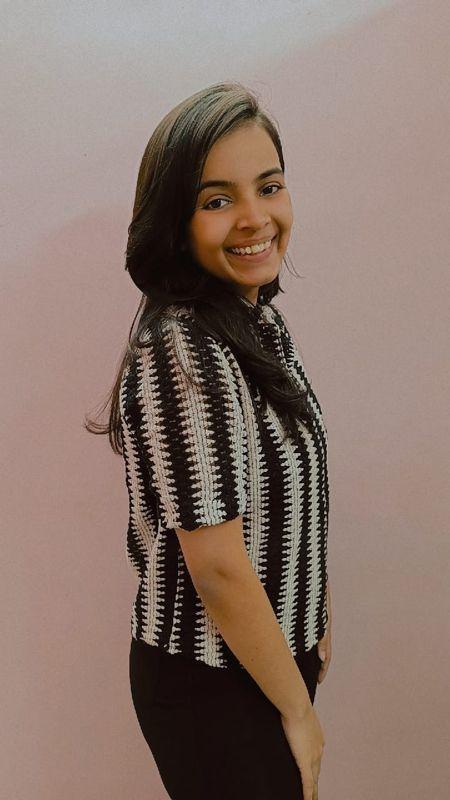
- **Color Calibration:** The source image is high-contrast studio lighting, while the user image is softer with slight grain. The vibrant red of the tunic must be slightly desaturated and texturized (adding slight ISO noise) to match the camera quality and ambient lighting temperature of the user's room to prevent it from looking like a "sticker."
PHASE 4: IDENTITY PROTECTION
- **Facial Lock:** Absolute pixel-lock required on the user's face, smile, jawline, and the specific angle of the neck.
- **Body Integrity:** The user's shoulder width, arm thickness, and posture must remain unaltered. The tunic fits loosely; therefore, the simulation must wrap around her existing form without slimming the waist or altering the visible curvature of her hips where the tunic falls.