Thinking Process
PHASE 1: VISUAL DECONSTRUCTION
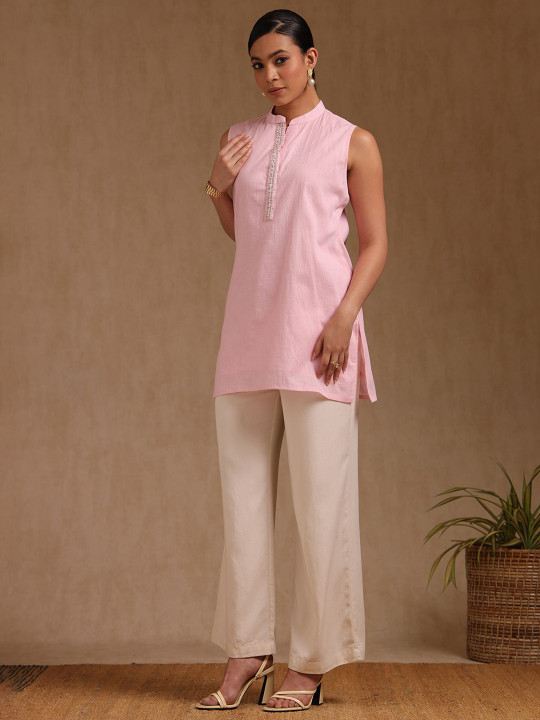
- **Fabric Physics:** The source garment appears to be a lightweight, woven cotton or linen blend. It has a matte finish with a semi-structured drape. It is breathable but not highly elastic. Light reflection should be diffuse (soft scattering) rather than specular; it should absorb ambient light rather than shine.
- **Key Features:**
- **Central Placket:** The vertical embroidered/beaded strip running down the center chest is the primary focal point and must maintain vertical integrity without warping excessively over the bust.
- **Mandarin Collar:** The high neck/collar detail must replace the open collar of the user's current shirt.
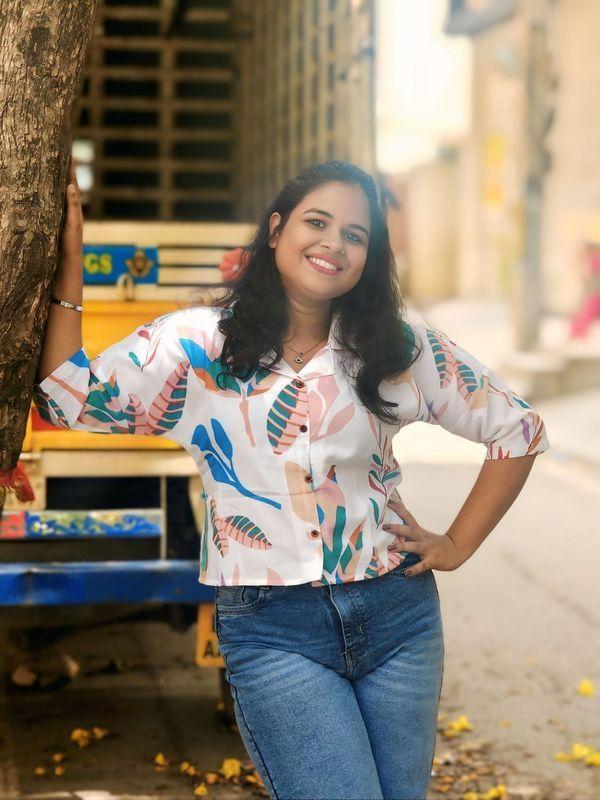
- **Sleeveless Cut:** The armholes are clean-cut. This requires generating skin texture for the user's arms, as her current image features ¾ length sleeves.
- **Hemline:** The tunic has a longer, straight hem that falls below the hip line, unlike the user's current cropped/tucked style.
PHASE 2: FIT & DRAPE SIMULATION
- **Body Mapping:**
- **Right Arm (raised):** As the user leans against the tree with her right arm up, the armhole on this side must stretch vertically. The fabric on the right lateral torso should pull tight against the ribs due to the stretch.
- **Left Arm (bent):** With the hand on the hip, the tunic (being longer than the current shirt) must drape over the hip and bunch naturally around the left wrist/forearm area, or fall behind the hand depending on implied tuck. Given the length, it likely falls straight, partially interrupted by the forearm.
- **Skin Generation:** Since the target is wearing sleeves and the source is sleeveless, realistic skin texture and shading must be generated for the user's upper arms and shoulders.
- **Occlusion Handling:**
- **Hair:** The user has dark, wavy hair cascading over both shoulders. The pink tunic must be rendered *under* these hair layers.
- **Necklace:** The user's necklace sits low; the high neck of the source garment will likely cover the chain. Any visible part of the pendant must be layered *over* the fabric or removed if the neckline covers it completely.
- **Left Hand:** The fingers and wrist of the left hand resting on the hip must occlude the tunic fabric.
PHASE 3: ENVIRONMENT & LIGHTING
- **Light Match:** The user is in an outdoor, daylight environment with soft, diffused lighting coming generally from above and the right. The garment must exhibit self-shadowing (folds) consistent with this diffuse daylight. A slight cast shadow from the tree/arm should fall onto the right side of the torso.
- **Color Calibration:** The source image has warm, studio lighting. The pink hue must be cool-shifted slightly to match the natural outdoor white balance of the user's photo. The saturation should be preserved but the brightness adjusted to match the exposure of the user's face and jeans.
PHASE 4: IDENTITY PROTECTION
- **Facial Lock:** The user's entire head, including the jawline, smile, and specific hairstyle, must be frozen. The neck transition point is critical due to the change in collar style.
- **Body Integrity:** Strictly forbid any warping or slimming of the user's torso or arms. The garment must be simulated to fit *her* dimensions (shoulders, bust, waist) as they appear in the image, rather than shrinking the user to fit the model's size. The curvature of her hip (where the hand rests) must be maintained.