Thinking Process
PHASE 1: VISUAL DECONSTRUCTION
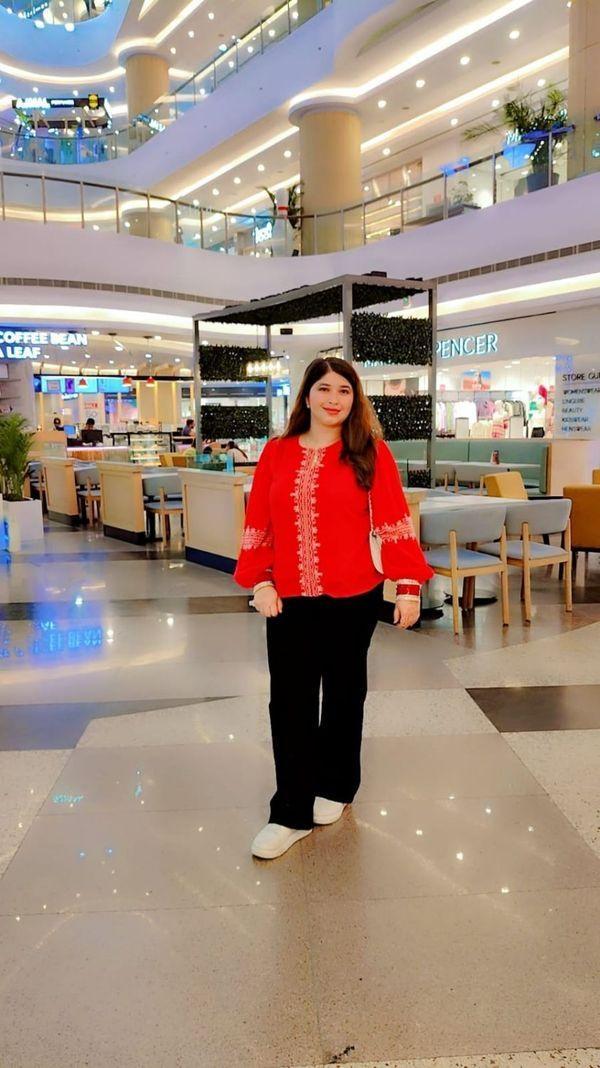
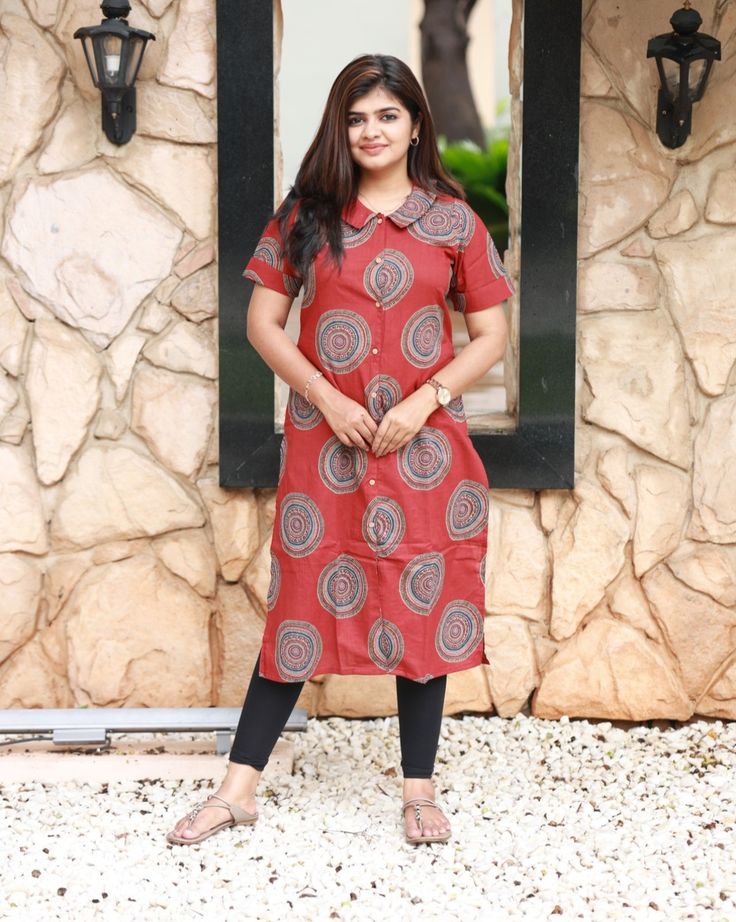
- **Fabric Physics:** The source garment appears to be a medium-weight cotton or cotton-linen blend. It has a matte finish with low reflectivity, distinct from the potentially shinier synthetic fabric currently worn by the user. The simulation must treat the fabric as semi-structured; it holds the shape of the collar and cuffs but drapes softly around the torso without stiff creasing.
- **Key Features:** The large circular medallion patterns (blue/grey on red/maroon) must be preserved without distortion. The "Peter Pan" style flat collar, the central button placket running the length of the torso, and the folded cuffs on the short sleeves are critical design elements. The tunic length (extending past the hips) is a defining characteristic that differs from the user's current waist-length top.
PHASE 2: FIT & DRAPE SIMULATION
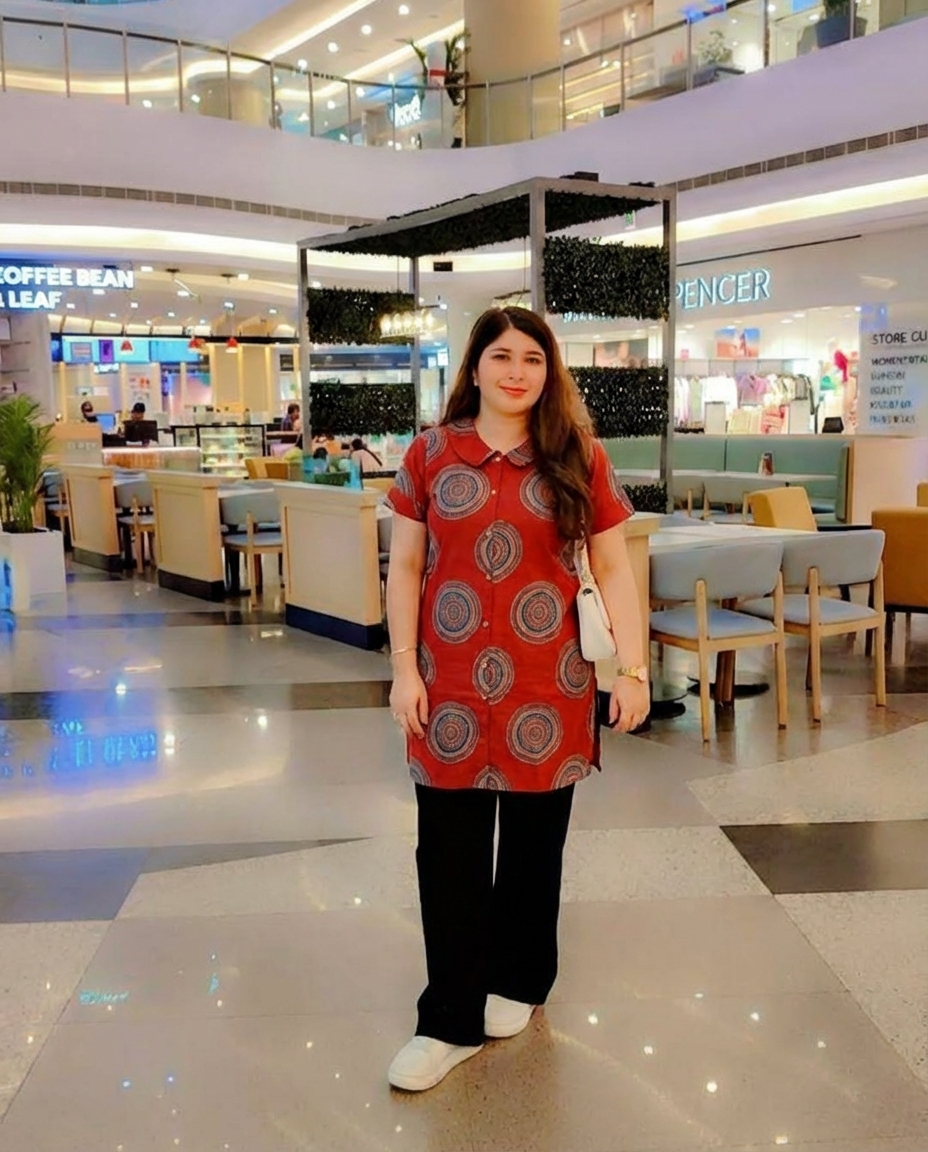
- **Body Mapping:** The target garment is a tunic/kurti, meaning the hemline must extend below the user's waist, draping over the hips and covering the upper portion of the black trousers. The silhouette should be an A-line shape, hanging relatively straight due to gravity rather than clinging tightly to the midsection. Since the source garment has short sleeves and the user is wearing long sleeves, the simulation must infer/generate the user's forearms or accurately mask the transition at the bicep level.
- **Occlusion Handling:** The user's long dark hair falls over both the left and right shoulders/chest area. This hair must be segmented and layered *over* the new garment’s collar and upper chest area. The user's hands (specifically the visible right hand) and the white purse/clutch on the left side must be masked out to ensure the new longer hemline passes behind the hand/wrist but covers the hip area.
PHASE 3: ENVIRONMENT & LIGHTING
- **Light Match:** The user environment features diffuse, overhead artificial mall lighting (cool/neutral white), resulting in soft, downward-casting shadows. The source garment was photographed in warmer, directional outdoor light. The texture map of the new garment must be neutralized (removing warm yellow casts) and relit to reflect the "flat" lighting of the mall, ensuring no harsh directional shadows appear on the fabric folds.
- **Color Calibration:** The source red/maroon is sun-lit and vibrant. It must be slightly desaturated and cooled to match the indoor color temperature of the mall scene. The contrast of the circular patterns should be maintained but softened slightly to blend with the lower-contrast indoor environment.
PHASE 4: IDENTITY PROTECTION
- **Facial Lock:** Absolute freeze on the user’s entire head region above the neck, including eyes, nose, mouth, jawline, and the specific volume/style of the hair.
- **Body Integrity:** Strictly forbid any slimming or reshaping of the user's torso or arms. The source garment must be warped and scaled laterally to fit the user's bust and hip measurements, ensuring the circular patterns remain circular and do not stretch horizontally into ovals. The user's stance and shoulder width must remain identical to the original image.