Thinking Process
PHASE 1: VISUAL DECONSTRUCTION
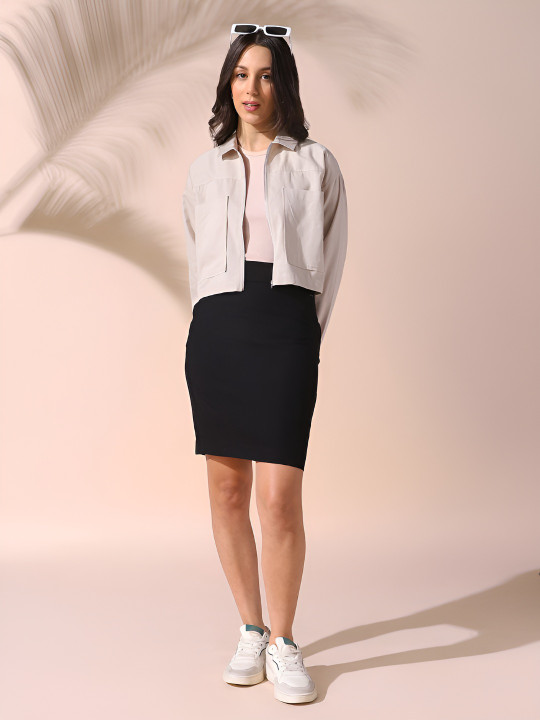
- **Fabric Physics:** The source garment is a light beige cropped "shacket" (shirt-jacket) appearing to be made of cotton twill or a structured polyester blend. It has a matte finish with low specular reflection. The physics engine must treat this as semi-rigid material (high structural stiffness, low drape) rather than fluid cloth; it should hold its boxy shape rather than clinging to the skin.
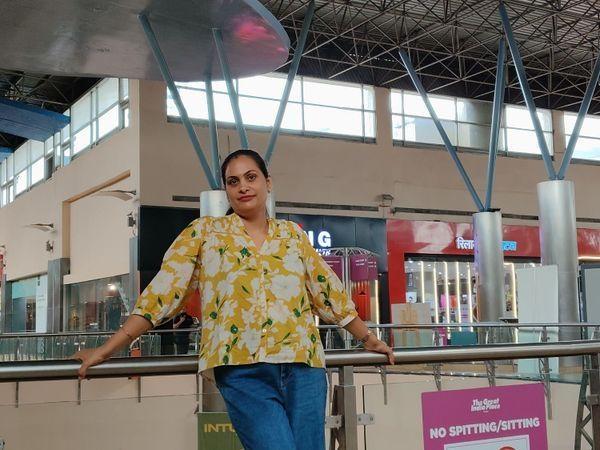
- **Key Features:** The large rectangular chest patch pockets with flaps must remain prominent and undistorted. The structured collar, the front zipper/placket line, and the drop-shoulder seams are critical geometry. The cropped hemline (ending near the waist) is a defining silhouette feature that differs significantly from the user's current long tunic.
PHASE 2: FIT & DRAPE SIMULATION
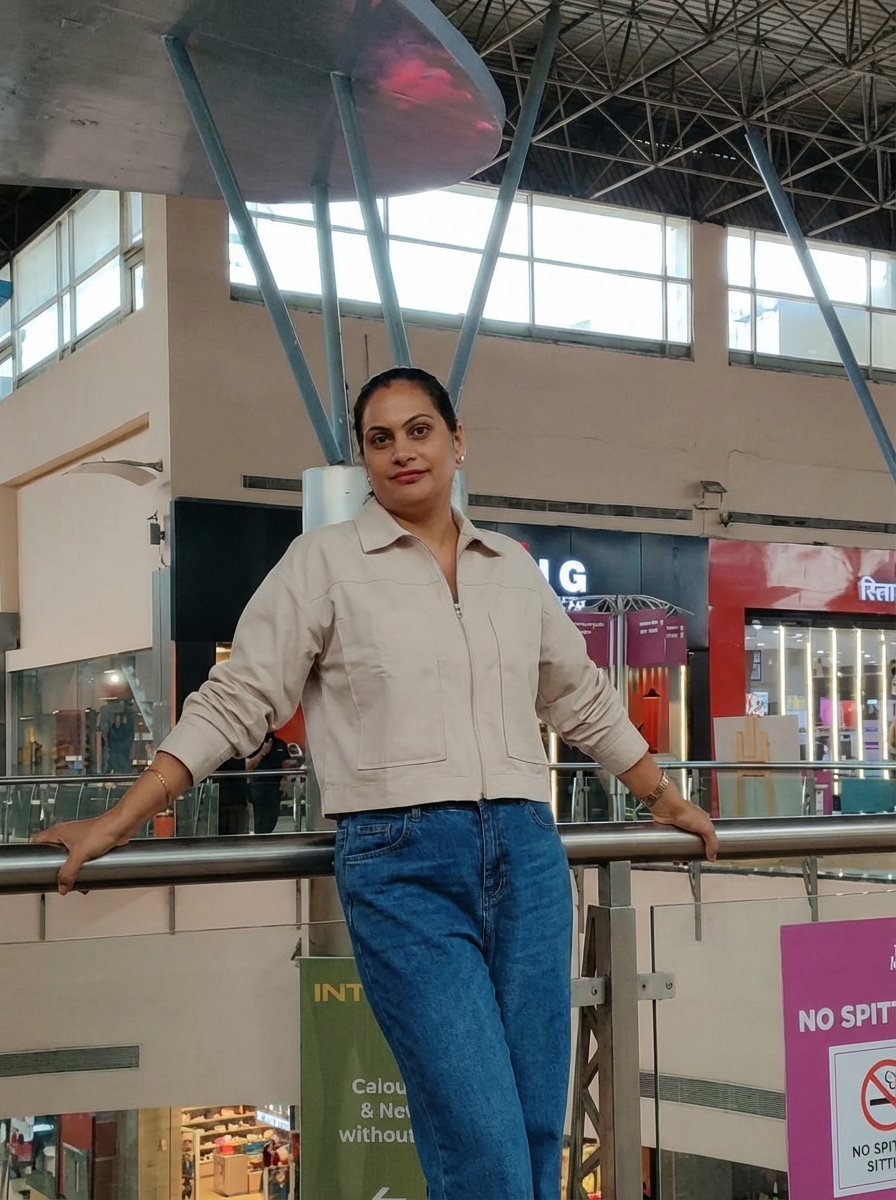
- **Body Mapping:** Due to the user's pose (leaning back against a railing with arms extended sideways/backward), the garment must exhibit tension across the chest and clavicle area. The fabric should naturally pull slightly upward at the hem. Unlike the source image where sleeves hang straight, the sleeves here must bunch naturally at the elbow and axilla (armpit) due to the arm extension. The hem should fall away from the lower back slightly due to the leaning posture.
- **Occlusion Handling:** The user's hair is tied back, minimizing occlusion risks at the neck. However, the lower arms/wrists interact with the railing; the sleeve cuffs must terminate naturally before the wrists to avoid blending into the metal railing. The hands are essentially behind the plane of the torso and should remain unaffected.
PHASE 3: ENVIRONMENT & LIGHTING
- **Light Match:** The target environment is a large commercial space (mall/atrium) with diffuse, cool-toned daylight entering from large windows/skylights above and behind, mixed with artificial ambient light. The generated jacket must shed the warm, directional studio lighting of the source image. Shadows should be soft and cast downward from the collar and pocket flaps, consistent with overhead industrial lighting.
- **Color Calibration:** The warm cream/beige tone of the source jacket must be color-graded to a cooler, neutral beige to match the ambient temperature of the mall environment. Highlights on the fabric should reflect the white/blue tint of the skylights, not the yellow warmth of the studio source.
PHASE 4: IDENTITY PROTECTION
- **Facial Lock:** Absolute freeze required on the user's face, jawline, neck, and ears. The hairline and the specific pulled-back hairstyle must remain pixel-perfect.
- **Body Integrity:** Strictly forbidden to slim the arms or torso. The simulation must respect the user’s natural volume. The boxy cut of the jacket should add volume relative to the current garment, not reduce the user's silhouette. The leaning posture must remain exactly as is; do not artificially "straighten" the user.