Thinking Process
PHASE 1: VISUAL DECONSTRUCTION
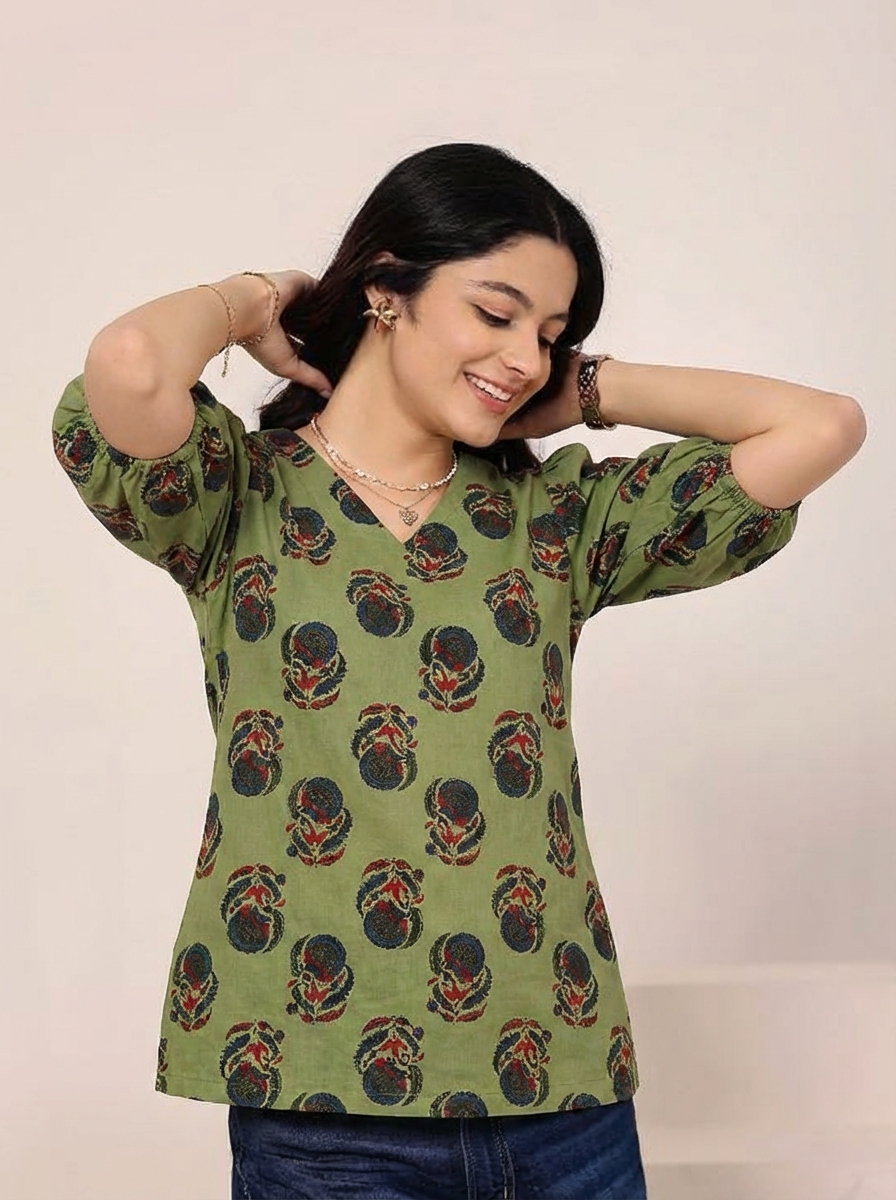
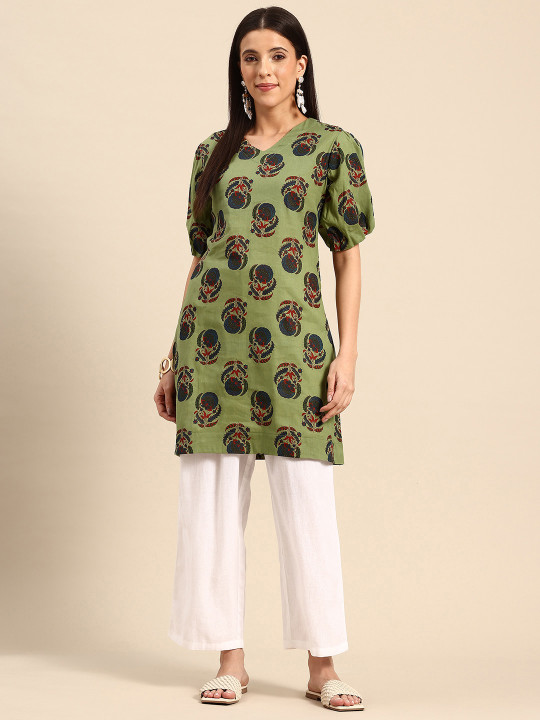
- **Fabric Physics:** The source garment is a printed Cotton or Cotton-Linen blend. It exhibits a matte finish with low light reflectivity (diffuse reflection). The fabric structure is semi-rigid; it holds the shape of the puff sleeves but drapes vertically without clinging. It is not elastic.
- **Key Features:**
- **Puff Sleeves:** The gathered fabric at the shoulder seam and the elastic/fitted cuff at the bicep.
- **Pattern:** The specific red/blue/black block print floral motif on the green background.
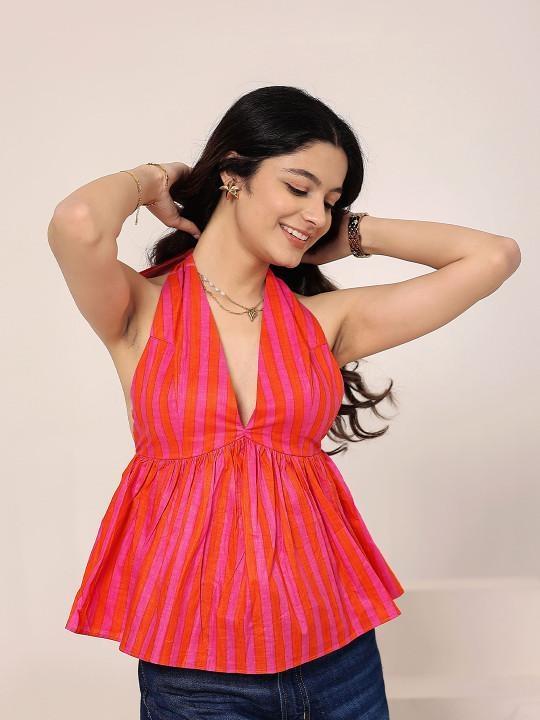
- **Neckline:** The distinct V-neck cut which is higher than the target's current deep-V halter.
- **Silhouette:** The straight, tunic-style cut (Kurti) which extends past the hips, unlike the target's current cropped peplum.
PHASE 2: FIT & DRAPE SIMULATION
- **Body Mapping:**
- **Torso:** The tunic must hang loosely over the torso, obscuring the waist definition seen in the current halter top. It should drape straight down over the top of the jeans.
- **Shoulders & Arms:** This is the critical friction point. Because the user's arms are raised/bent behind the head, the tunic's puff sleeves must be simulated to ride up slightly. The fabric at the armpit will lift and tension lines should appear radiating from the armpit toward the chest. The sleeve cuffs must encircle the user's biceps, not cut through them.
- **Occlusion Handling:**
- **Hair:** The user's dark hair falls behind the shoulders, but any loose strands near the neck must be segmented and layered *over* the new tunic's collar area.
- **Necklace:** The current necklace sits low; the new tunic neckline is higher. The necklace should likely be obscured by the fabric, or if the V-neck allows, masked carefully to sit *on top* of the green fabric.
- **Arms:** The inner arms are exposed. The new sleeves must wrap around the upper arm volume, occluding the bare skin currently visible at the shoulders.
PHASE 3: ENVIRONMENT & LIGHTING
- **Light Match:** The user image has soft, diffuse studio lighting coming from the front/left, casting soft shadows to the viewer's right (note the shadow on the user's left ribcage). The green tunic must receive this same lighting treatment, generating self-shadowing under the bust and inside the folds of the lifted sleeves.
- **Color Calibration:** The source image has a slightly warmer/yellow undertone. The user image is cooler/neutral. The green of the tunic must be color-corrected to appear natural in the cooler white light of the user's environment to avoid looking like a "sticker."
PHASE 4: IDENTITY PROTECTION
- **Facial Lock:** Absolute preservation of the user's face, jawline, ears, and the hair framing the face. The hands behind the head must remain untouched.
- **Body Integrity:** Do not slimmer the user's arms or alter the hip width. The tunic adds volume compared to the halter top; allow the garment to expand the silhouette naturally rather than warping the user's body to fit the cloth.