
Thinking Process
PHASE 1: VISUAL DECONSTRUCTION
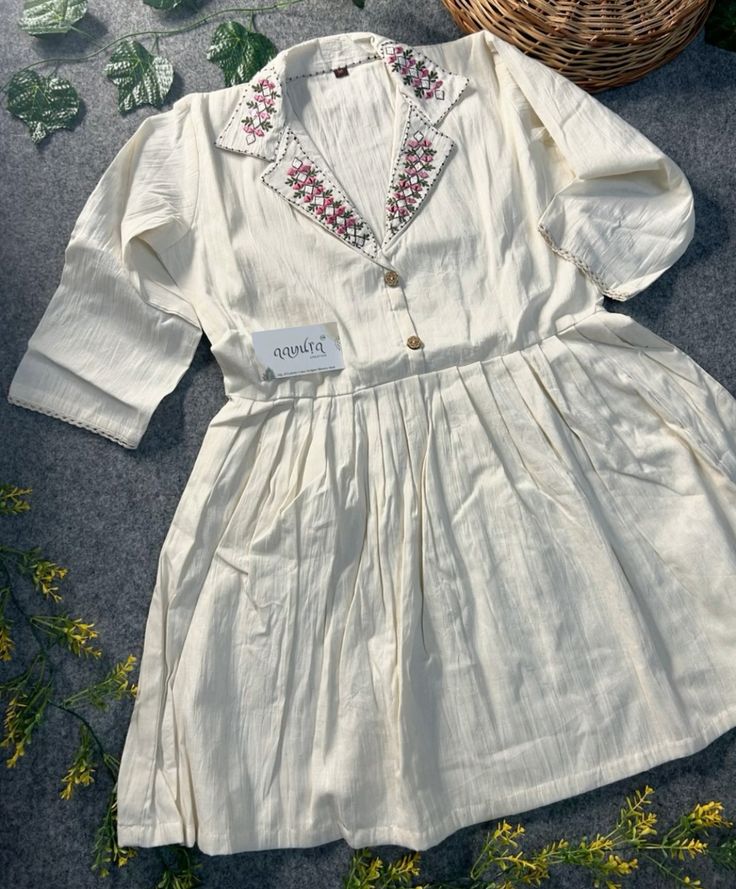
- **Fabric Physics:** The source garment appears to be a textured cotton or linen blend with low sheen and high breathability. The simulation must treat this as a semi-rigid fabric with moderate drag; it will not flow like water (silk) but will hold creases. It has a matte finish with a visible weave structure that must be preserved to avoid a "plastic" look.
- **Key Features:**
- **Embroidery:** The pink and green floral geometric embroidery on the notched lapel/collar is the focal point and must be transferred with high resolution.
- **Structure:** The gathering/pleats at the empire waistline (just below the bust) are critical for the silhouette.
- **Hardware:** Wooden buttons down the center placket must be rendered with 3D depth, not flat textures.
- **Sleeve Detail:** The subtle crochet/lace trim at the sleeve cuffs must be preserved.
PHASE 2: FIT & DRAPE SIMULATION
- **Body Mapping:**
- **Crossed Arms Interaction:** This is a high-complexity interaction. The garment typically has an A-line flare, but the user's crossed arms will compress the fabric against the torso. The simulation must flatten the chest area under the arms and generate tension wrinkles radiating from the armpits and elbows.
- **Lower Drape:** The lower portion of the tunic (below the crossed arms) should flare slightly outwards, draping over the top of the jeans, replacing the tight silhouette of the current yellow t-shirt.
- **Occlusion Handling:**
- **Primary Occlusion (Arms):** The user's forearms and hands are crossing the chest. The new garment must be generated strictly *behind* the arms. The skin of the arms must mask out the garment.
- **Secondary Occlusion (Accessories):** The tan shoulder bag and its strap (visible on the user's right shoulder/viewer's left) must overlay the new garment. The bag body under the user's left arm must also remain visible, compressing the new fabric at that contact point.
PHASE 3: ENVIRONMENT & LIGHTING
- **Light Match:** The User Image features diffuse outdoor daylight, likely overcast or shaded, creating soft shadows. The source garment is studio-lit with cool, even lighting. The garment's white/cream albedo must be warmed slightly to match the ambient temperature of the outdoor scene. Shadows on the garment must be soft and directional, consistent with the shadows on the user's face (light coming from slightly above and front-right).
- **Color Calibration:** The bright white of the studio cloth must be tone-mapped to a "natural white" that reflects the ambient colors of the environment (slight greenish/grey cast from the fence and pavement) to prevent the shirt from looking like a bright, glowing sticker.
PHASE 4: IDENTITY PROTECTION
- **Facial Lock:** Absolute pixel freeze required for the user's face, neck, and hairline. The user's expression and skin tone must remain untouched.
- **Body Integrity:** The user's somatic structure (shoulder width, arm thickness, and torso volume) is non-negotiable. Do not slimming the waist or alter the arm definition. The garment must adapt to the body, not the body to the garment. The visible skin on the arms and feet must remain the original pixels.