
Thinking Process
PHASE 1: VISUAL DECONSTRUCTION
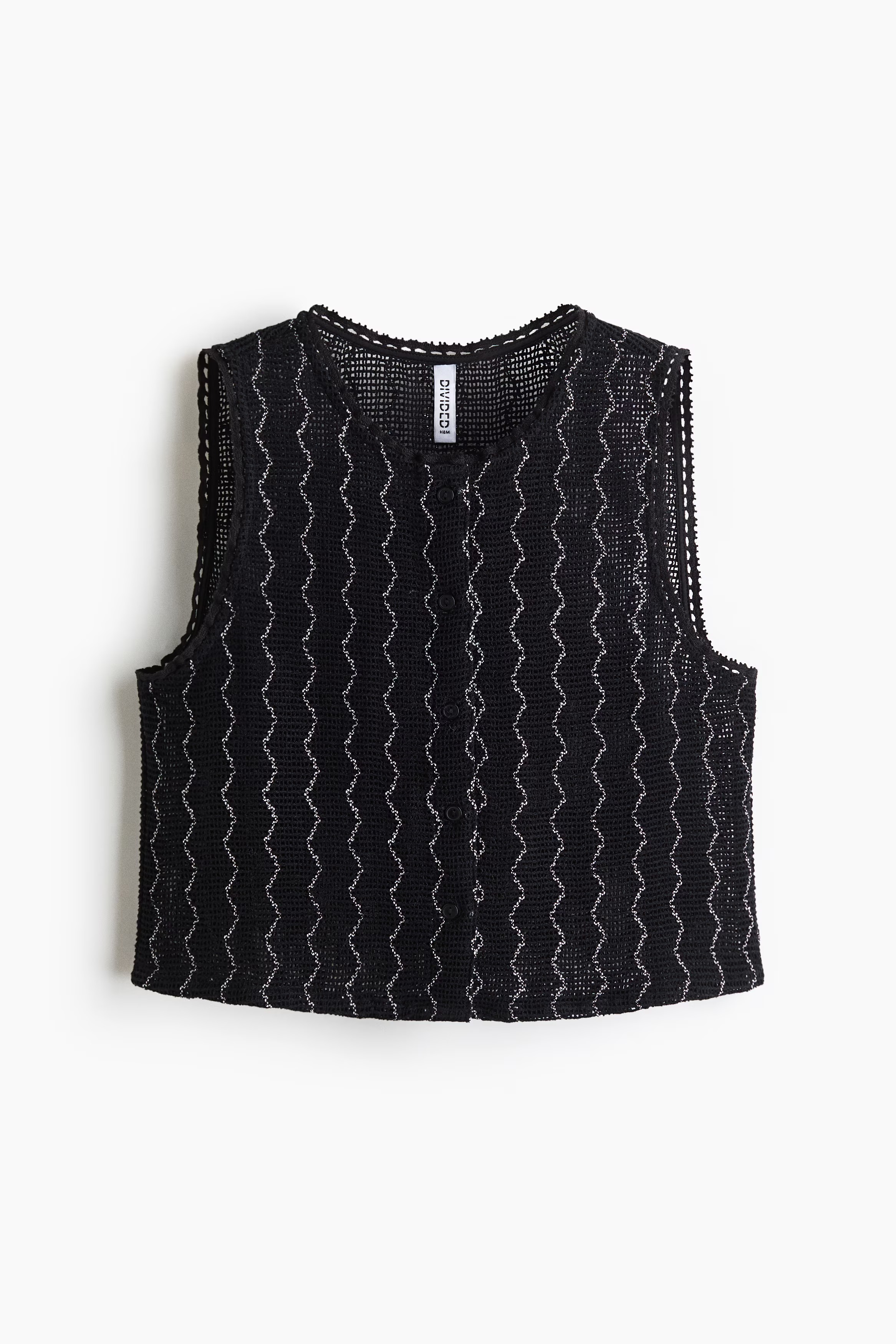
- **Fabric Physics:** The source garment is a semi-sheer, open-knit crochet or mesh texture. It possesses medium weight with low stiffness, resulting in a flexible drape that conforms to body contours without being clingy. Light interaction should be diffuse with no specular highlights; focus must be on high-frequency ambient occlusion to define the depth of the knit structure and the "holes" in the mesh.
- **Key Features:** The vertical white zigzag (chevron) stitching pattern against the black background is critical. The central vertical button placket, the scalloped/picot edging on the armholes and neckline, and the specific texture density of the mesh must be preserved. The "DIVIDED" label tag inside the neck should be disregarded/removed for realism.
PHASE 2: FIT & DRAPE SIMULATION
- **Body Mapping:** The garment is a sleeveless vest/waistcoat style. It needs to replace the current short-sleeved blouse. The drape should hang naturally from the shoulders, skimming the bust and falling towards the waist. Since the target user's current top is tucked in, the simulation must decide a hemline interaction; likely falling just above the hip, interacting with the top of the trousers. The user's bare arms must be digitally reconstructed where the current sleeves are removed.
- **Occlusion Handling:**
1. **Hair:** The user has dark hair falling over both shoulders and the upper chest; the vest must be rendered *underneath* these hair strands.
2. **Hands/Arms:** The user’s hands are clasped at the waistline/stomach. The lower portion of the vest must be masked *behind* the hands and forearms.
3. **Accessories:** The necklace and the red wristband must remain visible on the top layer.
PHASE 3: ENVIRONMENT & LIGHTING
- **Light Match:** The target environment uses indoor event lighting, seemingly diffuse and slightly cool (purple backdrop reflection) with a soft overhead source. The black values of the vest must be lifted slightly to match the black point of the user's environment to prevent "crushing" the texture details. Shadows generated by the vest onto the user's skin should be soft and directional (downward).
- **Color Calibration:** The source image is studio-lit (neutral white balance). The target image has a slight purple/blue color cast from the background. The white zigzag pattern on the vest must be color-graded to reflect a subtle tint of the ambient purple light to integrate naturally.
PHASE 4: IDENTITY PROTECTION
- **Facial Lock:** Absolute freeze on the facial region including eyes, nose, mouth, jawline, and the glasses. The user's skin tone on the face and neck must be preserved.
- **Body Integrity:** The user's shoulder width, bust volume, and arm thickness must remain unaltered. Digital inpainting of the upper arms (removing the old sleeves) must match the user's existing skin tone and texture exactly, without slimming or warping the limb structure.