
Thinking Process
PHASE 1: VISUAL DECONSTRUCTION
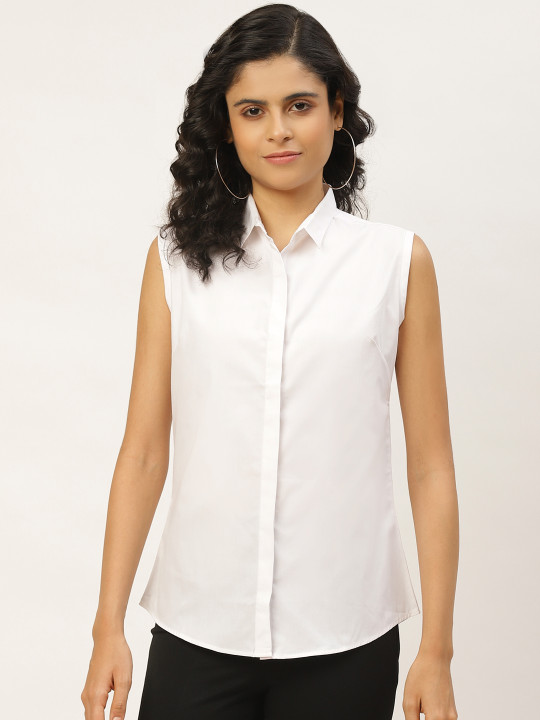
- **Fabric Physics:** The source garment is a structured cotton poplin or broadcloth blend. It possesses a matte finish with low reflectivity but distinct crispness. Unlike the user's current soft/draping knit top, this material holds its shape. The simulation must render a "stiffer" drape, particularly around the collar and button placket, avoiding fluid, silk-like ripples.
- **Key Features:** The sharp, structured shirt collar and the central button placket (white-on-white buttons) are the defining features. The sleeveless armhole stitching and the curved "shirttail" hemline must be preserved. The darts near the bust line in the source image must remain to indicate the tailored fit.
PHASE 2: FIT & DRAPE SIMULATION
- **Body Mapping:** The user is leaning slightly backward against a railing with arms extended. The new garment must settle against the torso, following gravity straight down from the chest peak, rather than clinging to the stomach. Because the user is leaning back, the back hem of the shirt should interact with the railing—potentially flattening slightly or bunching just above the rail contact point. *Critical Physics Note:* The simulation must account for the volume reduction; the current pink top is billowy, while the target white shirt is fitted. The silhouette must narrow to the user's actual torso size, requiring the generation of accurate skin texture on the arms where the current long sleeves will be removed.
- **Occlusion Handling:** The user's long dark hair falls over both shoulders and covers the upper right chest area (viewer's left). This hair mask must be segmented and layered *strictly over* the new white collar and shoulder fabric. The hands are positioned away from the torso and do not constitute an occlusion risk for the shirt itself.
PHASE 3: ENVIRONMENT & LIGHTING
- **Light Match:** The target environment is an outdoor setting with dappled natural daylight (sunlight filtering through trees). The lighting is soft and diffuse with a slight overhead directionality. The stark studio white of the source shirt must be tone-mapped to a softer, natural white that accepts the ambient cool daylight temperature and potential slight green bounce light from the surrounding foliage.
- **Color Calibration:** The white point must be lowered to match the exposure of the user's face. Shadows on the shirt should be soft and diffused, matching the contrast level seen on the user's black jeans, avoiding the harsh high-contrast shadows present in the studio source image.
PHASE 4: IDENTITY PROTECTION
- **Facial Lock:** The user's entire head, including facial structure, makeup, and expression, must remain pixel-perfectly frozen. The hair geometry must remain identical.
- **Body Integrity:** Do not slim or alter the user's underlying somatic structure. While the silhouette will naturally look slimmer due to the change from a loose top to a fitted shirt, the hip width and torso volume must reflect the user's actual anatomy, not the model's anatomy from the source image. The skin tone generated for the now-exposed arms must perfectly match the user's facial skin tone.