Thinking Process
PHASE 1: VISUAL DECONSTRUCTION
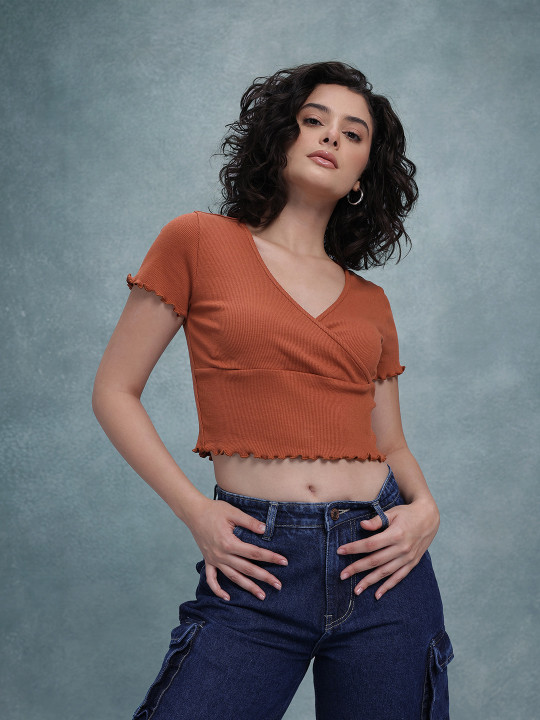
- **Fabric Physics:** The source garment is a ribbed knit jersey (likely cotton-spandex blend). It possesses high elasticity and matte reflectivity. Unlike the stiff structure of a jacket or the draping of silk, this fabric functions via "body-con" physics—it must stretch and contour tightly against the skin, exhibiting tension lines rather than loose folds. The ribbing texture provides anisotropic friction, meaning light will catch the vertical ridges while the valleys remain in shadow.
- **Key Features:**
1. **Lettuce-Edge Hemming:** The wavy, ruffled edges on the sleeves and bottom hem are non-negotiable geometry that must be preserved.
2. **Surplice Neckline:** The V-neck crossover construction must align centrally on the target's torso.
3. **Vertical Ribbing:** The texture map must not look flat; the vertical lines must warp cylindrically around the user's torso curvature.
4. **Crop Length:** The garment is shorter than the user's current top; the simulation must respect the cropped cut.
PHASE 2: FIT & DRAPE SIMULATION
- **Body Mapping:**
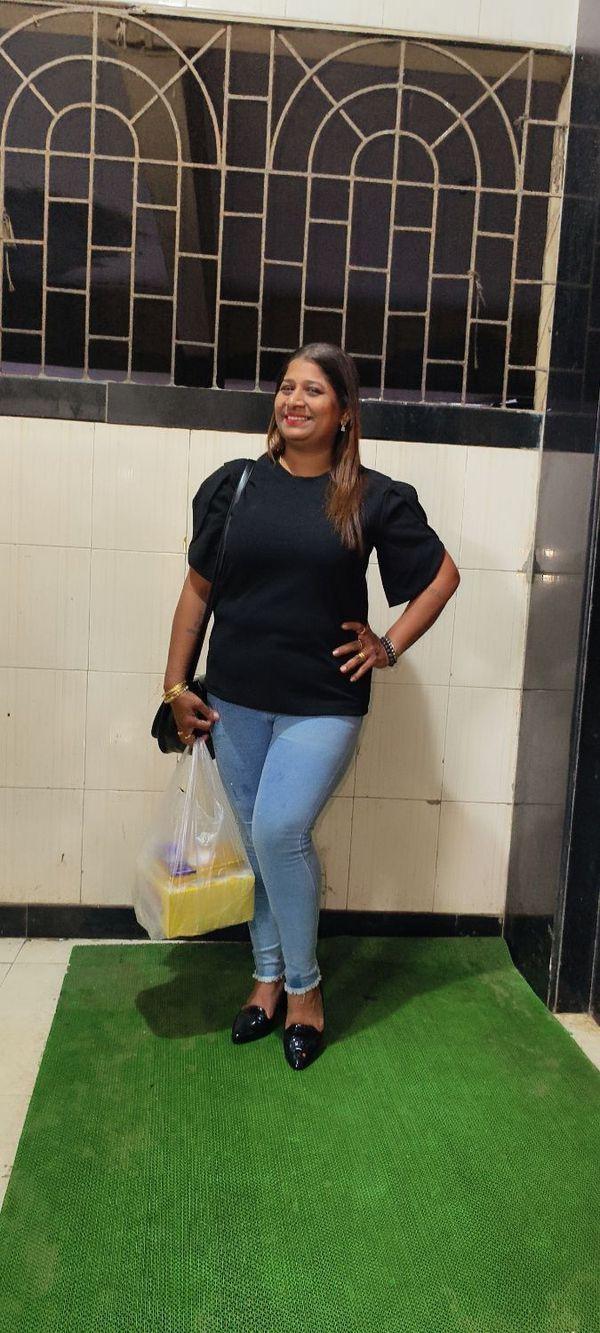
- **Torso:** The user has a slight rotation to her right. The garment texture must wrap accordingly.
- **Left Arm (Hand on Hip):** The fabric at the left axilla (armpit) and shoulder must compress and bunch slightly due to the lifted deltoid. The sleeve opening on this side will be angled upward.
- **Right Arm (Holding Bag):** The sleeve should hang vertically with gravity, relaxing the lettuce edge.
- **Midriff Handling:** Since the source is a crop top and the user's current black top covers her waist, the area between the new hemline and the jeans waistband requires generative in-painting of skin texture to replace the black fabric, strictly matching the user's skin tone.
- **Occlusion Handling:**
- **Hair:** The user's long hair falls over her left shoulder and chest area. This hair mask must be segmented and layered *on top* of the new garment.
- **Accessories:** The black bag strap crossing the user's right shoulder must be preserved and composited *over* the rust top.
- **Left Wrist/Hand:** While the hand is on the hip, it is likely below the hemline of this crop top, but any intersection with the ruffled hem must favor the hand occluding the fabric.
PHASE 3: ENVIRONMENT & LIGHTING
- **Light Match:** The user environment features overhead, slightly harsh artificial lighting (evident from the specular highlight on her forehead and the drop shadow on the wall). The new garment must shed the soft, diffuse studio lighting of the source and adopt a higher contrast shading model. Shadows should be cast downward and slightly to the viewer's right, accentuating the depth of the fabric's ribbing.
- **Color Calibration:** The source garment is a warm rust orange. The user's environment has cool/greenish undertones (green mat, white tiles). The garment's saturation should be slightly reduced, and a subtle cyan-green tint applied to the highlights to integrate it into the corridor's ambient light, preventing it from looking like a pasted sticker.
PHASE 4: IDENTITY PROTECTION
- **Facial Lock:** The user's face, neck, chin, and hair geometry are to be completely frozen. No retouching of the jawline or skin texture on the face is permitted.
- **Body Integrity:** The simulation must map the garment to the user's current volumetric dimensions. Strictly forbidden to slim the waist or arms to match the source model's physique. The garment stretches to fit the user; the user does not shrink to fit the garment.
