Thinking Process
PHASE 1: VISUAL DECONSTRUCTION
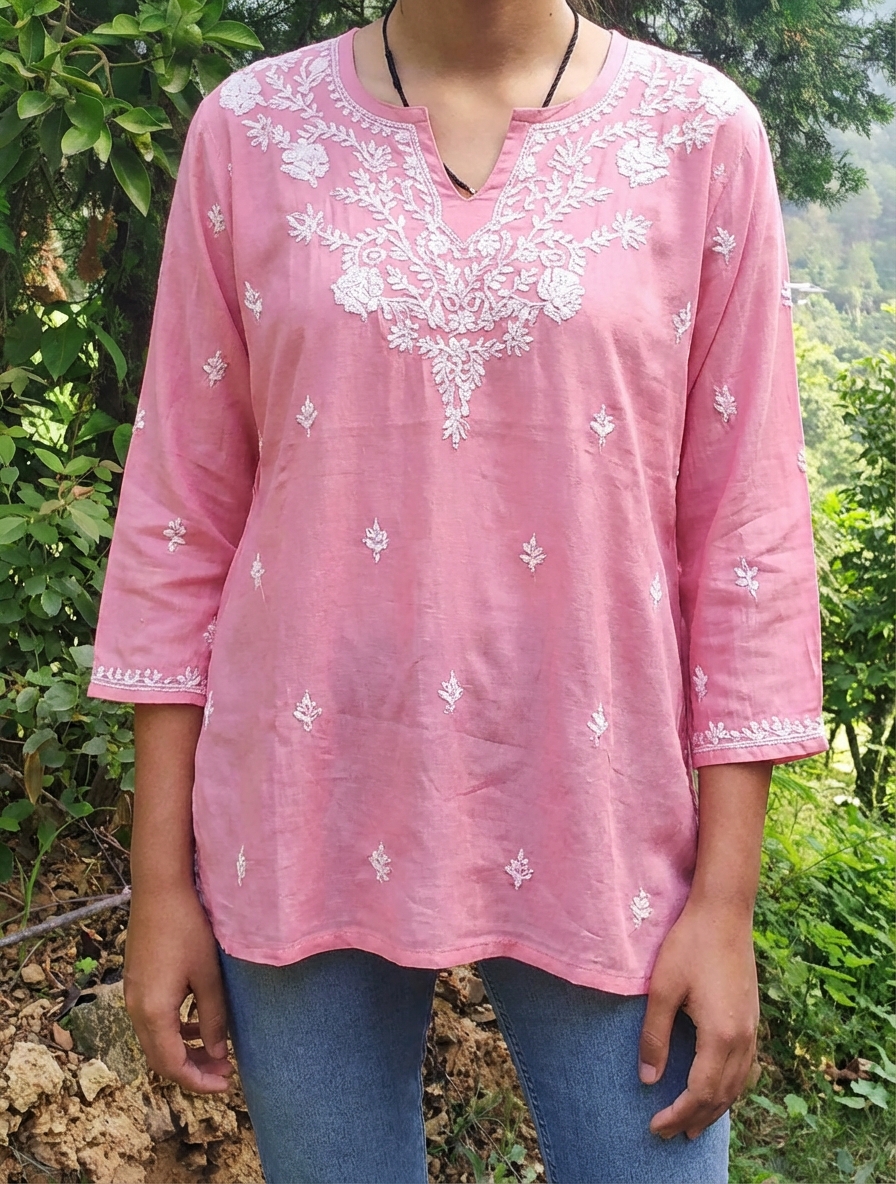
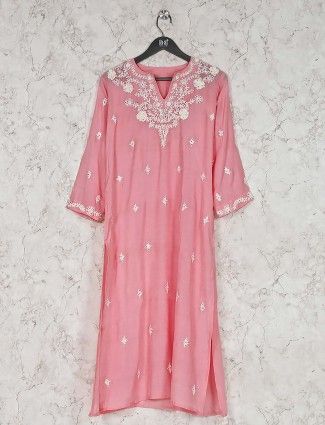
- **Fabric Physics:** The source garment appears to be a lightweight, semi-sheer fabric (likely Georgette, Chiffon, or soft Cotton blend) with a matte finish. It possesses low bending stiffness and high shear, meaning it should drape softly rather than holding rigid shapes. Light interaction should be diffuse with very minimal specular highlights; it is not shiny.
- **Key Features:** The intricate white Chikankari-style embroidery on the neckline and the scattered "butis" (small motifs) across the body must be preserved with high fidelity. The 3/4 length sleeves and the side slits (chalks) at the hemline are structural essentials that define the silhouette. The hemline is significantly longer than the user's current top.
PHASE 2: FIT & DRAPE SIMULATION
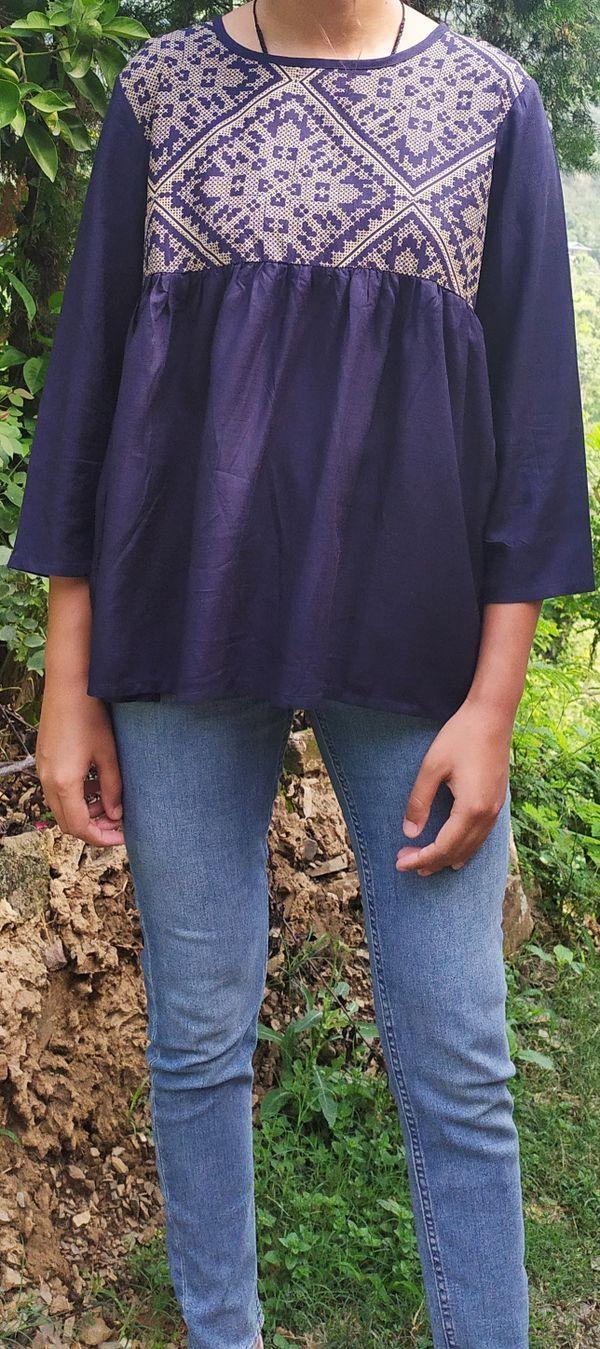
- **Body Mapping:** Unlike the user's current empire-waist top which flares out, the target pink kurta has a straighter, longer silhouette. The simulation must ignore the "puffiness" of the current blue top and drape the pink fabric closer to the user's actual torso and hips. Gravity will pull the fabric vertically; the hemline should extend down past the hips, covering the upper portion of the jeans. Sleeves should follow the cylindrical volume of the arms, showing slight tension at the shoulders and loosening toward the wrists.
- **Occlusion Handling:** The black cord necklace visible on the user's neck is a critical occlusion object; the new garment's neckline must sit *under* this cord, or the cord must be composited on top. The user's hands are free, but the kurta sleeves will cover the upper arms entirely. The bottom hem of the kurta must naturally occlude (cover) the pockets and zipper area of the jeans.
PHASE 3: ENVIRONMENT & LIGHTING
- **Light Match:** The user is in an outdoor environment with diffuse, natural daylight (likely shaded or overcast) creating soft, non-directional shadows. The new garment must shed its flat studio lighting and adopt this soft ambient occlusion. Shadows should be generated under the bust, inside the armpits, and cast onto the jeans where the kurta hem ends.
- **Color Calibration:** The studio-white balance of the pink cloth needs to be warmed slightly to match the outdoor color temperature. A very subtle green color bleed (bounce light) from the surrounding foliage should be calculated onto the edges of the pink fabric to integrate it into the scene realistically.
PHASE 4: IDENTITY PROTECTION
- **Facial Lock:** The user's chin, neck area, and the visible skin of the décolletage above the neckline must remain frozen pixel-perfect.
- **Body Integrity:** Strictly forbidden to alter the user's shoulder width, arm thickness, or hip width. The simulation must fit the cloth to the body, not warp the body to the cloth. The natural stance and skin tone of the hands must remain completely untouched.