
Thinking Process
PHASE 1: VISUAL DECONSTRUCTION
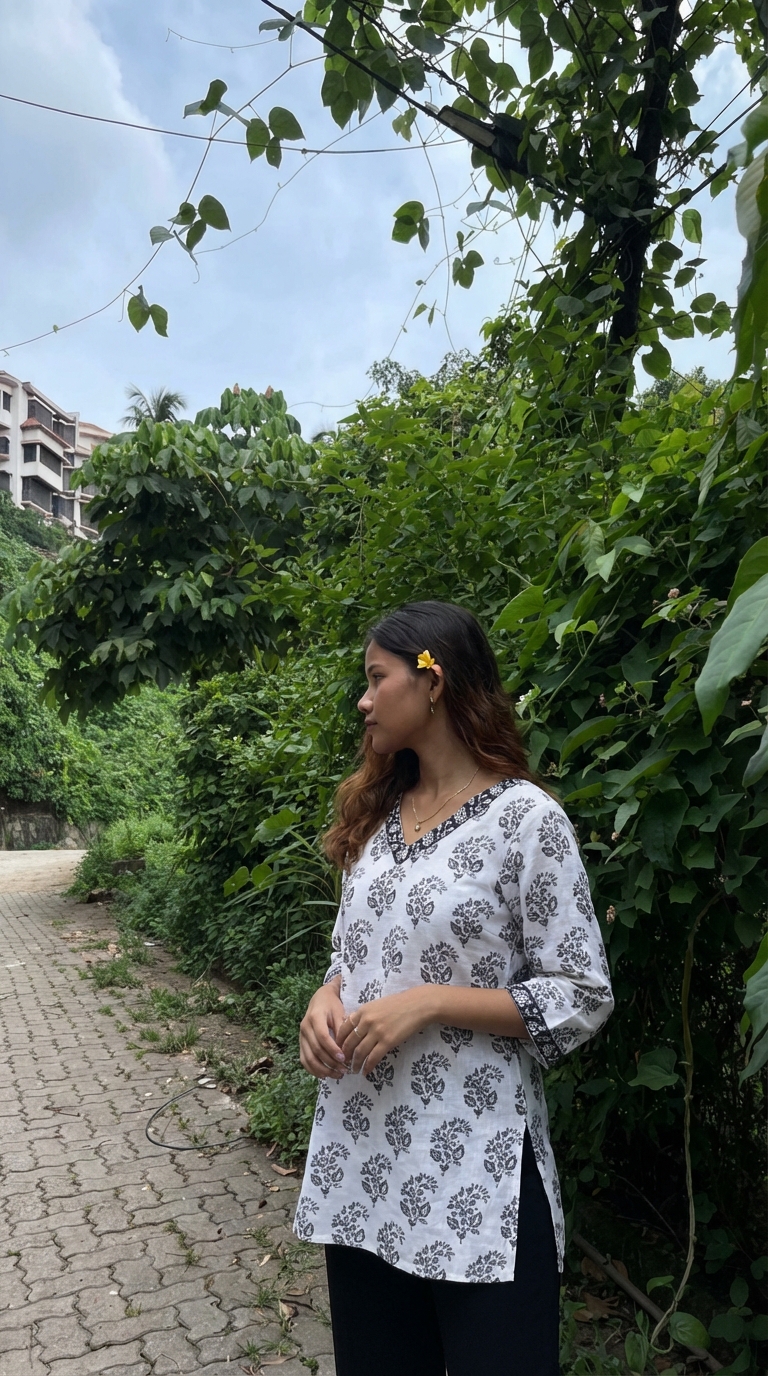
- **Fabric Physics:** The source garment appears to be a cotton or linen blend Kurti. It possesses a low-stiffness, matte finish with no specular highlights. The physics engine must simulate a "crisp but breathable" drape—meaning it holds its A-line shape slightly but creases sharply at compression points rather than flowing like fluid silk or stretching like spandex.
- **Key Features:** The distinctive V-neck border and matching cuff borders must be preserved with high fidelity. The floral block-print pattern must maintain aspect ratio without warping during the wrap. The side slits (vents) at the bottom hem are structurally significant and must be rendered to allow the garment to fall naturally over the hip/thigh area without ballooning.
PHASE 2: FIT & DRAPE SIMULATION
- **Body Mapping:**
- **Torso Alignment:** The user is in a 3/4 profile pose. The garment texture must be mapped cylindrically to wrap around the torso, distorting the front floral pattern slightly to account for the perspective turn.
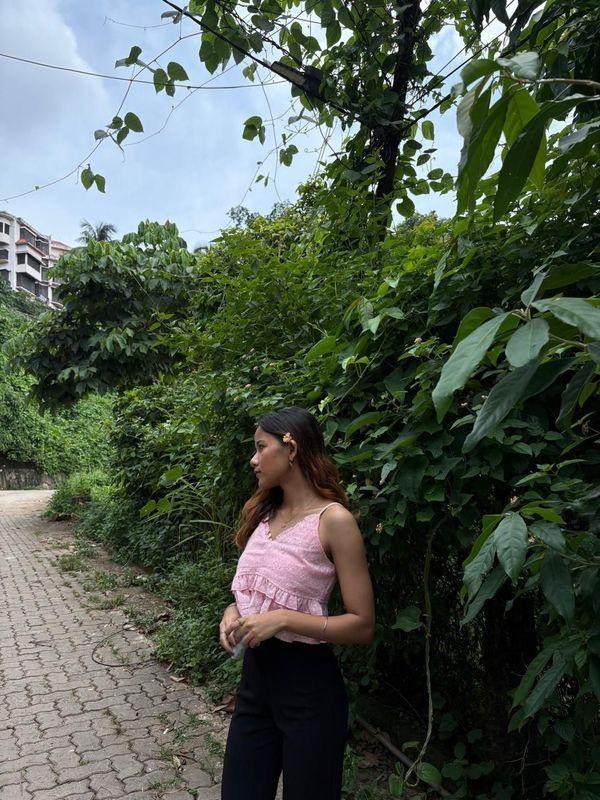
- **Length & Layering:** Unlike the current cropped top, the Kurti is tunic-length. It must drape *over* the waistline of the black pants, extending down to the upper thigh.
- **Arm Articulation:** The user's right arm is bent at approximately 90 degrees. The 3/4 sleeve of the Kurti must exhibit compression wrinkles at the inner elbow (antecubital fossa) and tension stretching across the outer elbow. The left arm is mostly obscured; the sleeve should hang naturally by the side.
- **Occlusion Handling:**
- **Hair:** The user has long, dark wavy hair falling over her back and right shoulder. This is a critical occlusion layer; the Kurti fabric must pass *underneath* the hair volume.
- **Accessories:** The delicate necklace fits within the V-neckline and should sit *on top* of the user's skin, visible above the garment.
- **Hands:** The user's right hand and wrist are interacting with the waist/phone. The sleeve cuff must end appropriately on the forearm and not clip through the hand or the object being held.
PHASE 3: ENVIRONMENT & LIGHTING
- **Light Match:** The user is in an outdoor, overcast/diffuse daylight environment. Lighting is soft and relatively flat with low contrast. The "studio white" of the source garment must be toned down to match the scene's exposure—likely slightly reducing brightness and shifting the white point to match the cool/blue ambient skylight.
- **Color Calibration:**
- **Green Bounce:** Due to the dense foliage surrounding the user, the white fabric of the Kurti must receive a subtle green color spill (global illumination) on the shadow sides to integrate realistically into the scene.
- **Black Point:** The black block print on the Kurti must match the black level of the user's existing pants and hair, ensuring it doesn't look like a high-contrast sticker.
PHASE 4: IDENTITY PROTECTION
- **Facial Lock:** Absolute freeze on the user's facial profile, jawline, ear, and the yellow flower tucked behind the ear. The skin tone on the neck and exposed chest area must be blended seamlessly with the new V-neckline.
- **Body Integrity:** The simulation must respect the user's petite frame. The Kurti is a relaxed fit; do not slim the garment to make it skin-tight, nor expand the user's body to fill the loose garment. The silhouette should show a loose-fitting tunic hanging naturally on a slim body.