Thinking Process
PHASE 1: VISUAL DECONSTRUCTION
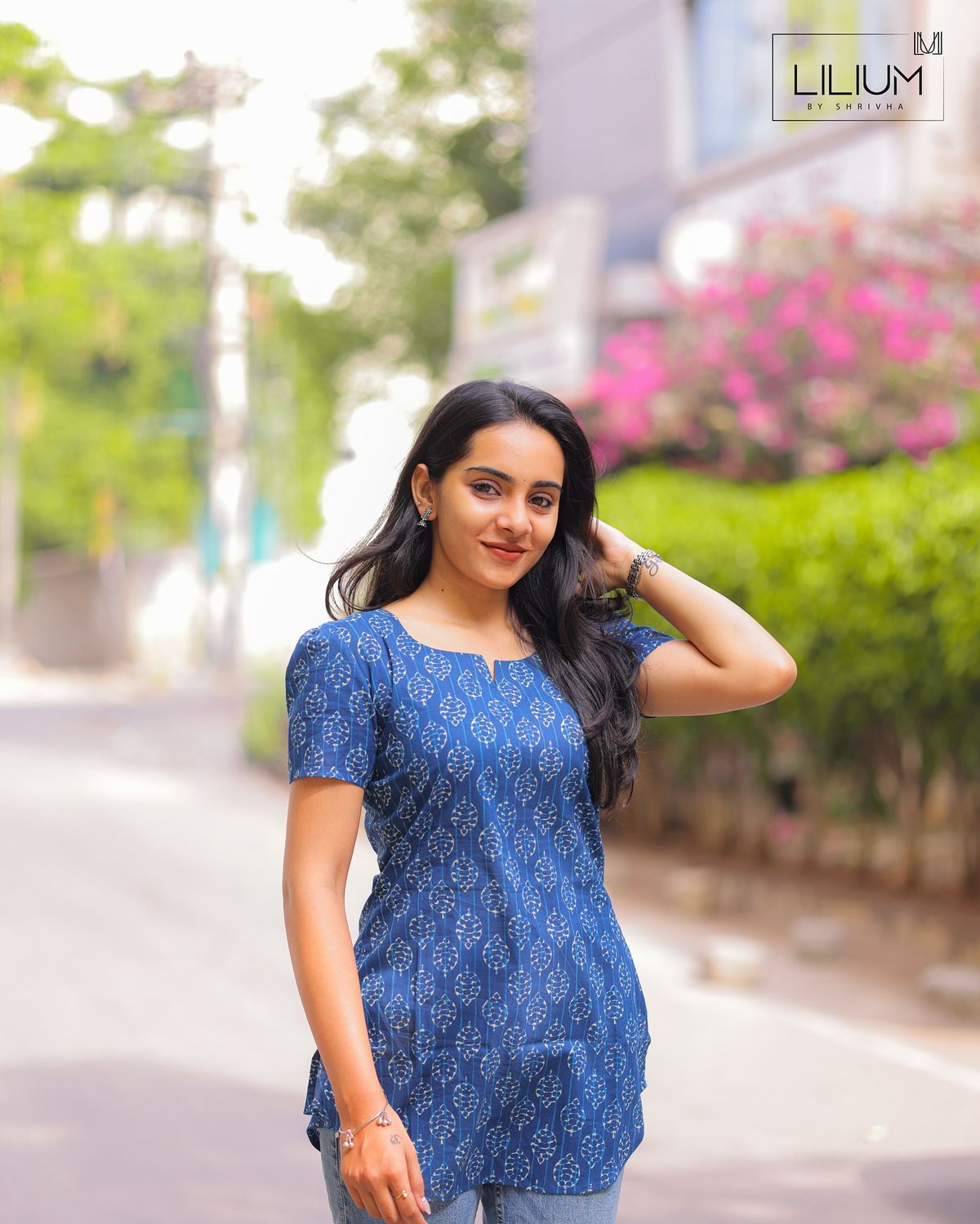
- **Fabric Physics:** The source garment is a cotton or cotton-blend 'Kurti' (tunic). It has a matte finish with low specularity (absorbs light rather than reflecting it). The fabric weight is medium-light; it possesses some structural stiffness to hold the sleeve shape but is pliant enough to drape vertically without clinging tightly to the midsection.
- **Key Features:**
- **Neckline:** Round neck with a distinctive central "V" notch slit.
- **Pattern:** Vertical columns of white leaf/paisley motifs on a medium-blue background.
- **Sleeves:** Short sleeves (mid-bicep length), unlike the user's current long sleeves.
- **Length:** This is a tunic-length garment; the hemline must extend below the waist to the upper thigh/hip area, covering the waistband of the jeans.
PHASE 2: FIT & DRAPE SIMULATION
- **Body Mapping:**
- **Torso:** The garment is a tunic, not a fitted crop top. It must flow over the user's waist indentation and hang relatively straight down to the hips, following gravity rather than the body's curvature at the lower back.
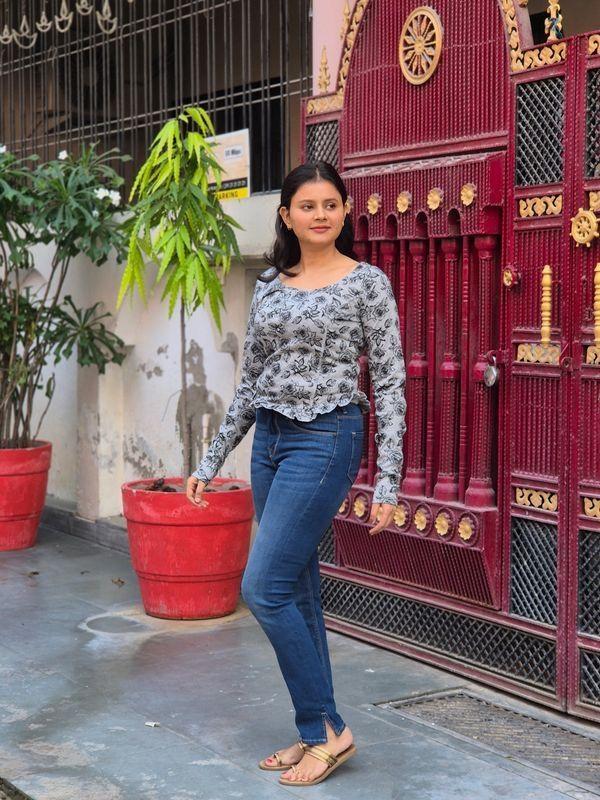
- **Sleeve Transition:** The simulation requires generative inpainting for the user's arms. The current long grey sleeves must be removed, and the user's skin texture must be reconstructed from the mid-bicep down to the wrist to accommodate the source's short sleeves.
- **Shoulders:** The shoulder seam must align with the user's natural shoulder line, maintaining the slight backward lean of her upper body.
- **Occlusion Handling:**
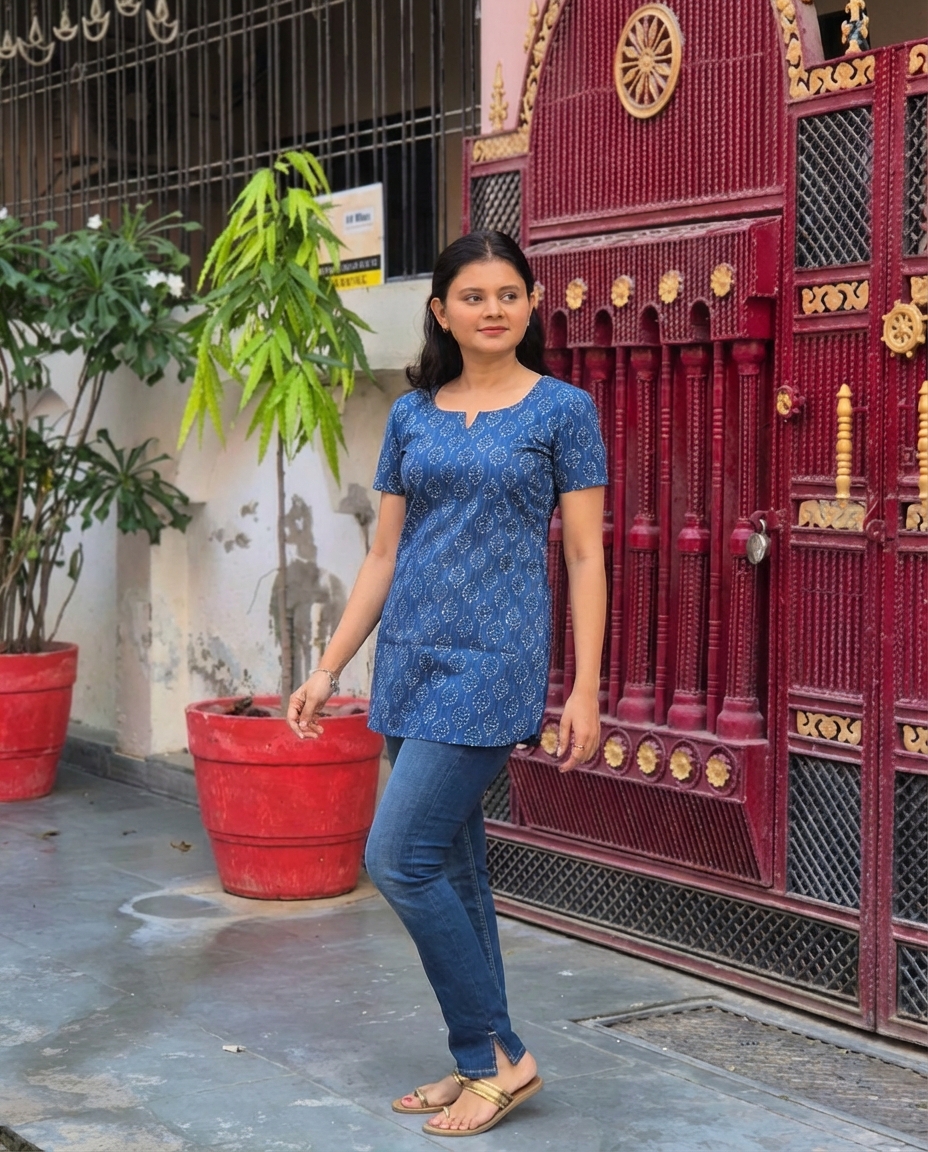
- **Hair:** The user's dark hair drapes behind her shoulders and slightly over the left trapezius. These hair strands must be segmented and layered *over* the new blue fabric to maintain realism.
- **Arms:** The user's arms hang freely by her sides; the new garment must pass behind the forearms at the hip level if the tunic is wide, ensuring no clipping occurs between the cloth and the inner arm.
PHASE 3: ENVIRONMENT & LIGHTING
- **Light Match:** The user is in an outdoor environment with soft, diffuse daylight coming from the front-left. The new garment must render with soft, non-harsh shadows. The shading should be darker on the user's right side (away from the light source) and under the bust.
- **Color Calibration:** The source image is high-contrast and cool-toned. The target environment has warm reflections from the red gate. The blue of the kurti must be slightly warmed and desaturated to integrate with the ambient light of the paved courtyard, picking up subtle warm bounce light from the red gate on the right side.
PHASE 4: IDENTITY PROTECTION
- **Facial Lock:** Absolute freeze on the facial region (eyes, nose, mouth), jawline, and neck structure. The hairline and ear visibility must remain untouched.
- **Body Integrity:** The user's skeletal structure, specifically shoulder width and arm thickness, must remain 1:1. Do not slim the waist or hips to fit the tunic; the tunic must adapt to the user's existing silhouette. The generative reconstruction of the bare forearms (due to sleeve length change) must match the skin tone of the user's face and feet.