Thinking Process
PHASE 1: VISUAL DECONSTRUCTION
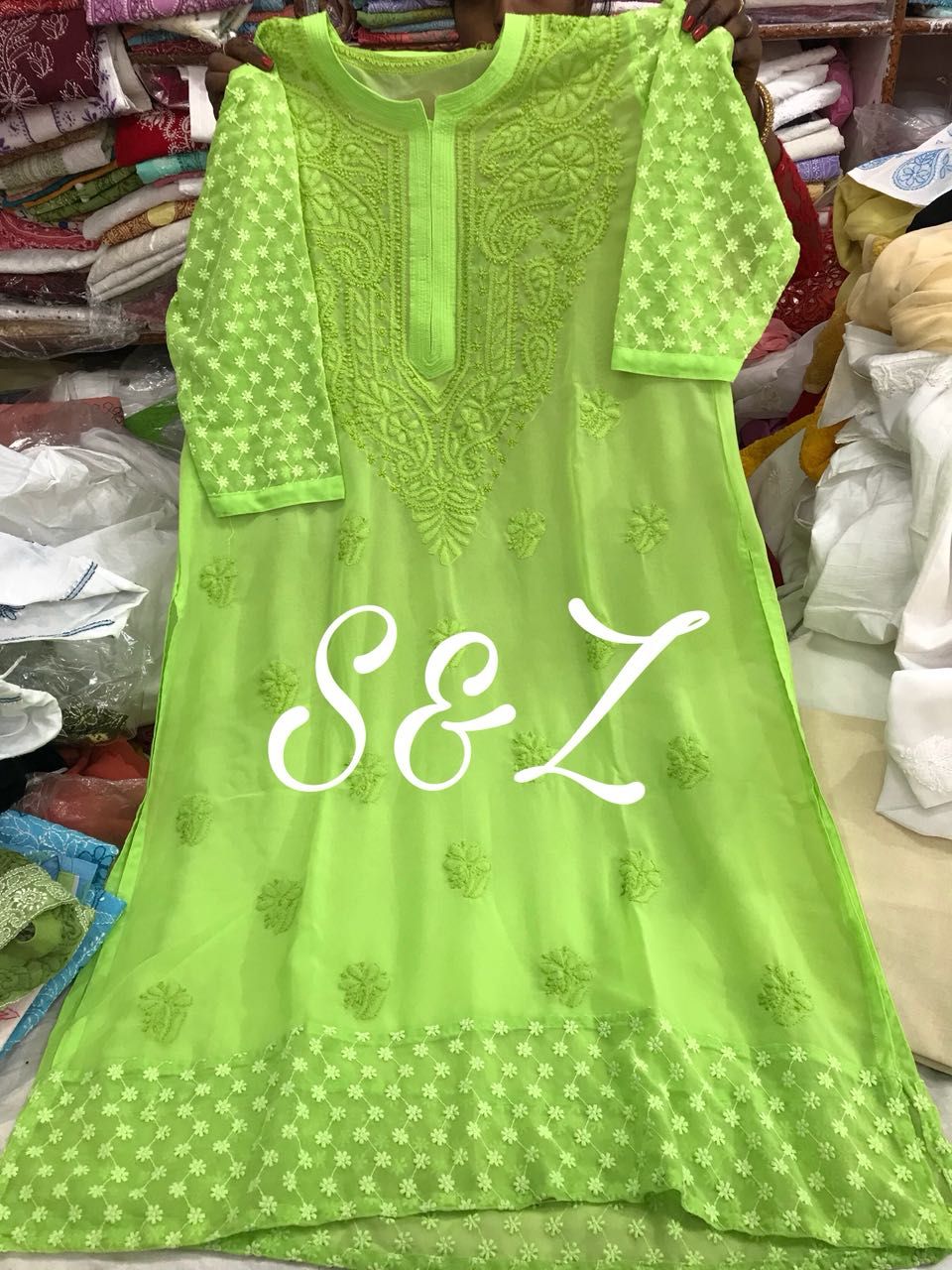
- **Fabric Physics:** The source garment is a semi-sheer, lightweight georgette or chiffon material typical of Chikankari kurtas. It possesses high flow and drape characteristics, lacking structural stiffness. The rendering must account for subsurface scattering and partial transparency, particularly in the sleeve areas where skin needs to be faintly visible beneath the fabric. The texture requires a matte finish with specular highlights only on the embroidery threads.
- **Key Features:**
- Intricate "Chikankari" embroidery (white thread work on green fabric) on the yoke, sleeves, and bottom hem must be preserved with 3D normal mapping to show thread elevation.
- The specific neckline shape (round with a vertical slit) must replace the current V-neck structure.
- The extensive bottom hem embroidery panel must be retained.
- **Critical:** The large white "S & Z" watermark overlay on the source image must be algorithmically removed and texture-filled to match the green fabric.
PHASE 2: FIT & DRAPE SIMULATION
- **Body Mapping:**
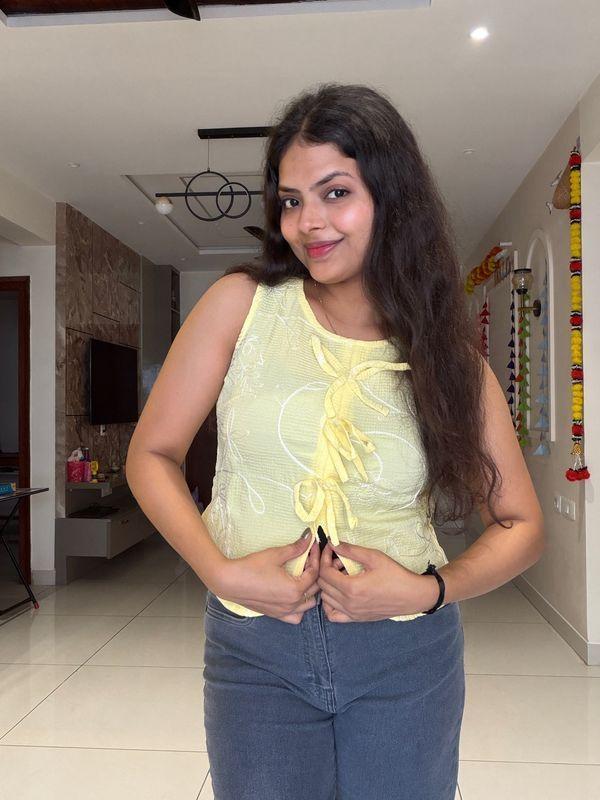
- **Sleeve Generation:** The target is currently sleeveless; the simulation must generate realistic long sleeves that follow the contour of the user's arms, wrinkling at the inner elbow bend (cubital fossa) due to the bent-arm pose.
- **Length Extension:** The source is a long kurta (tunic), whereas the user is wearing a waist-length crop top. The VTO must extend the fabric well past the waist, draping over the hips and upper thighs, covering the top portion of the jeans.
- **Tension Points:** Fabric tension needs to be simulated across the chest due to the fit, and slight bunching should occur at the waist where the hands are pressing against the torso.
- **Occlusion Handling:**
- **Hair:** The user's long, dark, wavy hair cascading over her left shoulder (viewer's right) is a hard occlusion layer. The green kurta must pass *under* this hair volume without altering the hair strands.
- **Hands:** The user's hands are actively gripping/touching her midsection. The new garment must appear to be *under* the hands. The physics engine must calculate cloth collision at the fingertips, potentially showing the kurta fabric slightly compressed or gathered where the fingers press in.
PHASE 3: ENVIRONMENT & LIGHTING
- **Light Match:** The user is in an environment with overhead, warm-toned artificial recessed lighting (downlighting). Shadows on the new garment must be cast downwards (e.g., under the bust, under the sleeve folds). The embroidery needs to catch this overhead light to create micro-shadows, enhancing the texture depth.
- **Color Calibration:** The source garment is a high-saturation neon/lime green. To prevent it from looking like a "flat sticker," the saturation must be slightly desaturated and warmed to match the ambient room temperature (approx. 3000K-3500K). The brightness of the green must be modulated to reflect the indoor exposure levels of the user image.
PHASE 4: IDENTITY PROTECTION
- **Facial Lock:** Absolute freeze on the facial region (eyes, nose, lips, cheeks) and the neck area above the garment neckline. The skin tone on the face must remain consistent with the skin tone visible through the sheer sleeves.
- **Body Integrity:** The user's waist width and arm volume must be preserved. The simulation must fit the cloth to the body, not warp the body to the cloth. No slimming filters or structural changes to the torso silhouette are permitted.
