Thinking Process
PHASE 1: VISUAL DECONSTRUCTION
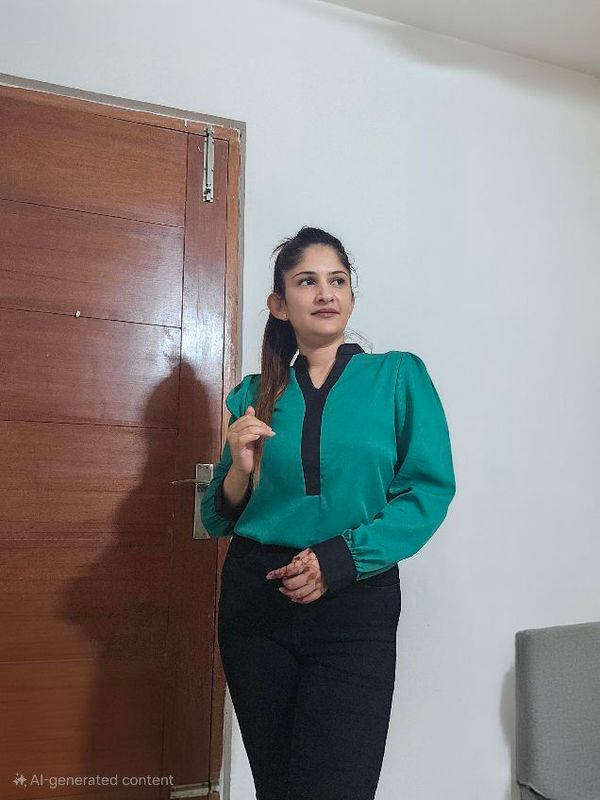
- **Fabric Physics:** The source garment appears to be a polyester crepe or soft synthetic blend. It possesses a semi-matte finish with low-to-medium specular highlights (soft sheen, not glossy). It has medium weight, allowing for distinct folding without appearing stiff; it should drape fluidly rather than holding a rigid shape.
- **Key Features:** The contrasting black V-neck placket extending down the chest and the matching black cuffs are critical structural elements. The bishop-style sleeves (gathering at the shoulder and wrist) must be preserved. The solid emerald green color uniformity must be maintained, reconstructing the center-chest area currently obscured by the source model's hand.
PHASE 2: FIT & DRAPE SIMULATION
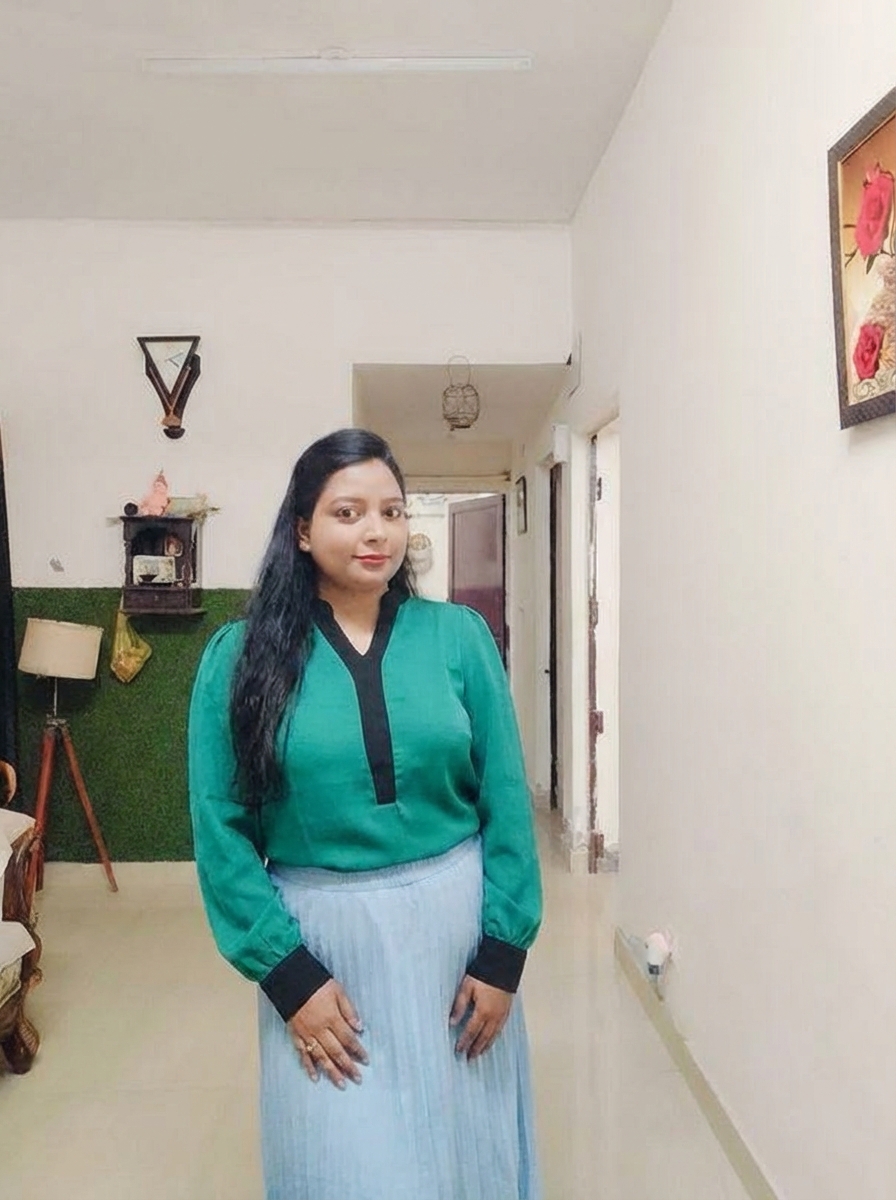
- **Body Mapping:** On the target user, the garment must follow the natural gravity of her standing pose. The shoulder seams should align with her acromion process. The fabric on the sleeves must extend fully to the wrist, bunching slightly above the black cuffs due to the bishop style. Since the target is wearing a high-waisted skirt, the simulation should ideally render the top tucked in or cropped at the waistline to respect the skirt's volume.
- **Occlusion Handling:** The user's long dark hair falls behind her shoulders, so shoulder occlusion is minimal, but the collar area must sit under the jawline shadow. The user's hands rest near the hips; the garment's hem or lower folds must be rendered *behind* the hands/wrists if untucked, or cleanly disappear into the skirt waistband if tucked.
PHASE 3: ENVIRONMENT & LIGHTING
- **Light Match:** The target environment utilizes diffuse, overhead indoor lighting (likely a tube light), casting soft, downward shadows. The new green garment must generate self-shadowing in the armpits, under the bust, and within the sleeve folds that matches the ambient occlusion of the room. The light direction is top-down.
- **Color Calibration:** The source image lighting is cooler/whiter than the target room's slightly warmer tone. The emerald green must be color-graded to reflect the warmer ambient light of the user's room to avoid a "cut-and-paste" artifact look. The black trim must remain deep black and not washed out by the room's fill light.
PHASE 4: IDENTITY PROTECTION
- **Facial Lock:** Absolute pixel preservation required for the user’s entire head region, including the hairline, facial features, and neck structure up to the clavicle.
- **Body Integrity:** The user's body proportions (shoulder width, arm thickness, waist circumference) must remain unaltered. The simulation must drape the cloth *over* the user's existing volume, strictly forbidding any slimming filters or warping of the user's underlying anatomy to fit the garment.