Thinking Process
PHASE 1: VISUAL DECONSTRUCTION
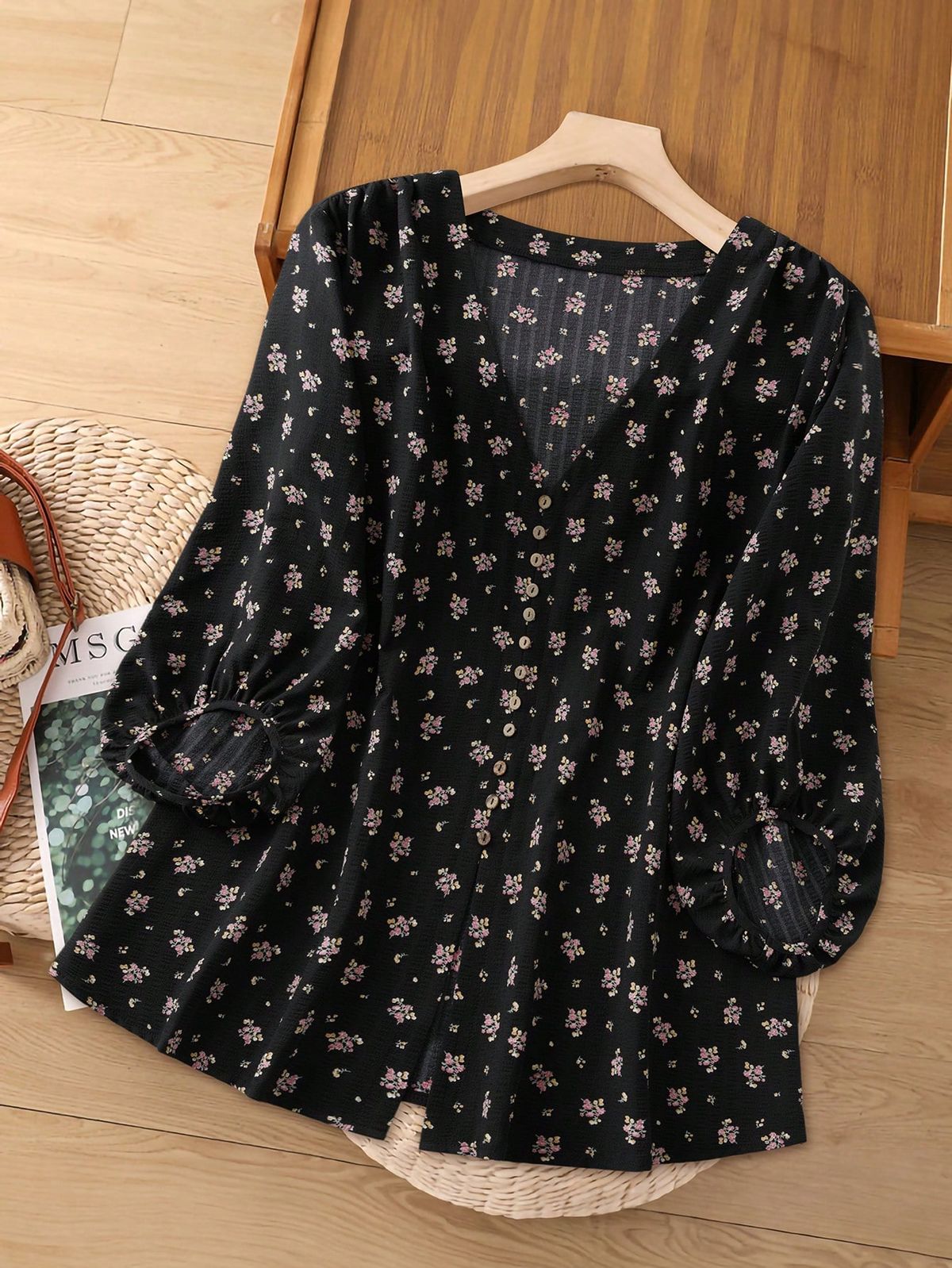
- **Fabric Physics:** The source garment appears to be a lightweight, textured crepe or rayon blend with a matte finish. It possesses low structural rigidity, meaning it relies heavily on gravity for its shape. It should not exhibit specular highlights (shine) like silk, but rather diffuse, soft light scattering. The fabric simulation must account for a "crinkle" texture map to replicate the surface irregularity visible in the flat lay.
- **Key Features:**
- **Central Button Placket:** The row of small, contrasting buttons down the center front is a rigid anchor point and must deform linearly with the torso's curvature.
- **Bishop Sleeves:** The elasticated/cinched cuffs create volume above the wrist. This gathering is essential to the silhouette.
- **Floral Pattern:** The small pink/purple floral print density must remain consistent and wrap correctly around the cylindrical volume of the torso and arms without warping.
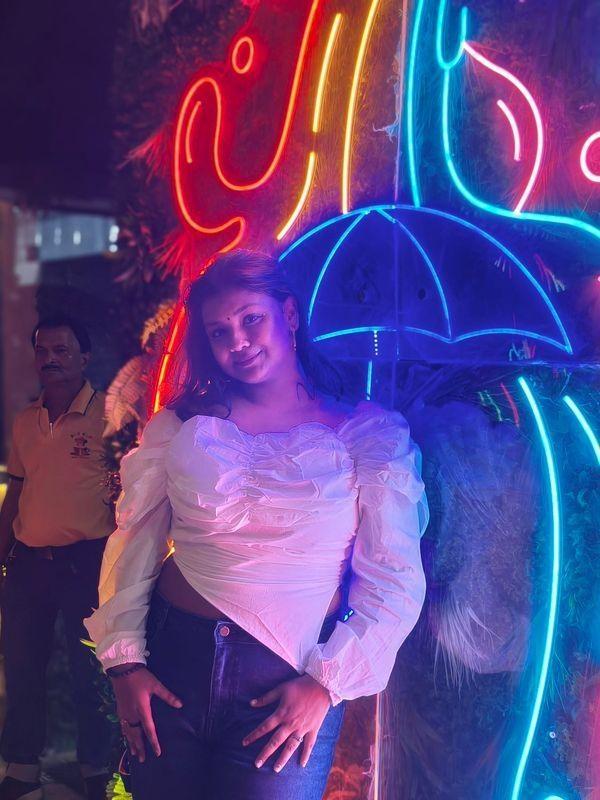
- **V-Neckline:** The depth of the V-neck must be calculated relative to the user's clavicle, sitting higher than the current off-shoulder garment.
PHASE 2: FIT & DRAPE SIMULATION
- **Body Mapping:**
- **Shoulder Reconstruction:** The target user is currently wearing an off-the-shoulder top. The simulation must infer the position of the trapezius and deltoids to properly hang the full shoulder of the source blouse.
- **Torso Drape:** Unlike the current tight, cropped bodice, the source garment is a relaxed tunic fit. It must drape vertically from the chest, bridging the gap over the currently exposed midriff and overlapping the waistband of the jeans.
- **Sleeve Interaction:** The fabric should hang loosely from the shoulder, tapering only at the wrists where the elastic sits. Given the user's arms are relaxed downwards, the fabric must pool slightly above the wrist cuffs due to gravity.
- **Occlusion Handling:**
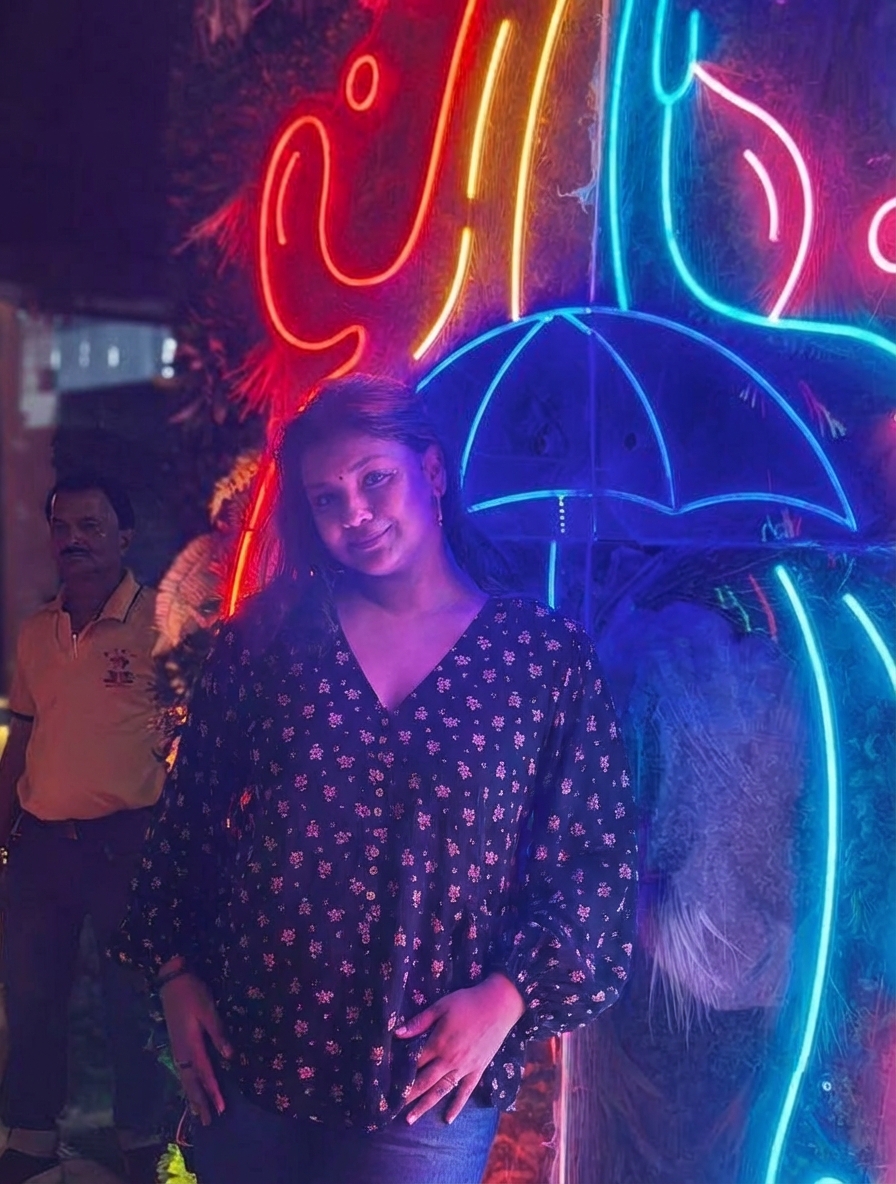
- **Hair:** The user has long hair flowing over her left shoulder (viewer's right) and behind the neck. This hair mask must be segmented with high precision and composited as the top layer *over* the new black blouse.
- **Hands:** The user's hands are resting on her upper thighs. Depending on the final length of the blouse, the hemline may interact with the thumbs/fingers. The hands must serve as a collision object; the fabric must either drape behind them or the hands must be masked *over* the garment hem.
PHASE 3: ENVIRONMENT & LIGHTING
- **Light Match:** The target environment contains complex, high-contrast neon lighting.
- **Left Side (Viewer's Left):** Strong warm/red neon rim lighting must be applied to the left sleeve and torso side of the black garment.
- **Right Side (Viewer's Right):** Cool blue/cyan neon lighting must hit the right shoulder and arm.
- **Ambient:** The deep black of the source cloth must be lifted to a dark purple/navy tone in the shadows to match the ambient light color of the room, rather than appearing as pure RGB(0,0,0).
- **Color Calibration:** The pink and purple flowers on the source garment must be color-graded to interact with the neon light sources. The pink flowers should glow slightly under the red light, while becoming muted under the blue light.
PHASE 4: IDENTITY PROTECTION
- **Facial Lock:** The user's face, neck, and specific lighting artifacts on her skin (the red/blue highlights on her cheeks and jawline) must be masked and frozen. No generative changes are permitted above the clavicle line.
- **Body Integrity:** The user's shoulder width, hip width, and arm volume must be preserved. The simulation acts as a cloth layer *on top* of the existing voxel body shape; no slimming, warping, or skeletal restructuring of the target person is allowed. The visible denim jeans below the new hemline must remain untouched.