Thinking Process
PHASE 1: VISUAL DECONSTRUCTION
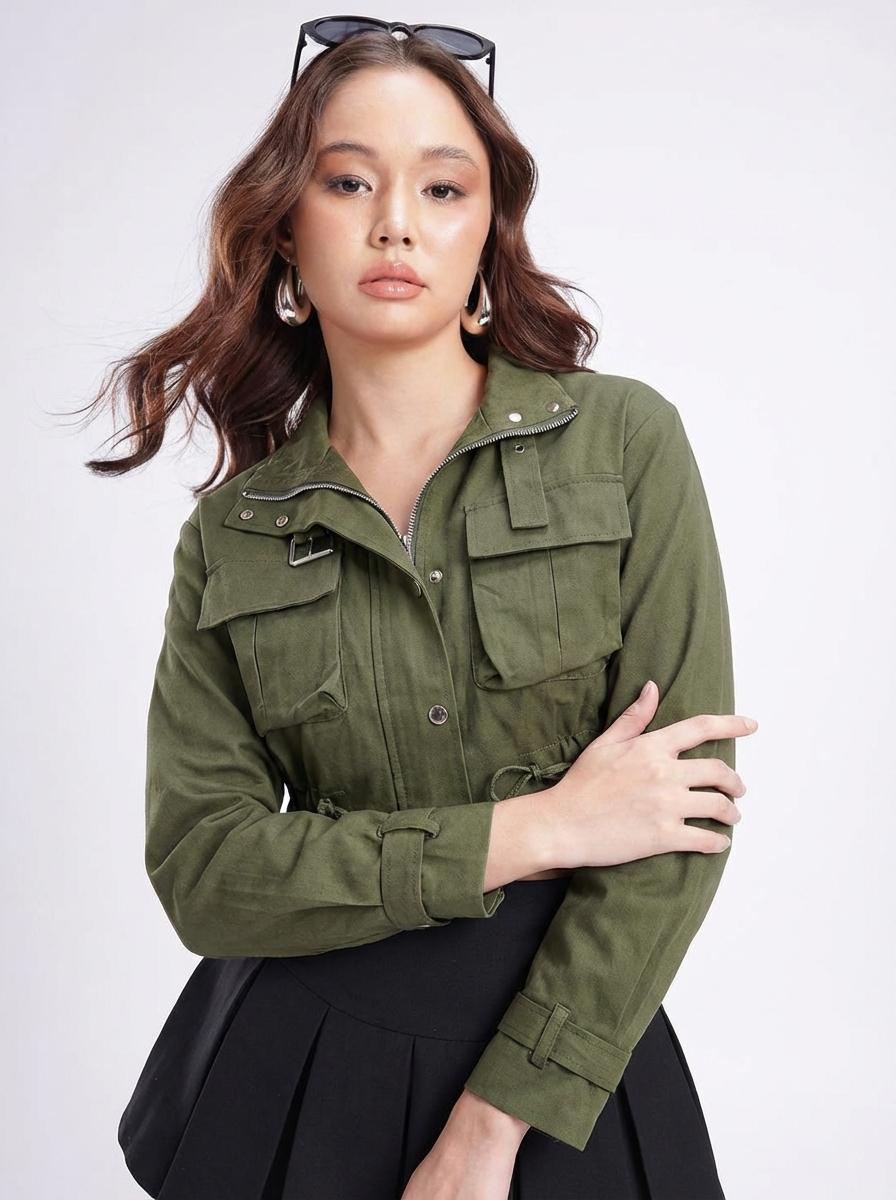
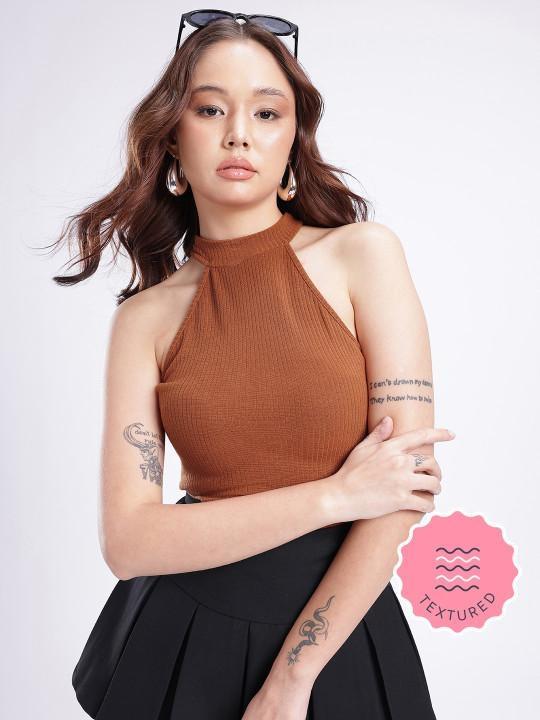
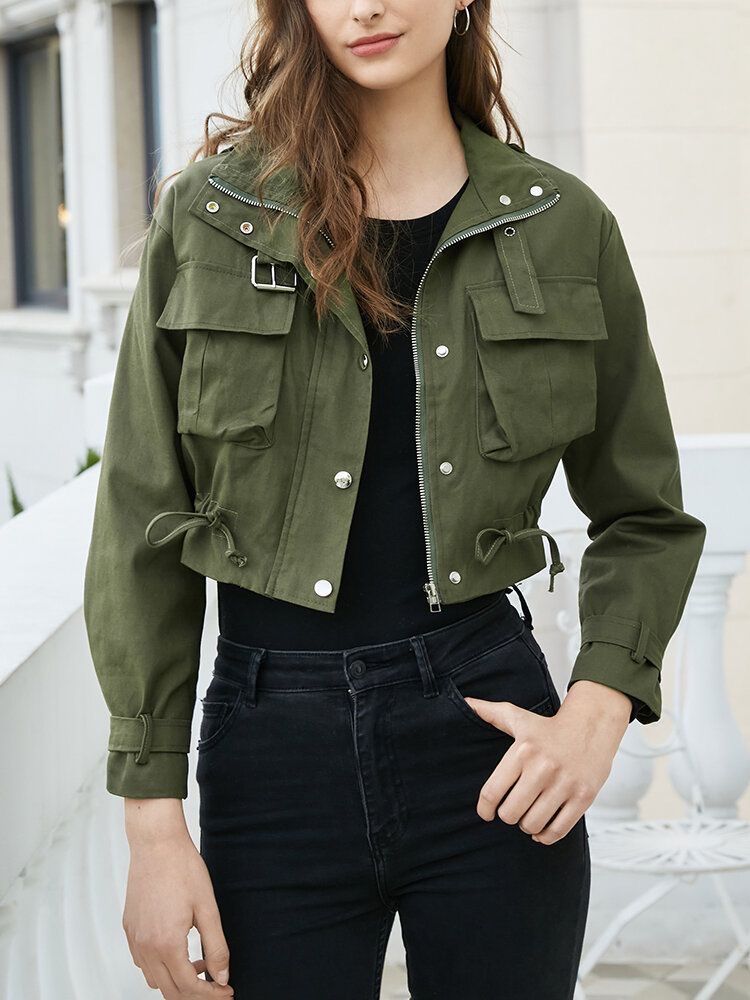
- **Fabric Physics:** The source garment is a medium-weight cotton twill or canvas utility jacket. It possesses high structural rigidity (stiffness) compared to the user's current knit top. It acts as a matte surface, diffusing light rather than reflecting it speculatively. The fabric will not cling to the skin but will create angular folds at stress points.
- **Key Features:** The transfer must preserve the large 3D patch pockets with flaps on the chest, the silver snap buttons, the zippered front, the drawstring toggles at the cropped waistline, and the buckle/strap detail on the cuffs. The standing/structured collar is a critical silhouette element that must replace the current halter neckline.
PHASE 2: FIT & DRAPE SIMULATION
- **Body Mapping:**
- **Shoulders & Arms:** The jacket must replace the bare skin of the arms. Given the stiff fabric, the sleeves should not be skin-tight; they must show volume around the biceps.
- **Elbow Articulation:** On the user's left arm (bent across the waist), the fabric must generate deep, transverse compression creases at the inner elbow and stretch tension across the outer elbow.
- **Hemline:** The jacket is cropped. It should hang slightly away from the user's waist due to material stiffness, hovering just above the waistband of her skirt.
- **Occlusion Handling:**
- **Hair Layering:** The user's wavy brown hair falls over both shoulders. The hair mask must be generated and layered *over* the collar and shoulders of the new jacket.
- **Hand-Over-Sleeve:** The user's left hand is resting on her right forearm. The simulation must render the new right sleeve *underneath* the user's left hand fingers, while the user's left arm must be clothed in the new left sleeve.
- **Skirt Waistband:** The top of the black pleated skirt must be preserved where the cropped jacket ends; the jacket should not arbitrarily extend over the skirt unless the physics dictate a loose overhang.
PHASE 3: ENVIRONMENT & LIGHTING
- **Light Match:** The user is in a soft, high-key studio environment with diffuse lighting coming from the front-left. The source jacket has directional outdoor lighting. The jacket's self-shadows (under pocket flaps and collar) must be softened and lightened to match the low-contrast environment of the user image.
- **Color Calibration:** The olive green of the jacket must be color-graded to retain its earthy tone but adjusted for the cooler, pink-tinted white balance of the user's photo. The silver hardware (buttons/zippers) needs to reflect the ambient white studio light, not the outdoor sky of the source.
PHASE 4: IDENTITY PROTECTION
- **Facial Lock:** Absolute freeze on the facial region from the chin up, including the neck shape, ears, and the sunglasses resting on top of the head.
- **Body Integrity:** The user's shoulder width and skeletal structure must remain unchanged. While the jacket adds fabric volume, the underlying biomechanics (arm thickness, waist width) must not be slimmed or warped to match the source model's thinner frame. The tattoos on the left arm will be naturally covered by the opaque fabric of the jacket sleeves.