Thinking Process
PHASE 1: VISUAL DECONSTRUCTION
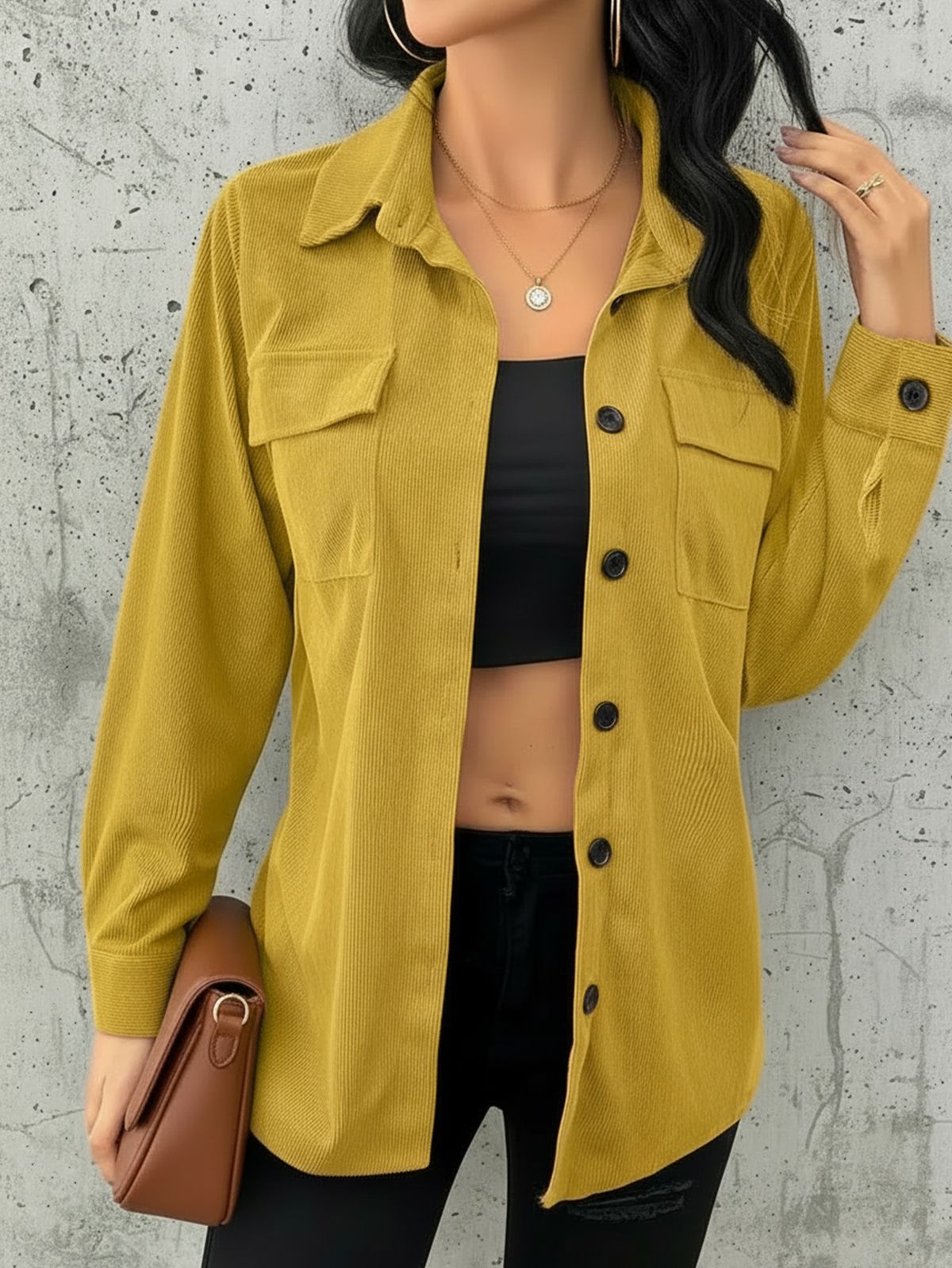
- **Fabric Physics:** The source garment is a heavy-weight corduroy (likely cotton blend). It possesses high bending stiffness and shear resistance, unlike the user's current lightweight, semi-sheer fabric. The material has a matte base with anisotropic specular highlights running vertically along the "wales" (ridges) of the corduroy texture. It will not flutter or cling; it will hold a structured, boxy shape.
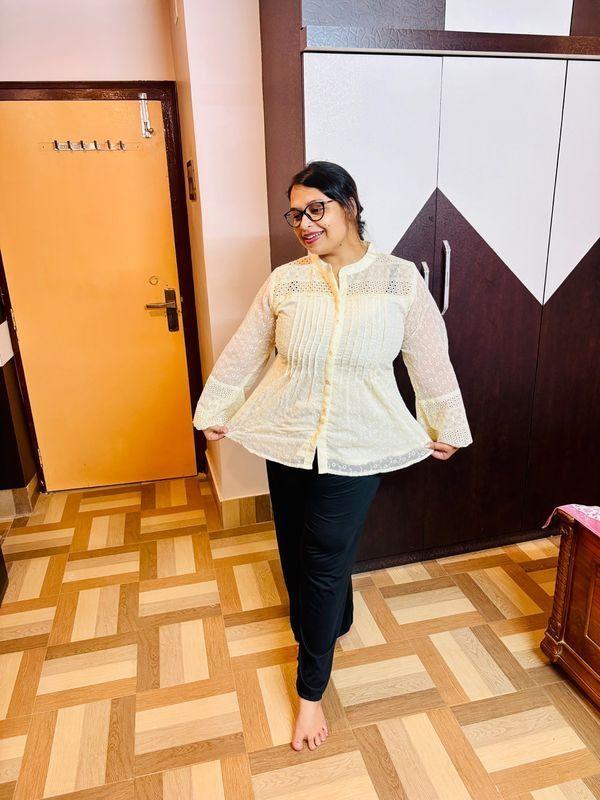
- **Key Features:** The two large front breast pockets with flaps, the pointed collar, and the contrasting black buttons are critical fiducial points. The vertical ribbed texture must be preserved without aliasing. The buttoned cuffs and the distinct hemline stitching of the "shacket" style must replace the user's current frilled/gathered hem.
PHASE 2: FIT & DRAPE SIMULATION
- **Body Mapping:** The jacket has a looser, boyfriend-style cut. Unlike the user's current cinched-waist top, the new garment should drape vertically from the shoulders, skimming over the bust and waist without gathering. The fabric rigidity means it will break (crease) sharply at the elbow bend rather than bunching softly. The shoulders should align with the user's acromion processes but maintain the source's slightly dropped-shoulder silhouette.
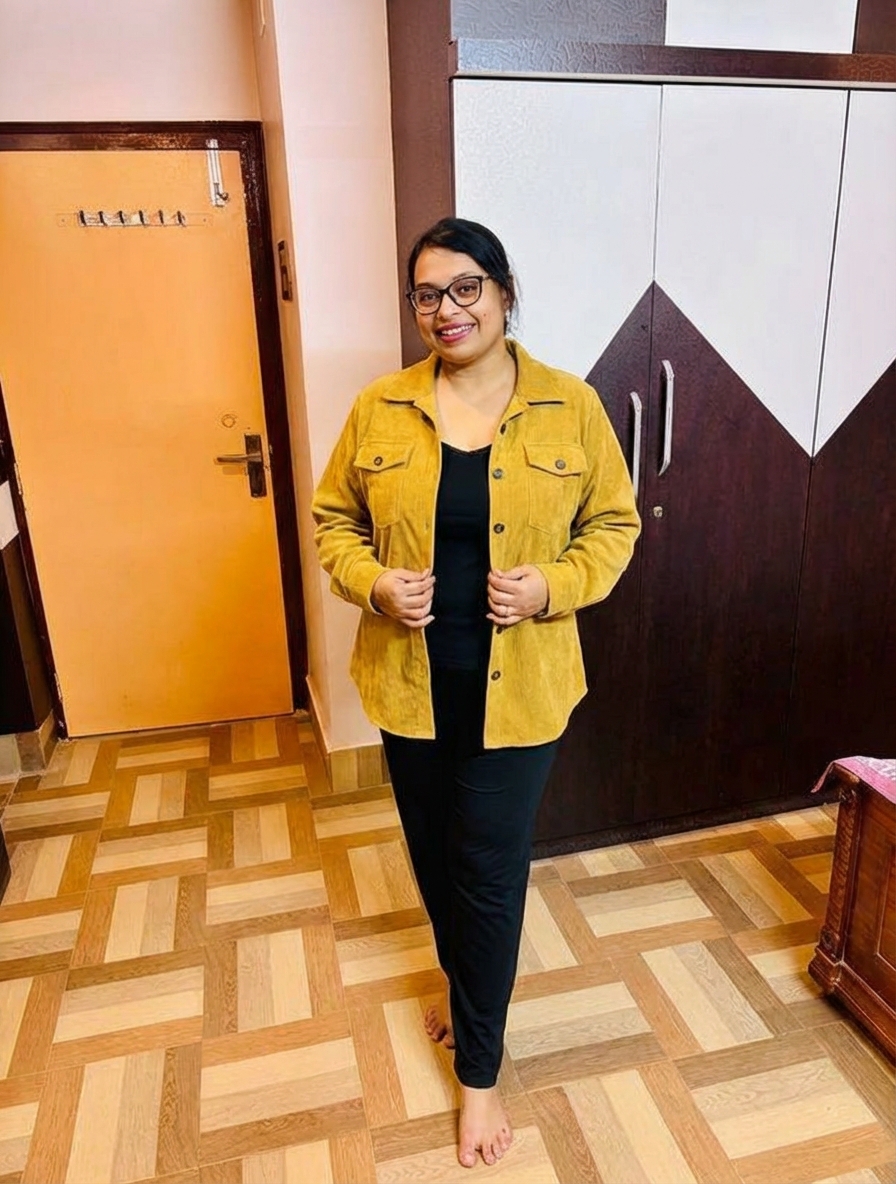
- **Occlusion Handling:** The user's hands are currently grasping the hem of her top. This interaction is complex; the simulation must layer the new stiff fabric *under* the fingers if the grasp is maintained, or reconstruct the hands to rest over the fabric. Given the corduroy's stiffness, the fabric should not deform significantly under the fingers; instead, the entire panel of the jacket should displace slightly outward. The user's hair appears tied back, minimizing neckline occlusion, but any loose strands must be segmented and layered *over* the new collar.
PHASE 3: ENVIRONMENT & LIGHTING
- **Light Match:** The target environment features warm, overhead artificial lighting (tungsten or warm LED), creating soft, downward-casting shadows. The source garment is lit by cool, flat studio light. The new render must warm the temperature of the mustard yellow to match the room's ambient occlusion. Shadows from the new collar and pockets must be cast downward onto the jacket itself, and the jacket must cast a shadow onto the black pants.
- **Color Calibration:** The source yellow is vibrant; it must be desaturated slightly and shifted towards orange/brown to integrate with the indoor lighting conditions to avoid looking like a bright "sticker" on the image. The black buttons must reflect the room's light sources (specularity).
PHASE 4: IDENTITY PROTECTION
- **Facial Lock:** The user's entire head region, specifically the glasses frames, eyes, and jawline, is a strictly frozen zone. No pixel alteration is permitted above the neck seam.
- **Body Integrity:** The user has a curvy physique. The simulation is strictly forbidden from warping the user's torso to match the slimmer mannequin in the source image. The garment mesh must be expanded (warped) to fit the user's existing anthropometric measurements, preserving her natural shoulder width and waist circumference.