Thinking Process
PHASE 1: VISUAL DECONSTRUCTION
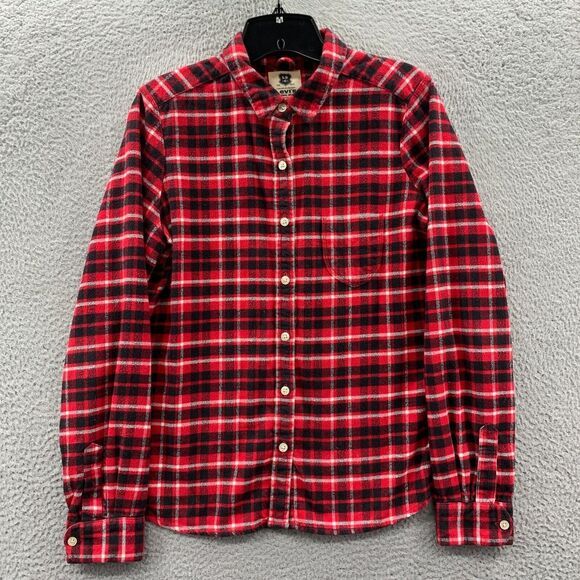
- **Fabric Physics:** The source garment is a flannel or heavy cotton blend. It has a matte finish with high light absorption (low specularity). The simulation must account for a medium-weight fabric that holds semi-rigid creases but softens at stress points. It is not flowy like silk; it should exhibit structured draping.
- **Key Features:** The "buffalo check" red and black plaid pattern must remain consistent in scale. The white pearlescent buttons offer high contrast and must be preserved (visible on the profile side). The single chest pocket on the left breast needs to be mapped to the user's front-side torso profile, even if partially obscured by the angle. The collar structure is stiff and must stand slightly off the neck.
PHASE 2: FIT & DRAPE SIMULATION
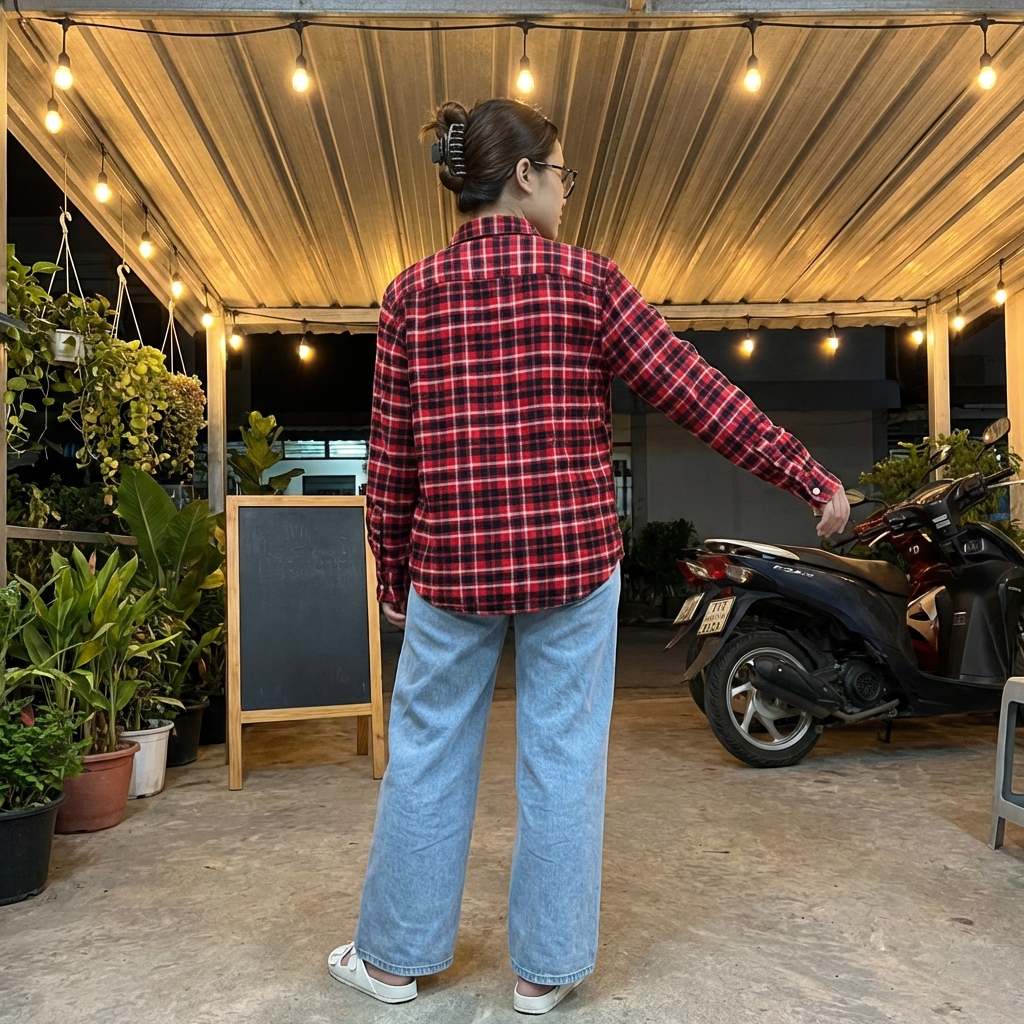
- **Body Mapping:** The user is in a rear-3/4 profile pose. The physics engine must infer the back panel of the shirt (as the source image only shows the front) by wrapping the plaid pattern continuously around the torso without texture stretching. The garment should drape vertically from the shoulder blades, hanging loosely over the lumbar region rather than clinging. The right sleeve should hang straight with minor circumferential buckling at the elbow due to the slight arm bend.
- **Occlusion Handling:** The user's hair, specifically the bun and the claw clip, falls over the nape of the neck; this area must be segmented and layered *over* the new shirt collar. The top of the jeans waistband interacts with the hem; the shirt should be rendered untucked to cover the waistline naturally, casting a shadow onto the denim.
PHASE 3: ENVIRONMENT & LIGHTING
- **Light Match:** The target environment is illuminated by overhead string lights (warm tungsten/sodium vapor, approx 2700K-3000K). The source garment's bright, studio-lit red must be color-graded to a deeper, warmer tone (shifting towards orange-red) to match the ambient warmth.
- **Color Calibration:** Apply a noise/grain filter to the high-resolution source garment to match the lower-light ISO grain of the target image. Shadows must be generated pointing downwards from the collar and under the armpit, consistent with the overhead light sources in the corrugated roof structure.
PHASE 4: IDENTITY PROTECTION
- **Facial Lock:** The user's visible ear, jawline profile, glasses (temple/arm), and the intricate details of the hair clip must be frozen and masked out from generation.
- **Body Integrity:** The shoulder width and posture (slouch/relaxed stand) must remain unaltered. The simulation must strictly adhere to the user's volumetric data; do not slim the torso or alter the hip alignment relative to the wide-leg jeans.