Thinking Process
PHASE 1: VISUAL DECONSTRUCTION
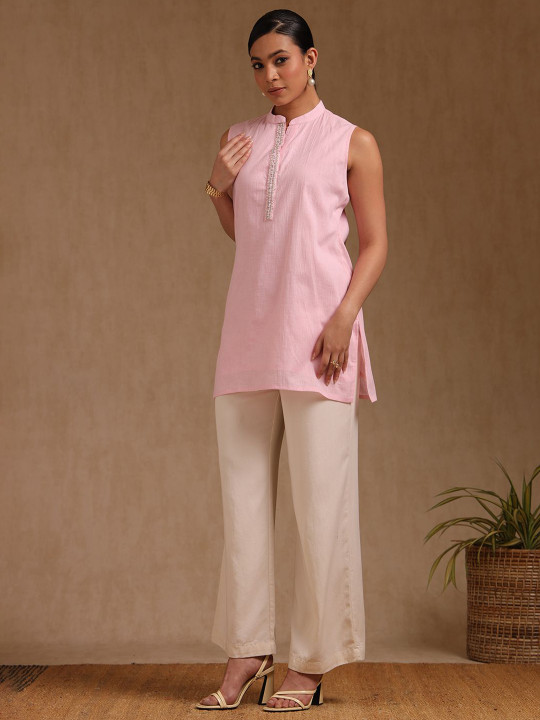
- **Fabric Physics:** The source garment appears to be a lightweight woven cotton or linen blend with a visible "slub" texture. It possesses a matte finish with zero specularity (no shine). The physics simulation must account for a semi-structured drape that holds its shape better than jersey knit, hanging relatively straight rather than clinging to body contours.
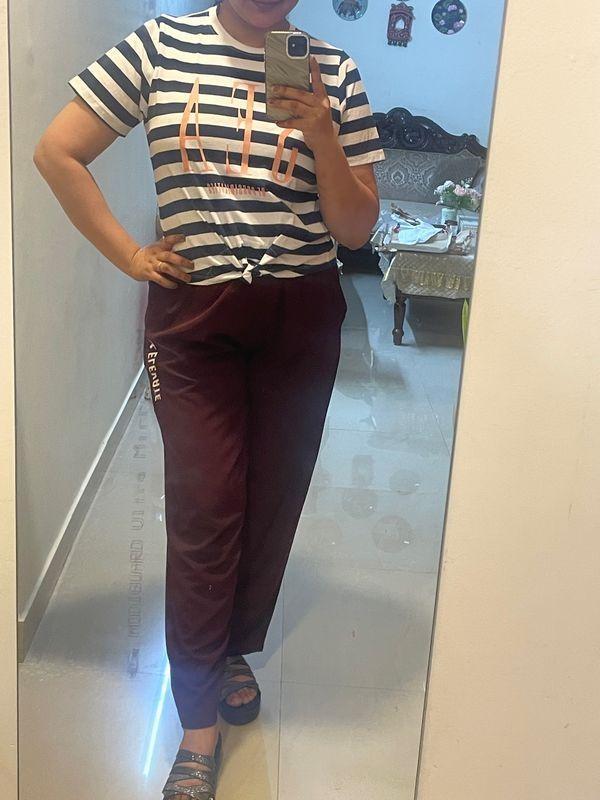
- **Key Features:** The central vertical embroidered/beaded placket is the primary focal point and must remain centered. The mandarin/stand-up collar structure needs to be preserved around the neck. The sleeveless armhole geometry must be accurately rendered (clean edges, no fraying). The hemline is straight with small side slits, which distinguishes it from the knotted t-shirt currently worn by the user.
PHASE 2: FIT & DRAPE SIMULATION
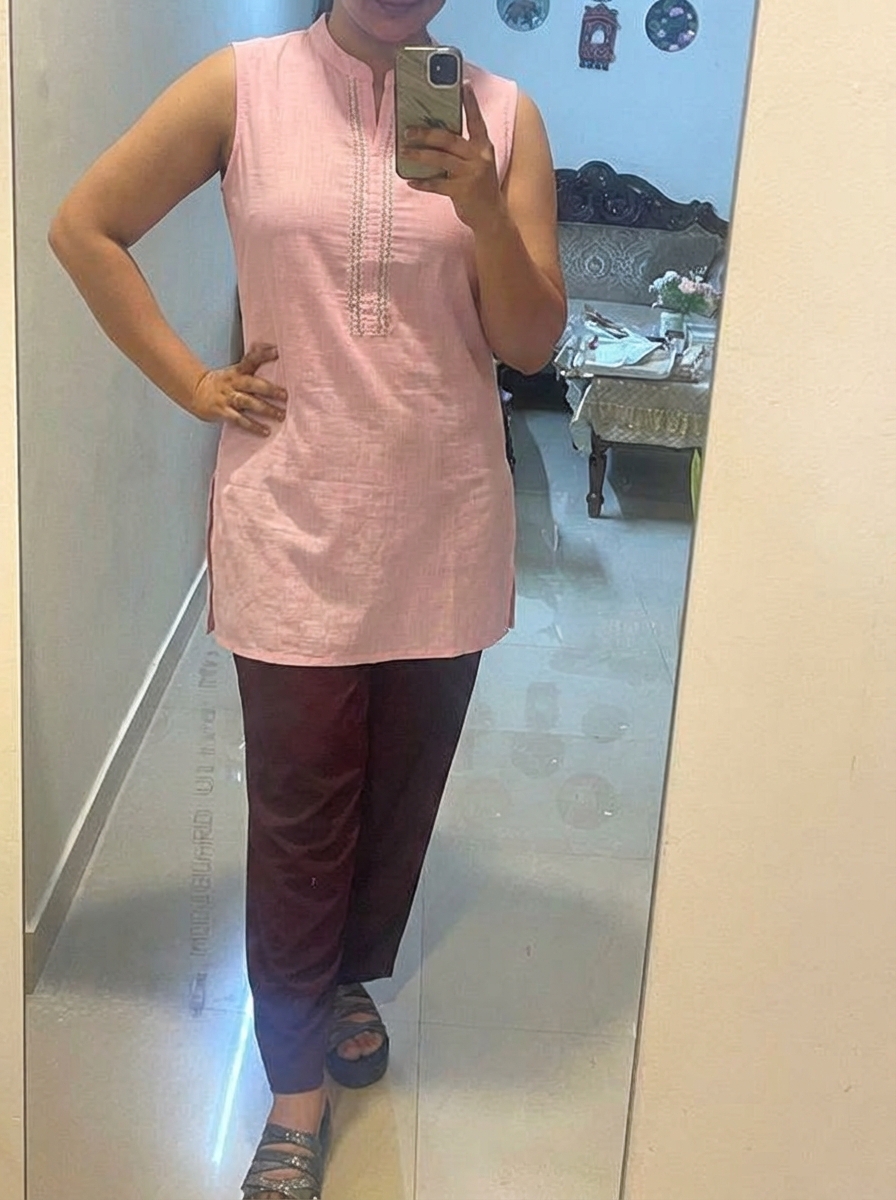
- **Body Mapping:** Unlike the current knotted t-shirt, the target pink tunic is a longer, straight-cut silhouette. It must drape vertically over the user's torso, extending past the waistline to the upper hips. On the user's right side (hand on hip), the fabric must buckle and fold naturally above the wrist, simulating interaction with the hip, rather than passing through the arm. The sleeveless cut means the user's bare shoulders (currently covered by sleeves) must be generated/exposed or the garment adapted to the arm structure if skin generation is disabled.
- **Occlusion Handling:** **CRITICAL:** The user's left hand and the smartphone are positioned directly over the center chest. The new garment must be rendered on a layer *behind* the phone and the holding hand. The right hand rests on the hip; the garment hem must settle around the fingers, not over them. The volume of the knot in the current t-shirt must be digitally "flattened" so the new tunic doesn't bulge unnaturally in the center.
PHASE 3: ENVIRONMENT & LIGHTING
- **Light Match:** The user image features diffuse, somewhat cool indoor lighting (typical mirror reflection) with a slight overhead bias. The source garment's warm studio lighting must be neutralized. Shadows on the new garment should be soft and cast downward/inward, specifically creating ambient occlusion where the fabric meets the armpits and under the bust.
- **Color Calibration:** The source pink is warm-toned. It requires a white-balance shift towards cool/cyan to match the ambient environment of the user's room and the mirror glass tint. Contrast should be slightly reduced to match the dynamic range of the user's selfie.
PHASE 4: IDENTITY PROTECTION
- **Facial Lock:** The user's visible facial features (jawline, mouth, nose) and the specific grip of the hand on the phone must be strictly frozen. Hair falling on the shoulders must remain distinct and layered *over* the new collar.
- **Body Integrity:** The simulation is strictly forbidden from warping the user's waist, arms, or hip width to match the source model. The garment must expand to fit the user's natural measurements, maintaining the user's authentic body silhouette.