Thinking Process
PHASE 1: VISUAL DECONSTRUCTION
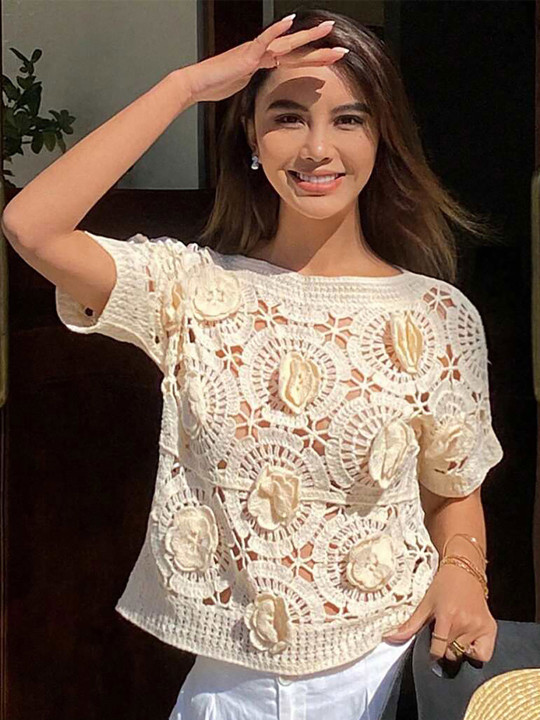
- **Fabric Physics:** The source garment is a heavy-weight, open-knit crochet or macramé structure. It possesses high structural stiffness with low elasticity compared to jersey knits. It will not flow like liquid; rather, it will hang heavily with distinct, rigid folds. The material is matte (cotton or wool blend) and absorbs light, but the open-weave structure dictates that lighting must account for subsurface scattering and distinct shadow casting through the holes onto the skin beneath.
- **Key Features:**
1. **3D Floral Appliqués:** The raised rosettes/flowers are volumetric geometry, not flat textures. They must cast small shadows onto the shirt itself.
2. **Open Latticework:** The transparency of the grid pattern is non-negotiable; the user's skin tone (or a generated under-layer) must be visible through the gaps.
3. **Scalloped Edges:** The hemline and sleeve cuffs have a specific looped crochet finish that must be preserved.
4. **Boat Neckline:** The wide, straight neckline structure needs to be maintained.
PHASE 2: FIT & DRAPE SIMULATION
- **Body Mapping:**
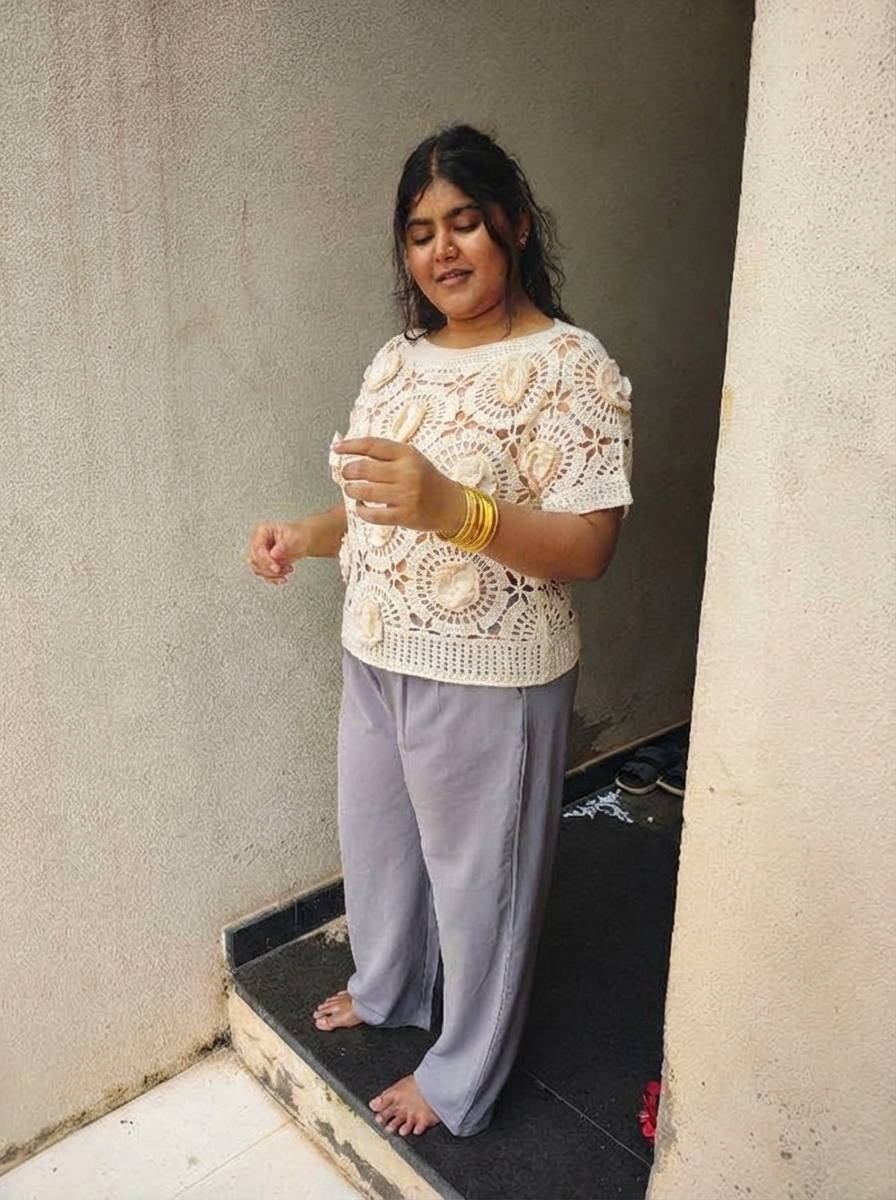
- **Volume Adaptation:** The user has a curvier bust and waist than the source model. The crochet top, originally loose/boxy, must expand laterally to accommodate the user's width without stretching the crochet pattern into distortion. It should hang vertically from the bust point, avoiding a tight cling at the midsection.
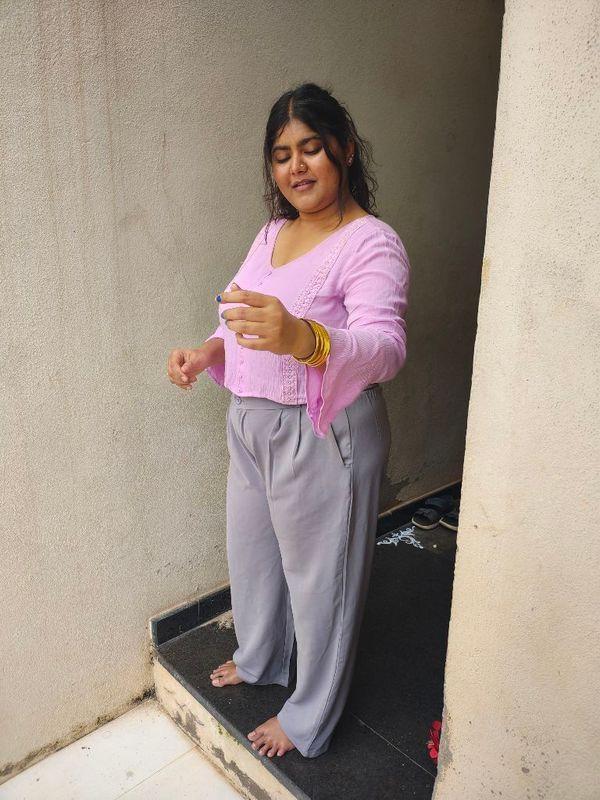
- **Sleeve Transition:** The source has short sleeves, while the user currently wears long bell sleeves. The simulation must generate realistic skin texture for the user's forearms where the pink sleeves currently exist, terminating the new garment at the mid-bicep.
- **Pose Interaction:** Due to the user's raised right arm, the stiff crochet fabric will bunch significantly at the right axilla (armpit) and lift slightly at the right hemline.
- **Occlusion Handling:**
- **Right Hand & Wrist:** The user's right hand and the gold bangles are positioned in front of the torso. These are high-priority occlusion zones; the crochet texture must pass *behind* the hand and bangles.
- **Hair Strands:** The loose, wavy strands of hair resting on the shoulders and clavicle area must be segmented and layered *over* the new boat neckline.
PHASE 3: ENVIRONMENT & LIGHTING
- **Light Match:**
- **Source Correction:** The source image has high-contrast, harsh sunlight. The target environment is soft, diffused ambient daylight (likely overcast or shaded). The sharp contrast and deep blacks of the source garment's shadows must be flattened and softened to match the lower contrast of the user's photo.
- **Directionality:** Light in the user's image is soft and top-down/frontal. Shadows should naturally gather under the bust and in the folds of the crochet, but they must be soft gradients, not hard edges.
- **Color Calibration:** The source garment is a bright cream/white. To avoid looking like a "sticker," the white point must be lowered to match the slightly warmer, dusty tone of the outdoor hallway walls. Global illumination from the beige walls should subtly tint the white fabric.
PHASE 4: IDENTITY PROTECTION
- **Facial Lock:** The user's facial structure, expression, nose ring, and the specific messy texture of the hair frame must remain absolutely pixel-frozen.
- **Body Integrity:** STRICT PROHIBITION on slimming or warping the user's torso. The digital garment must be draped onto the user's *existing* volumetric mesh. The user's skin tone (visible through the crochet holes) must match her face/neck perfectly.