Thinking Process
PHASE 1: VISUAL DECONSTRUCTION
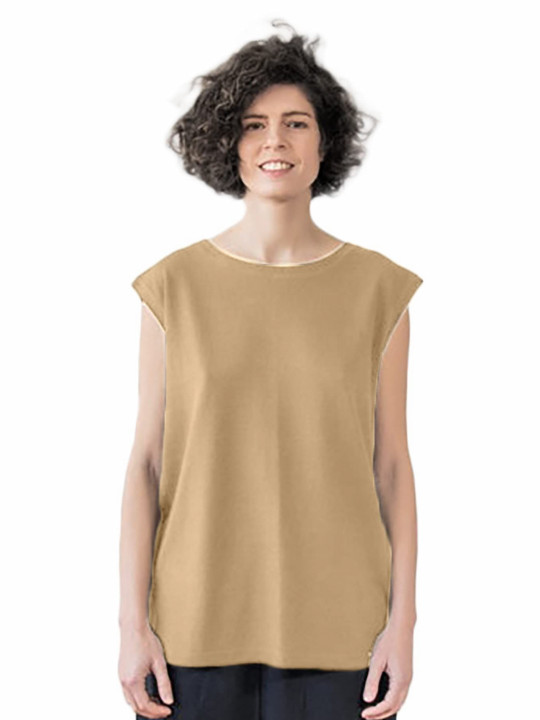
- **Fabric Physics:** The source garment is a sleeveless shell top, likely constructed from a matte woven fabric such as a cotton-linen blend or viscose. It has medium weight with low elasticity. It exhibits a diffuse reflection model (Lambertian), meaning it should not appear shiny or wet. The drape is semi-structured; it will hold a boxy shape rather than clinging tightly to the skin.
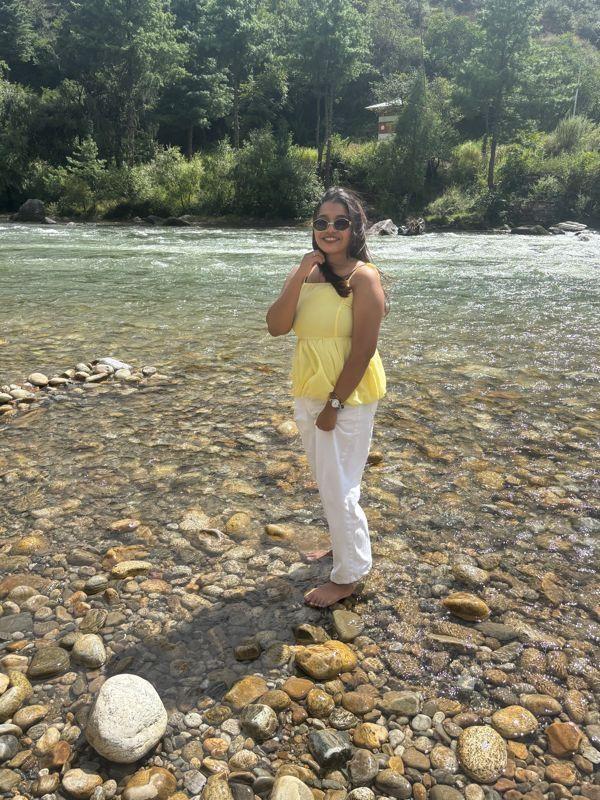
- **Key Features:** The wide boat/crew neckline with subtle edge stitching is the primary anchor point. The cap-sleeve construction (extending slightly past the shoulder joint) must be maintained. The garment lacks heavy fasteners but possesses a clean, straight hemline which must replace the flared peplum silhouette of the current yellow top.
PHASE 2: FIT & DRAPE SIMULATION
- **Body Mapping:** The user is positioned in a semi-profile stance (approx 45 degrees). The new garment is a relaxed fit, unlike the cinched waist of the current yellow top. The simulation must bridge the gap between the shoulder and the bust point without collapsing inward; the fabric should drape vertically from the bust due to gravity, creating a straighter silhouette than the current hourglass shape. The armholes need to be re-calculated to sit higher and closer to the armpit than the current low-cut yellow top.
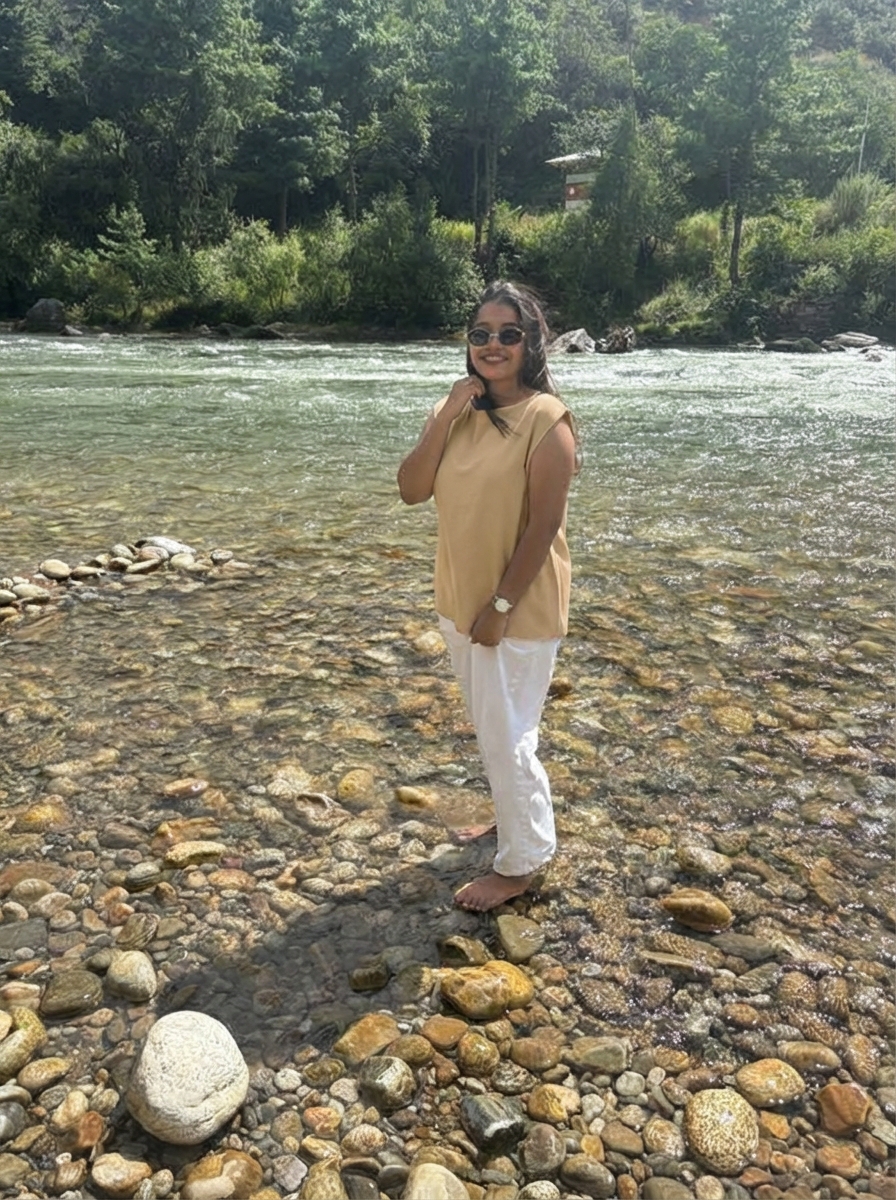
- **Occlusion Handling:** CRITICAL: The user's long dark hair flows over the right shoulder and chest area; the new fabric must be rendered strictly *underneath* these hair strands. The user's right hand touches the neck/collarbone area; the new, higher neckline of the beige top will likely intersect with the fingers/wrist. Deep masking is required to layer the hand *over* the new fabric.
PHASE 3: ENVIRONMENT & LIGHTING
- **Light Match:** The target environment is high-contrast outdoor daylight (sunlight). The light source appears to be overhead and slightly diffused. The new garment must shed the flat, soft studio lighting of the source image and adopt hard shadows where the hair and hand occlude the fabric. The "lower" portions of the shirt should receive slight ambient fill light reflected from the river water (cool tones) and the stones (warm tones).
- **Color Calibration:** The source beige is neutral but must be color-graded to match the outdoor white balance. It requires a subtle shift towards the warm spectrum to match the sunlight, while desaturating slightly to account for atmospheric scattering in the outdoor setting.
PHASE 4: IDENTITY PROTECTION
- **Facial Lock:** The user's entire head, including the sunglasses, nose, mouth, and jawline, is a rigid exclusion zone. The hair texture and volume must remain pixel-perfect.
- **Body Integrity:** The user's arm volume and skin tone must remain untouched. While the *clothing silhouette* will change from a flared peplum to a straight cut, the underlying somatic volume (torso width) must not be slimmed or warped. The exposed skin on the shoulders (currently visible due to spaghetti straps) will be partially covered by the wider cut of the new top; ensure skin texture blends naturally at the new garment boundaries.