Thinking Process
PHASE 1: VISUAL DECONSTRUCTION
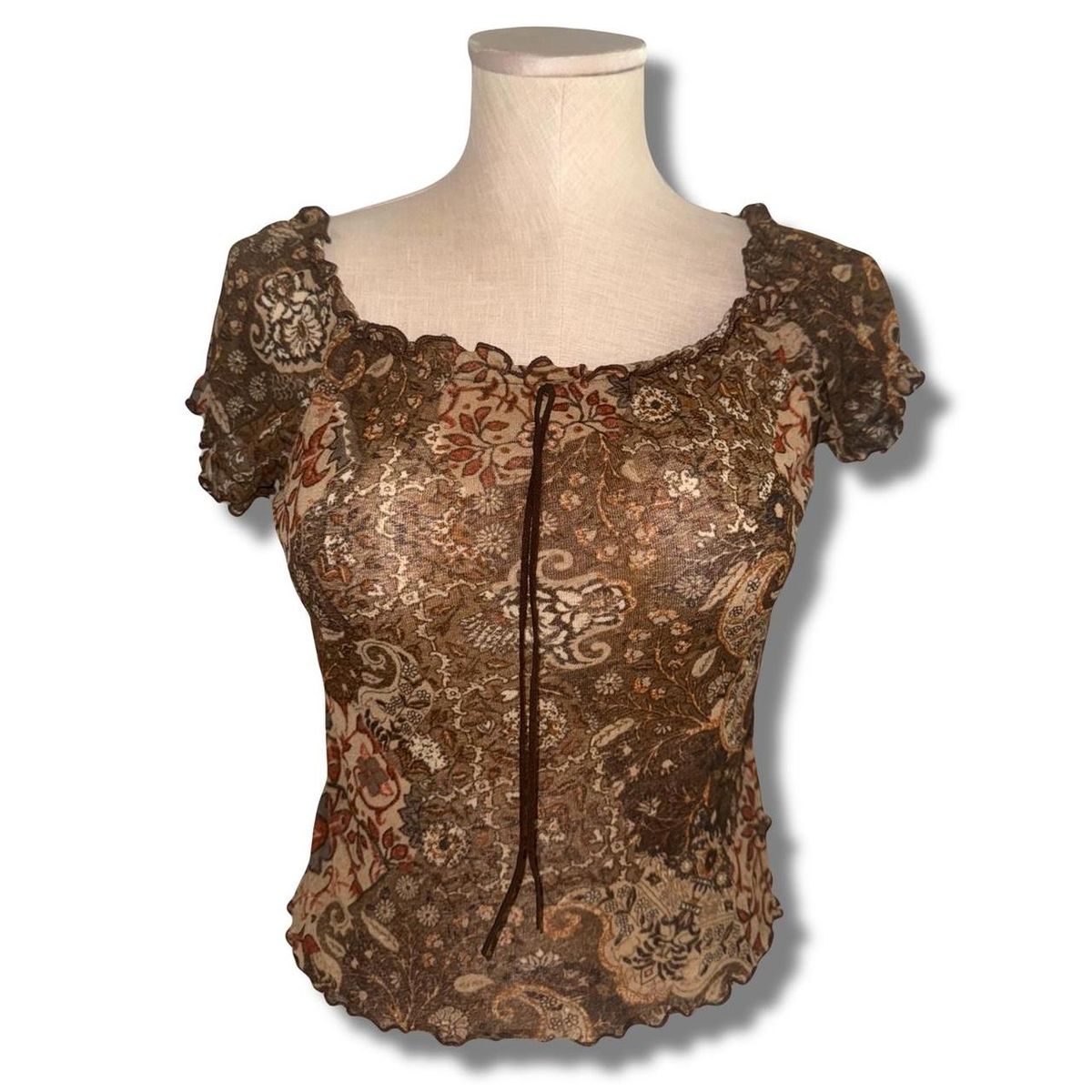
- **Fabric Physics:** The source garment appears to be a lightweight, semi-sheer mesh or synthetic blend with high elasticity. It lacks the rigidity of cotton; therefore, the simulation must render it as soft and pliable. It has a matte finish with very subtle specular highlights on the folds, indicating a texture that absorbs rather than reflects sharp light.
- **Key Features:** The "lettuce-edge" (ruffled) detailing on the neckline, sleeves, and bottom hem is the defining geometric feature and must be preserved. The central vertical drawstring/tie is loose and susceptible to gravity. The complex brown paisley/floral pattern must maintain its aspect ratio without warping unnaturally across the chest curvature.
PHASE 2: FIT & DRAPE SIMULATION
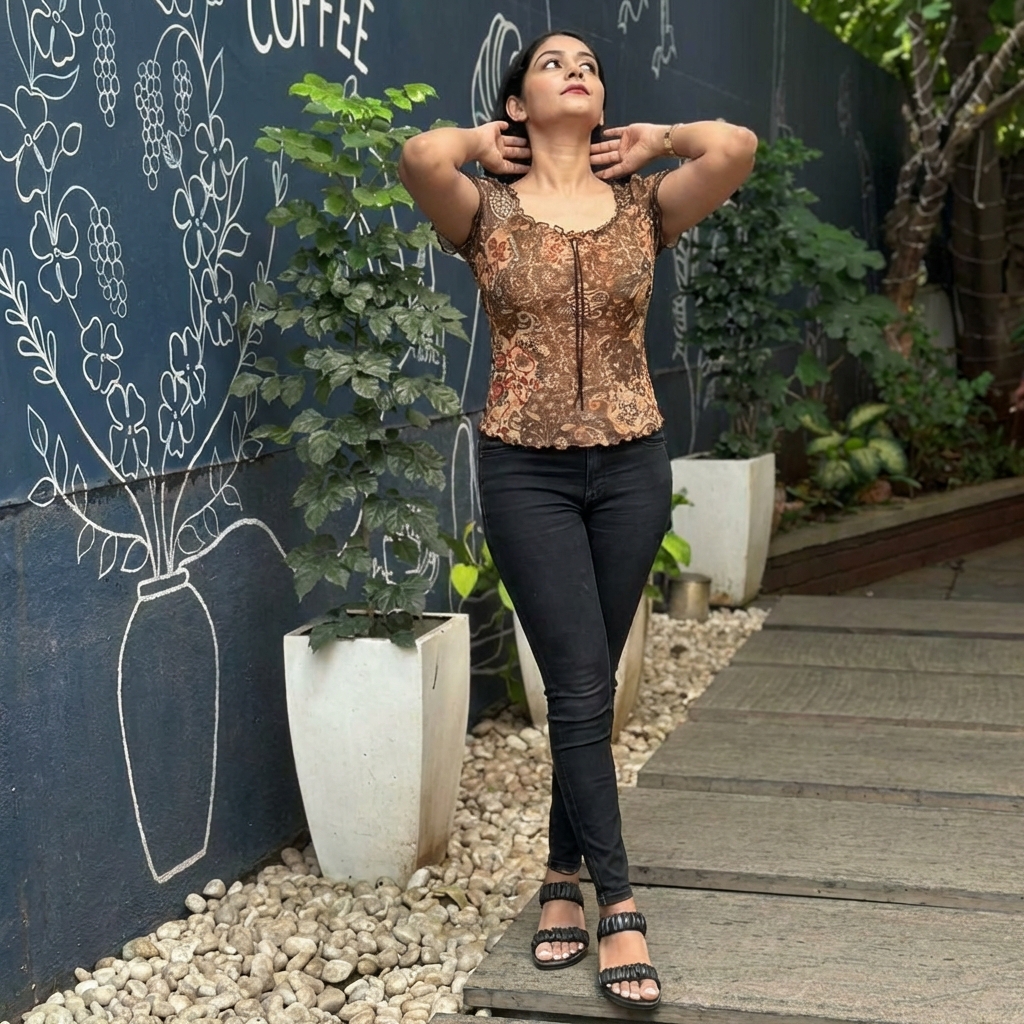
- **Body Mapping:** Due to the user's "arms raised" pose (hands behind head), the torso is elongated and the chest is lifted. The virtual garment must exhibit tension lines pulling upward from the armpits toward the shoulders. The short cap sleeves will bunch slightly at the top of the shoulder joint rather than hanging loose. The bottom hem will sit higher on the torso than in a neutral pose due to the raised arms. The central drawstring must hang vertically, conforming to the sternum and stomach contours, unaffected by the arm lift.
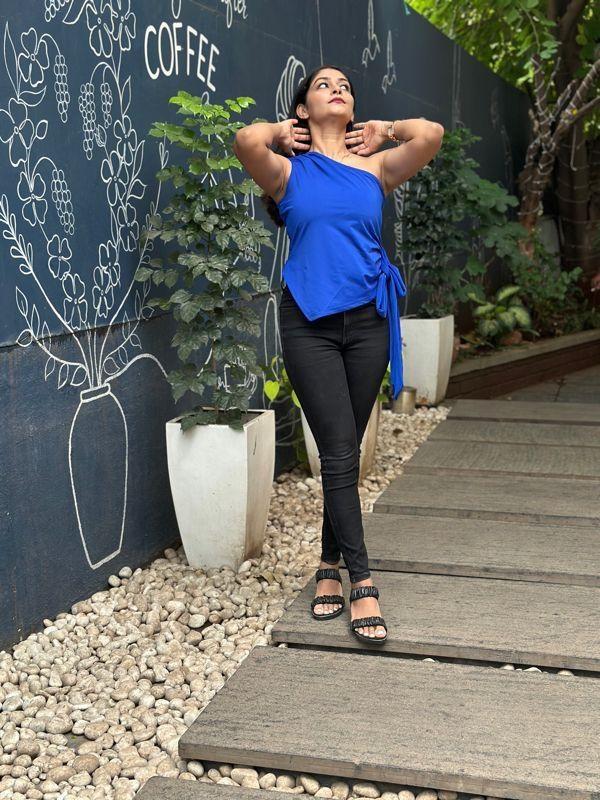
- **Occlusion Handling:** The user's long dark hair falls over the back and potentially touches the shoulder area; this must be segmented and layered *over* the new neckline/sleeves. The user's hands and wrists are near the neck/shoulders; accurate segmentation is required to ensure the garment passes *behind* the arms/hands if any overlap occurs. The current asymmetric blue top strap must be completely removed and replaced with the new garment's bilateral shoulder coverage.
PHASE 3: ENVIRONMENT & LIGHTING
- **Light Match:** The target environment is an outdoor shaded area with soft, diffused daylight coming from the upper-front. The garment needs to cast soft self-shadows in the folds and stronger ambient occlusion in the armpits and under the bust. The lighting on the cloth must match the cool/neutral daylight temperature, shifting away from the warm studio lighting of the source image.
- **Color Calibration:** The source garment's warm browns and creams must be slightly desaturated or cooled to match the outdoor lighting conditions to prevent a "sticker effect." The black values of the pattern should match the black point of the user's jeans.
PHASE 4: IDENTITY PROTECTION
- **Facial Lock:** The user's entire head, including hair texture, facial expression, and jawline, must remain pixel-perfectly frozen. The skin tone on the face and neck must be protected.
- **Body Integrity:** The user's arm thickness, shoulder width, and waist curvature must remain unaltered. The simulation must replace the clothing *on* the existing volume of the body, strictly forbidding any slimming, liquifying, or reshaping of the user's torso or limbs.