Thinking Process
PHASE 1: VISUAL DECONSTRUCTION
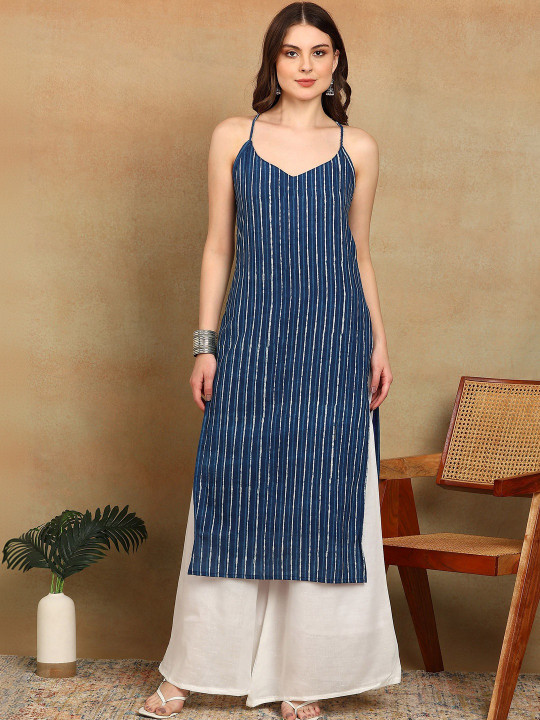
- **Fabric Physics:** The source garment is a lightweight, woven textile, likely cotton or a cotton-viscose blend. It exhibits a matte finish with a medium drape weight—heavier than silk but lighter than canvas. The vertical pinstripes appear to have a slight metallic or glossy texture, suggesting they should catch specular highlights differently than the matte blue base fabric.
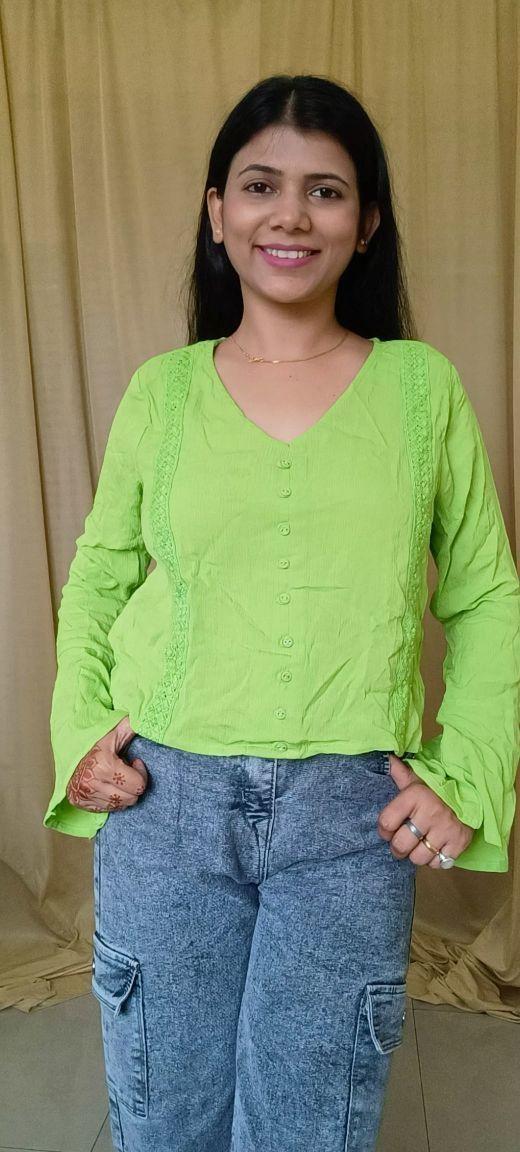
- **Key Features:** The spaghetti strap (camisole style) construction is the primary structural element. The deep V-neckline, the precise parallel alignment of the vertical stripes, and the side seams (which dictate how the garment hangs) must be preserved. The garment is sleeveless, contrasting with the user's current long sleeves.
PHASE 2: FIT & DRAPE SIMULATION
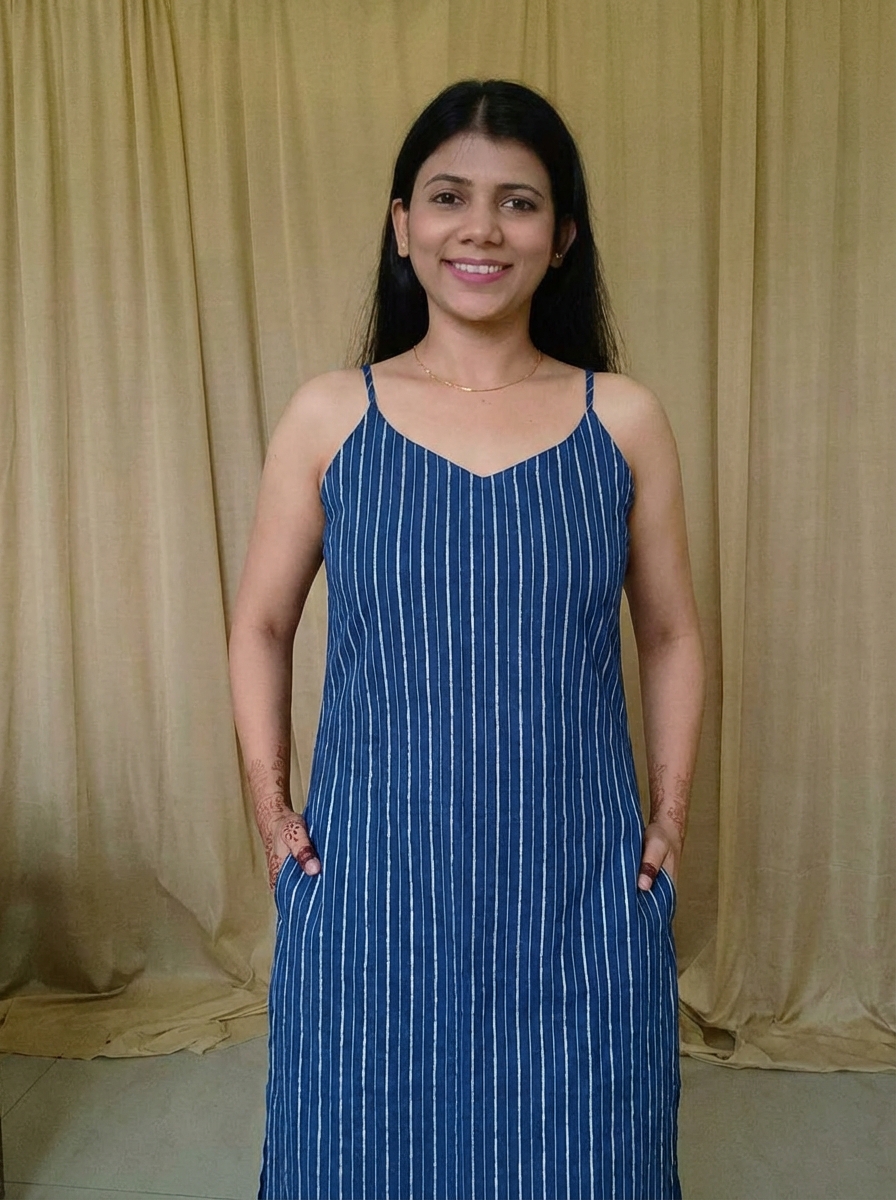
- **Body Mapping:** The target garment is a long tunic (kurta). It must drape straight down from the shoulders, skimming the bust and flaring slightly over the hips, effectively covering the waistband of the user's jeans. Unlike the user's current fitted green top, the blue kurta relies on gravity to hang vertically. **Crucially**, the simulation must generate accurate skin texture for the user's arms and shoulders, as the source is sleeveless and the target currently wears long sleeves.
- **Occlusion Handling:** The user's long dark hair falls over both shoulders; this hair mask must be segmented and layered *over* the new blue straps and bodice. The user's hands are partially tucked into pockets; the hem of the kurta (which is long) will likely interact here. The fabric must appear to drape *behind* the wrists/hands or flow naturally around the hips, ensuring the hands remain the top layer. The gold necklace must be preserved and sit against the newly exposed skin of the chest.
PHASE 3: ENVIRONMENT & LIGHTING
- **Light Match:** The user image features soft, diffuse, top-down indoor lighting with a neutral/cool temperature (evident by the beige curtain shadows). The source garment has warm studio lighting. The blue kurta must be color-corrected to remove the warm cast. Shadows on the garment should be soft and diffused, appearing under the bust and generated by the hair falling on the chest.
- **Color Calibration:** The deep indigo of the kurta must be balanced so it does not appear black in the user's lower-light environment. The white/silver stripes must reflect the room's ambient light, avoiding harsh studio glints.
PHASE 4: IDENTITY PROTECTION
- **Facial Lock:** The user's facial features (eyes, nose, smile), skin tone, and head shape must be strictly frozen. The hairline and the specific volume of the hair resting on the shoulders must be maintained.
- **Body Integrity:** The user's shoulder width and arm volume (which must be reconstructed) must remain consistent with her frame. Do not slim the waist or alter the hip width; the kurta should flow over her natural silhouette without warping her underlying anatomy.