Thinking Process
PHASE 1: VISUAL DECONSTRUCTION
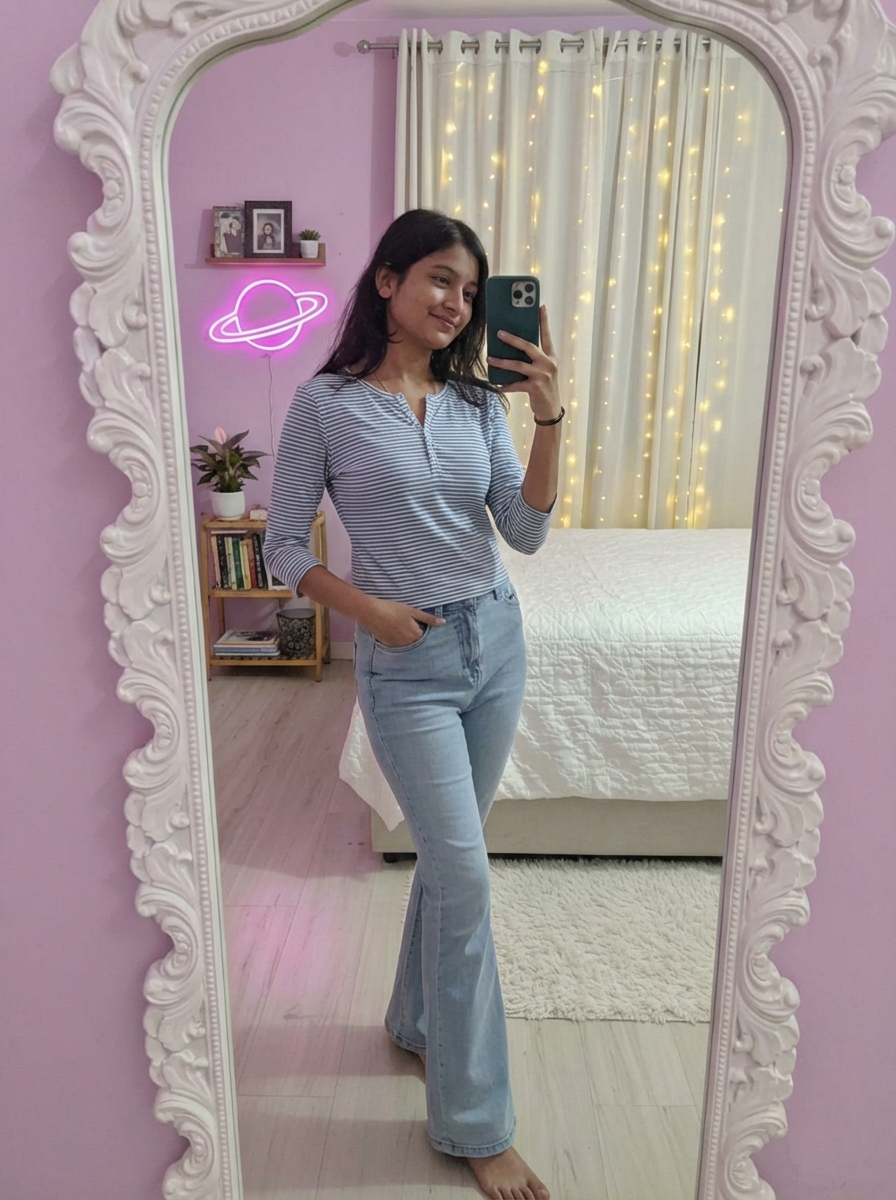
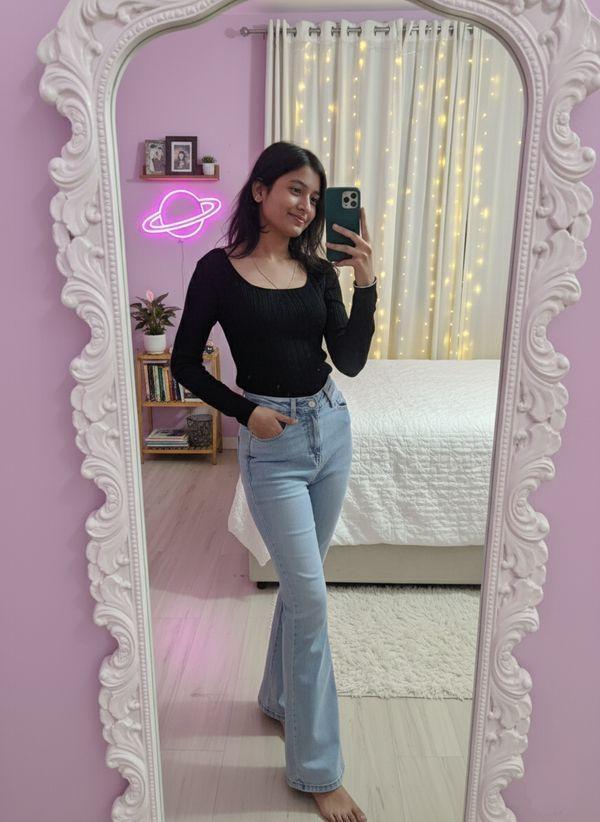
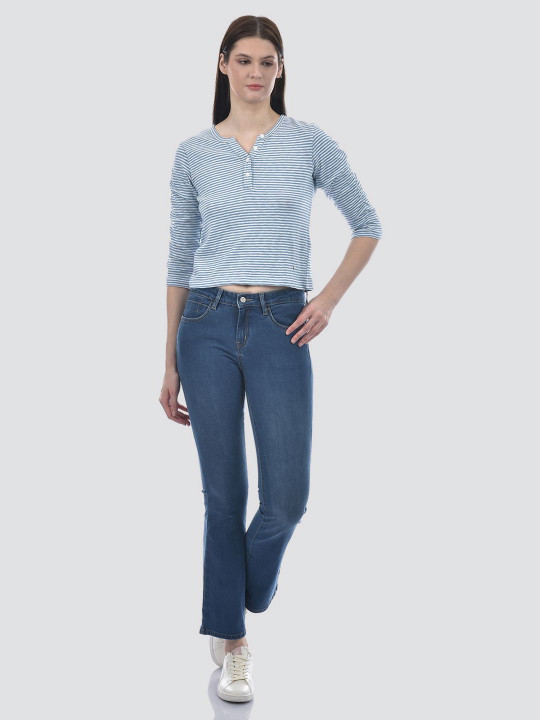
- **Fabric Physics:** The source garment is a light-to-medium weight cotton jersey blend. It possesses a matte finish with high light absorption and low specularity. Unlike the user's current rigid ribbed synthetic top, the source fabric is more pliable and susceptible to micro-wrinkling.
- **Key Features:** The horizontal blue and white stripes are the critical texture map; these must wrap volumetrically around the torso without warping into a flat 2D plane. The central Henley-style button placket at the neckline and the reinforced stitching at the sleeve cuffs must be preserved. The hemline appears slightly cropped and semi-relaxed, contrasting with the user's current tuck-in style.
PHASE 2: FIT & DRAPE SIMULATION
- **Body Mapping:**
- **Right Arm (Pocket):** The user's hand is inserted into the jeans pocket. The source garment's sleeve must bunch realistically at the forearm/wrist, creating compression folds just above the pocket line.
- **Left Arm (Phone):** Because the arm is raised to hold the phone, the fabric must exhibit tension lines stretching from the armpit across the upper chest. The sleeve should slide slightly down the forearm due to gravity.
- **Torso:** The fit should be relaxed compared to the current skin-tight black top. It should not cling to the ribcage but rather drape vertically from the bust apex, creating a small air gap at the waist.
- **Occlusion Handling:**
- **Hair:** The user has long dark hair falling over both the left and right shoulders/chest. This is a hard occlusion layer that must be segmented and composited *on top* of the new striped shirt.
- **Phone & Hand:** The left hand and the smartphone create a solid occlusion mask over the upper chest/shoulder area.
- **Waist:** The hem of the new shirt must interact naturally with the high-waisted denim; it should hang *over* the waistband, not be tucked in, unless the user intends a tucked look (default to natural hang for this crop cut).
PHASE 3: ENVIRONMENT & LIGHTING
- **Light Match:** The room features soft, diffuse indoor artificial lighting (warm tungsten temperature) with a pink ambient cast from the walls. The new garment must shed the sterile studio lighting of the source image. Shadows must be soft and directional, falling downwards and slightly to the left based on the phone/mirror reflection angle.
- **Color Calibration:** The white stripes on the source garment must be color-graded to accept the pink environmental bounce light. Pure white will look fake; it needs a warm, slight rose-tinted white balance to integrate into the mirror selfie reflection.
PHASE 4: IDENTITY PROTECTION
- **Facial Lock:** The user's face, neck structure, and specific hairstyle are strictly frozen. The boundary between the new Henley neckline and the user's neck skin must be blended seamlessly without altering the jawline.
- **Body Integrity:** The user's skeletal structure and skin boundaries (hands, exposed neck area) are immutable. Do not slim the waist or alter the arm thickness. The simulation adds the volume of the cloth *on top* of the existing body mesh, it does not reshape the body mesh itself.