
Thinking Process
PHASE 1: VISUAL DECONSTRUCTION
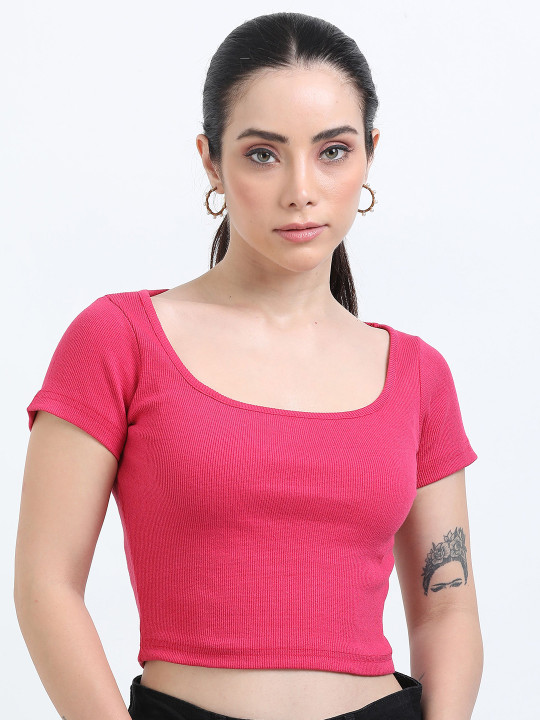
- **Fabric Physics:** The source garment is a ribbed knit (likely cotton-spandex blend). Unlike the user's current loose cotton t-shirt, this material is high-elasticity and form-fitting. It should not reflect hard light (specular highlights) but must exhibit "micro-shadowing" within the vertical ribbing texture to convey depth. It will stretch horizontally across the bust and torso rather than draping vertically.
- **Key Features:** The wide scoop neckline (significantly lower than the user's current crew neck), the distinct vertical ribbing pattern, the tight cap sleeves, and the cropped hemline (reinforced stitching) must be preserved. The fuschia/pink color saturation must be maintained but adapted to the lighting.
PHASE 2: FIT & DRAPE SIMULATION
- **Body Mapping:**
- **Torso Compression:** Due to the user's crossed-arm pose, the fabric must appear compressed and shadowed underneath the forearms and hands. It must not sit "on top" of the arms.
- **Skin Generation (Midriff):** The source is a crop top, whereas the target user is wearing a long t-shirt. The area between the new cropped hemline and the waistband of the jeans (currently covered by yellow fabric) requires accurate skin tone inpainting consistent with the user's complexion.
- **Sleeve Length:** The new cap sleeves are shorter than the current yellow sleeves. The user's upper arms (currently covered) must be reconstructed with appropriate skin texture.
- **Occlusion Handling:**
- **Crossed Arms:** The user's forearms, wrists, and hands are the primary occluders. The garment must be masked strictly *behind* these limbs.
- **Accessories:** The crossbody bag strap (tan) currently sitting over the yellow shirt must be segmented and layered *over* the new pink top. The gold chain necklace must also be preserved and composited over the user's skin (since the new neckline is lower).
PHASE 3: ENVIRONMENT & LIGHTING
- **Light Match:** The target environment features outdoor, diffused daylight (likely overcast or shaded) with soft shadows falling downwards and slightly to the right. The studio-lit source garment must be dimmed to match the exposure of the target scene. Shadows must be cast aggressively under the user's crossed arms onto the new fabric to ground the garment.
- **Color Calibration:** The source image is high-contrast studio quality. The new garment requires a slight addition of ISO grain/noise to match the lower resolution and texture of the target photograph. The pink hue needs to be slightly warmed to match the ambient outdoor color temperature.
PHASE 4: IDENTITY PROTECTION
- **Facial Lock:** The user's face, hair, ears, and neck area must remain pixel-perfectly frozen.
- **Body Integrity:** Strictly forbid any slimming or reshaping of the user's torso or arms. The ribbed fabric must stretch to accommodate the user's natural curvature and bust size, rather than shrinking the user to fit the garment. The generated midriff skin must match the volume of the existing torso.