Thinking Process
PHASE 1: VISUAL DECONSTRUCTION
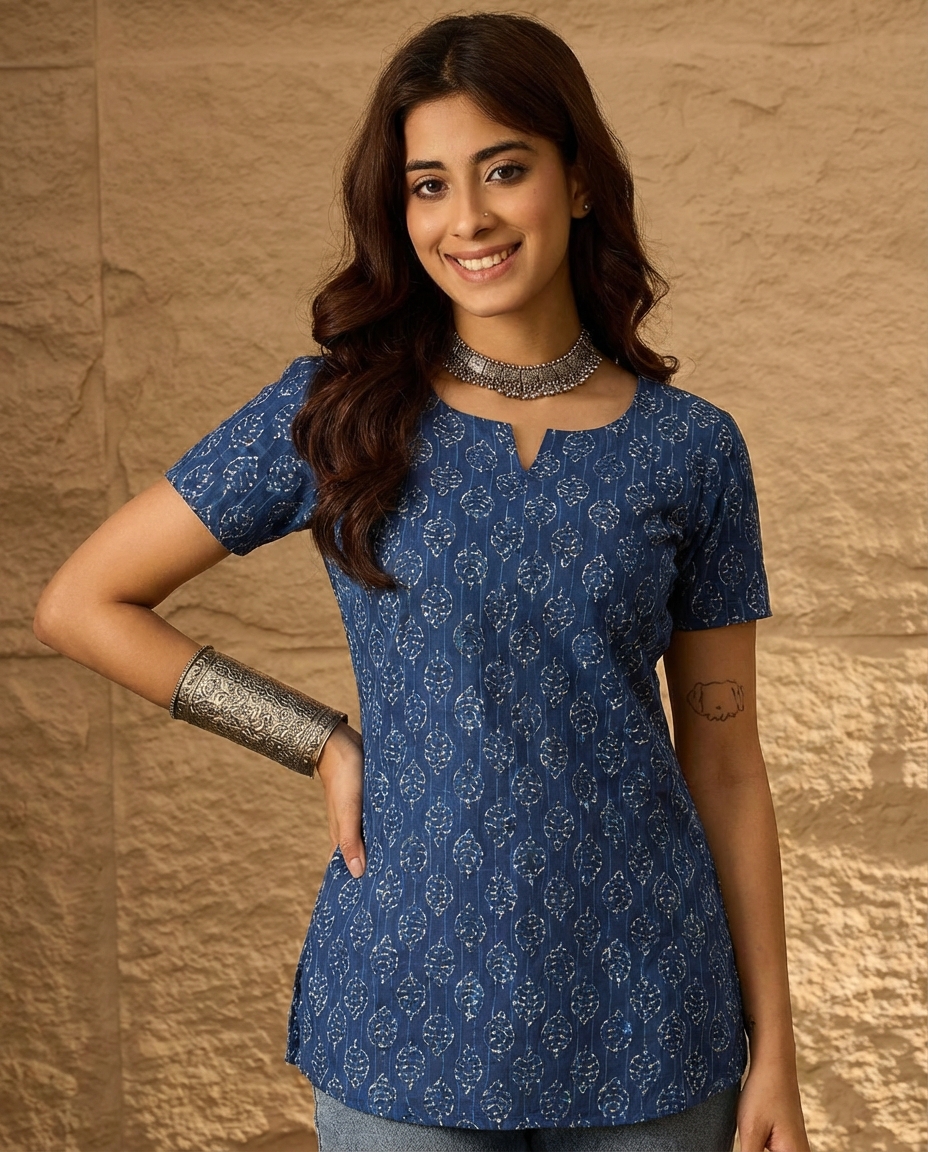
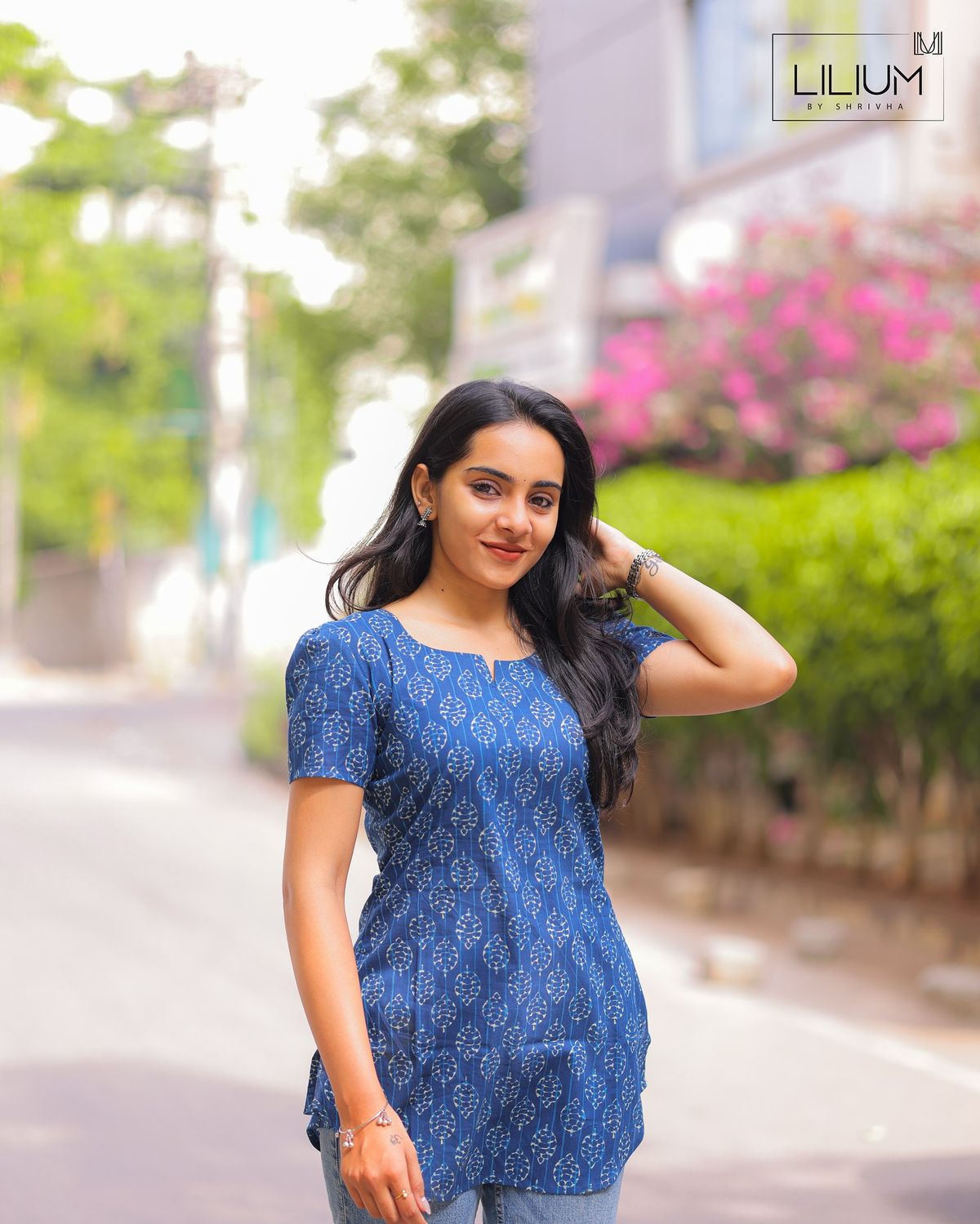
- **Fabric Physics:** The source garment appears to be a structured cotton or linen blend (likely Indigo block print). It has a matte finish with zero specularity (shine). Unlike the user's current elasticated tube top, this fabric has low elasticity; it should not cling tightly to the skin but rather hang with structural integrity. It requires a friction map typical of natural fibers, creating soft, angular folds rather than fluid, liquid draping.
- **Key Features:** The specific repetitive white leaf/paisley block print pattern arranged in vertical columns must be preserved without distortion. The "Notch Neck" (round neckline with a small V-split) is a defining style element. The short sleeves and the straight-cut side seams are essential geometry. The rich indigo blue hue must be maintained as the base color.
PHASE 2: FIT & DRAPE SIMULATION
- **Body Mapping:**
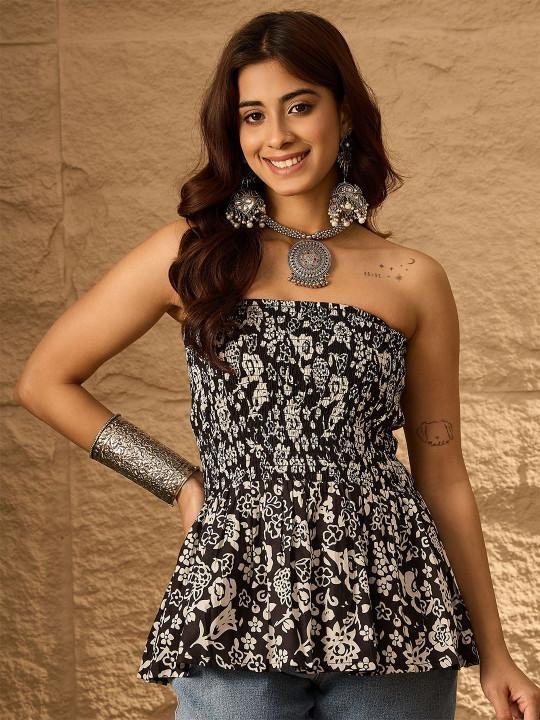
- **Shoulders & Sleeves:** The user is currently wearing a strapless top. The simulation must generate the fabric over the bare shoulders. On the user's right side (viewer's left), the arm is bent with the hand on the hip; the sleeve fabric must bunch and crease at the inner elbow/axilla region due to compression. On the user's left side (viewer's right), the arm is relaxed; the sleeve should hang structurally straight with a slight gap between fabric and skin.
- **Torso:** The source garment is a tunic/Kurti fit (looser than the current tube top). It should drape vertically from the chest down, skimming the waist rather than cinching it. The hemline should fall past the waistline of the jeans.
- **Occlusion Handling:**
- **Hair:** The user has long, wavy dark hair falling over both shoulders and down the chest. A hard occlusion mask must be applied here. The new blue fabric must be rendered *behind* these hair locks.
- **Jewelry:** The heavy silver choker necklace sits high. If the Kurti neckline rides high, the necklace must be layered *over* the fabric. However, the Kurti neckline likely sits just below the choker. The large silver cuff on the right wrist is outside the garment zone but ensures the arm definition is tracked correctly.
PHASE 3: ENVIRONMENT & LIGHTING
- **Light Match:** The user image features warm, directional lighting coming from the left (viewer's perspective), casting shadows on the right side of the body and the textured wall behind. The source garment (outdoor, diffuse lighting) must be relit. We must apply a warm gradient map to the blue fabric and generate a self-shadow gradient darkening the right side of the torso (viewer's right) to match the scene's depth.
- **Color Calibration:** The source blue is daylight-balanced (cool). It must be color-graded with a slight amber/warm tint to integrate with the golden-hour aesthetic of the target image. The white pattern on the shirt should take on a creamy, warm cast rather than pure white.
PHASE 4: IDENTITY PROTECTION
- **Facial Lock:** The entire head region above the neck crease, including the jawline, smile, earrings, and the specific drape of the hair around the face, is a frozen zone. No pixel modification is permitted here.
- **Body Integrity:** The user's exposed skin tone on the arms and upper chest/neck must remain unaltered. Do not warp the user's arm thickness or shoulder width to fit the clothes. The simulation must conform the *cloth to the body*, not the *body to the cloth*. Maintain the user's natural posture and silhouette volume; do not slim the waist to match the tightness of the original tube top, but allow the Kurti to sit with its intended loose fit.