Thinking Process
PHASE 1: VISUAL DECONSTRUCTION
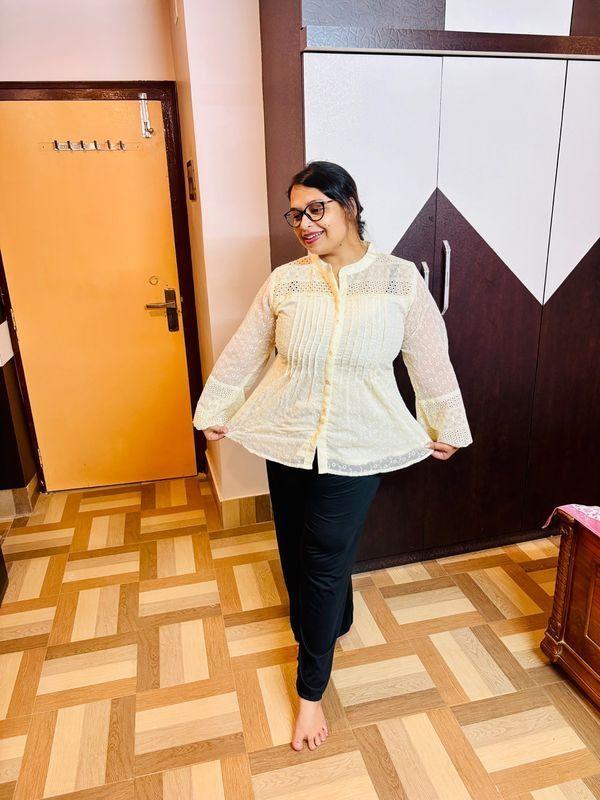
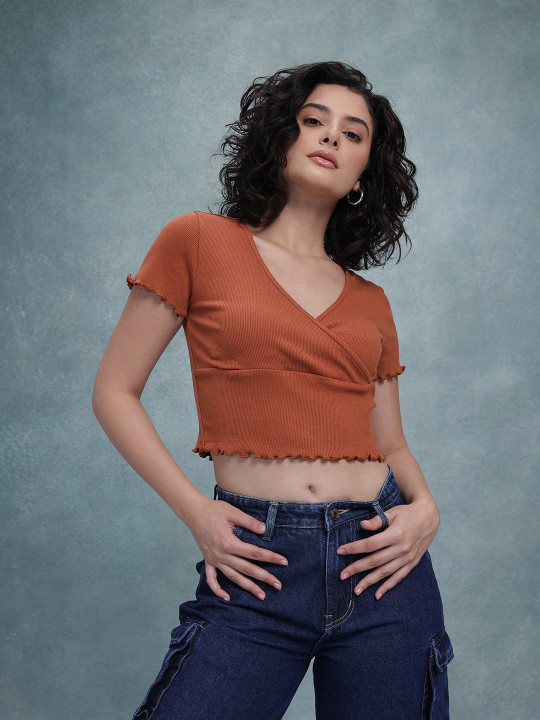
- **Fabric Physics:** The source garment is a ribbed knit fabric (likely a cotton-spandex blend). It has high elasticity and a matte finish. Unlike the user's current flowy tunic, this material does not billow; it relies on tension. Lighting interaction should show soft, diffused highlights on the "hills" of the ribbing and deeper shadows in the "valleys," strictly avoiding specular or glossy reflections.
- **Key Features:** The "lettuce edge" (ruffled/fluted) detailing on the sleeve cuffs and bottom hem is the signature design element and must be rendered with high geometric fidelity. The V-neck wrap construction and the horizontal under-bust seam must be preserved. The vertical ribbing texture needs to warp correctly around the bust and torso curvature.
PHASE 2: FIT & DRAPE SIMULATION
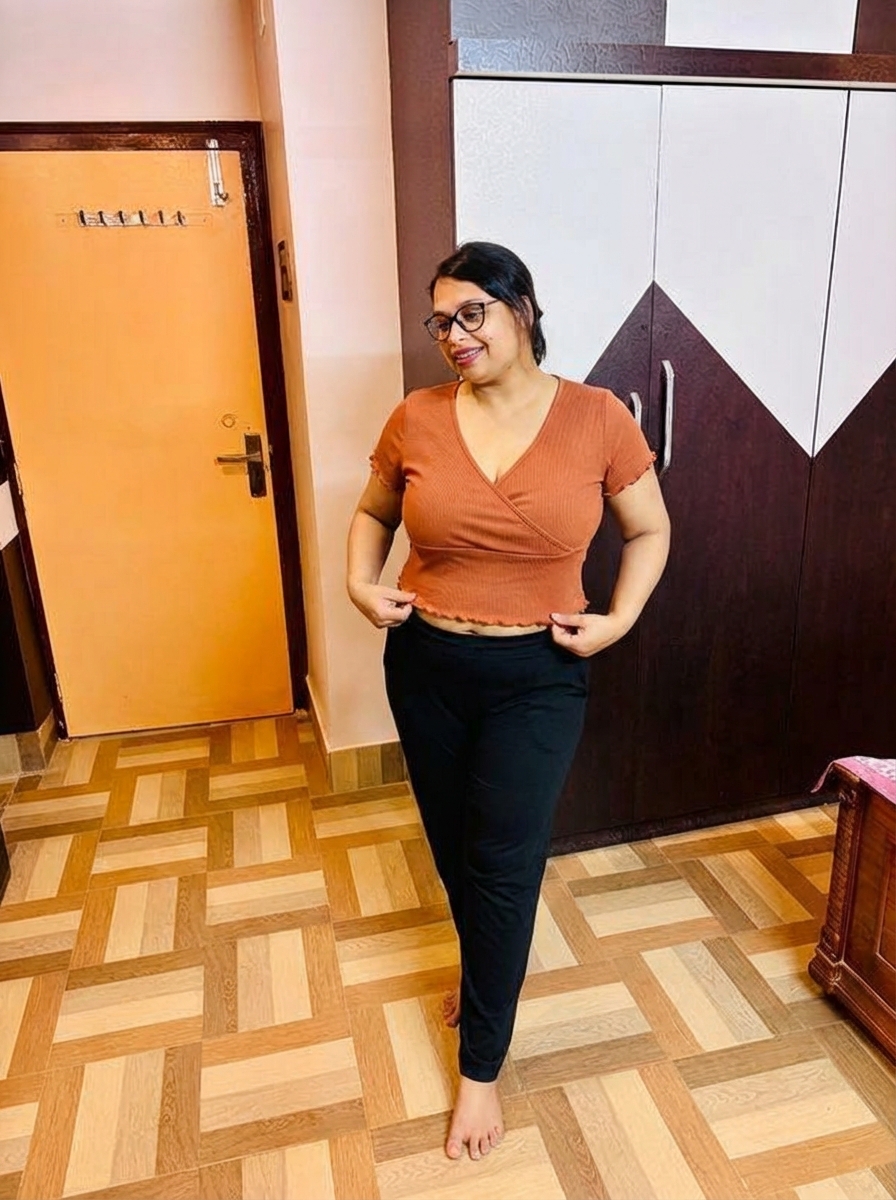
- **Body Mapping:** The simulation must ignore the volumetric bulk of the user's current yellow tunic. The target garment is a form-fitting crop top. It must be mapped to the user's estimated dermal layer/body mesh, sitting significantly higher than the current garment. The fit should be snug against the torso and bust, ending just above the waistline of the black pants. The sleeves are short and tight, replacing the current long, loose sleeves.
- **Occlusion Handling:** The user's hands are currently positioning the hem of the long tunic at hip level. Since the new garment is a crop top, the hands will be positioned *below* the new garment's hemline, interacting with empty space or the pants. Therefore, the hands must be fully segmented and preserved, but they will likely not occlude the new top itself. Any hair falling on the neck or shoulders must be layered *over* the new V-neck and collar area.
PHASE 3: ENVIRONMENT & LIGHTING
- **Light Match:** The user is in a room with warm, domestic lighting coming from the upper-left (judging by the sheen on the door and forehead). The source garment is lit by cool, balanced studio flash. The new render must warm the "rust" color of the top to match the yellow/orange ambient temperature of the room.
- **Color Calibration:** The source terracotta/rust color will appear slightly darker and warmer in this indoor setting compared to the studio shot. Shadows cast by the sleeves onto the user's torso must match the harshness/softness of the shadows currently seen on the floor tiles.
PHASE 4: IDENTITY PROTECTION
- **Facial Lock:** The user's entire head, including the specific jawline, glasses, and hairstyle, must be frozen and pixel-perfectly preserved. The neck area (currently covered by a mandarin collar) needs to be realistically exposed to accommodate the V-neck.
- **Body Integrity:** Strictly forbid slimming. The user's shoulder width, bust volume, and hip placement must remain unchanged. Although the *silhouette* will change because the new top is tight (removing the visual bulk of the loose tunic), the underlying biological measurements of the user must not be warped to match the source model's physique.