Thinking Process
PHASE 1: VISUAL DECONSTRUCTION
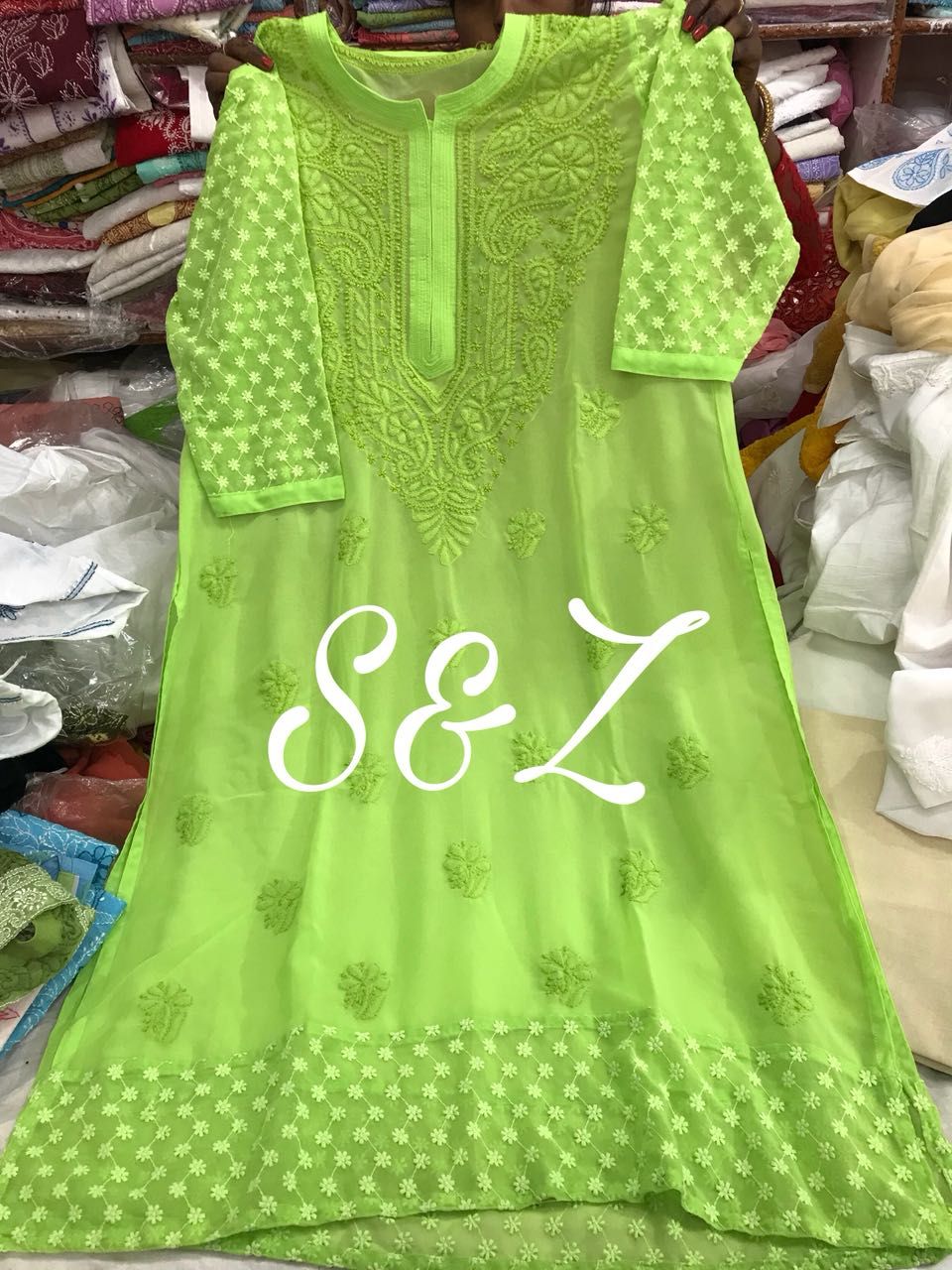
- **Fabric Physics:** The source garment is a lime green Chikankari kurta, likely made of Georgette or Chiffon. This requires a physics simulation for lightweight, semi-sheer fabric with high drape and low stiffness. It must exhibit "subsurface scattering" properties where light passes through the non-embroidered sections. The drape should be fluid and vertical, reacting to air resistance more than the current stiff cotton/synthetic top.
- **Key Features:** The dense white floral thread work (Chikankari) functions as a displacement map; these areas are heavier and opaque. The specific neckline design (split round neck with vertical placket) and the intricate border work at the hem and sleeve cuffs must be preserved. The large white "S & Z" watermark on the source image must be structurally inpainted out and ignored during texture synthesis.
PHASE 2: FIT & DRAPE SIMULATION
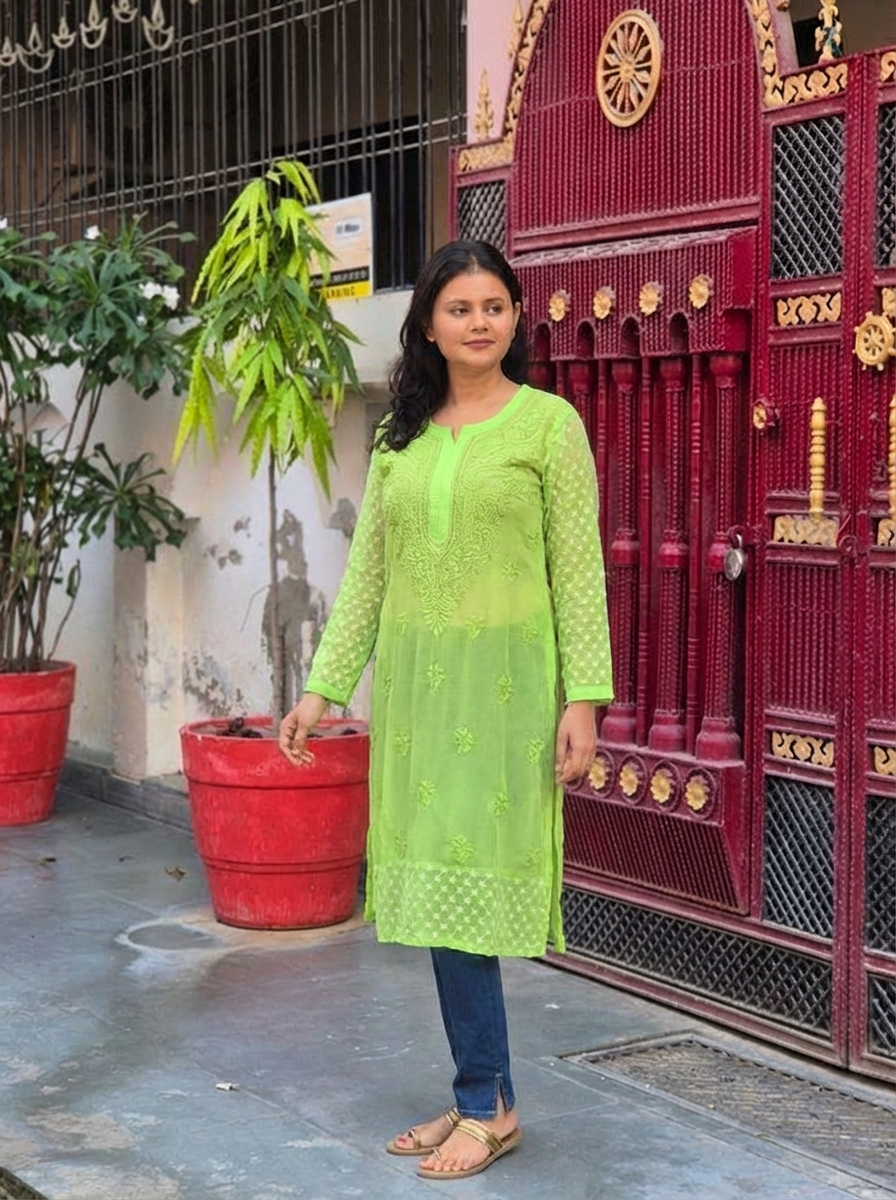
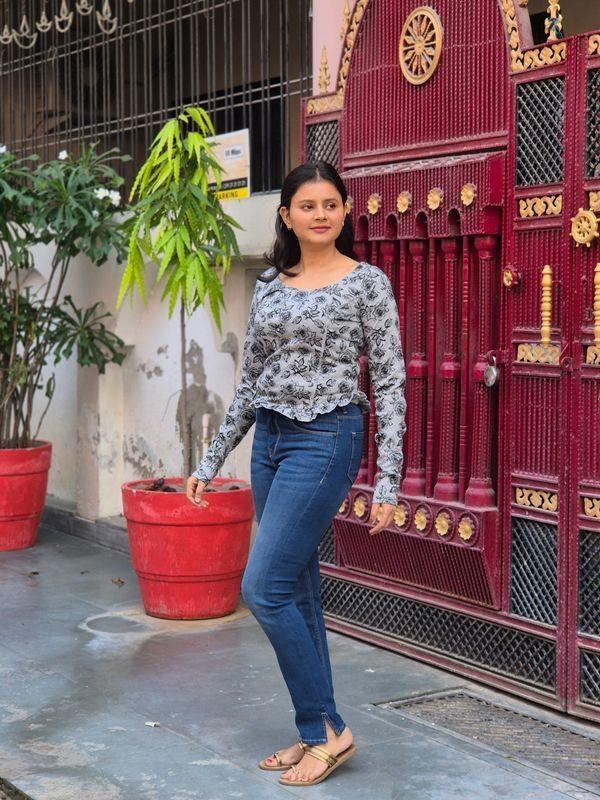
- **Body Mapping:** The target user is currently wearing a hip-length top, but the source garment is a knee-length or calf-length tunic. The simulation must extend the mesh significantly downwards, covering the waist, hips, and upper thighs of the jeans. The fit should be "relaxed" and "anti-fit" (typical of Kurtas), loosening the silhouette around the waist compared to the user's current form-fitting top. The sleeves are three-quarter to full length and should hang loosely around the forearms, not clinging to the biceps.
- **Occlusion Handling:**
- **Hair:** The user's dark hair falls over her right shoulder and back. This requires a precise segmentation mask to ensure the green fabric renders *underneath* the hair volume.
- **Hands:** The user's hands (fingers and wrists) must remain visible. The sleeve cuffs must terminate naturally at the wrist/forearm without clipping through the skin.
- **Lower Body:** Since the Kurta is long, it will obscure the upper portion of the blue jeans. The physics engine must calculate collision with the thighs so the fabric flows over the jeans rather than intersecting them.
PHASE 3: ENVIRONMENT & LIGHTING
- **Light Match:** The target environment features soft, diffused natural daylight (likely overcast or shaded outdoor setting). The source garment image was taken under harsh, artificial indoor lighting. We must neutralize the indoor color cast of the source and relight the Green Kurta with an Environment Map derived from the outdoor scene (soft white/blue ambient light).
- **Color Calibration:** The lime green saturation needs to be slightly desaturated to match the lower contrast of the outdoor scene. Shadows generated by the garment (self-shadowing in folds) must match the softness of the shadows seen on the red gate and plant pots. Hard black shadows must be avoided.
PHASE 4: IDENTITY PROTECTION
- **Facial Lock:** Absolute freeze on the facial ROI (Region of Interest) including eyes, nose, lips, jawline, and the specific skin texture of the neck. The hairstyle and hairline must remain pixel-perfect.
- **Body Integrity:** Strict prohibition on warping the user's skeletal structure. The shoulder width and arm thickness must remain identical to the original image. While the garment silhouette changes (becoming looser), the underlying body mesh (waist/hips) must not be slimmed or altered.