
Thinking Process
PHASE 1: VISUAL DECONSTRUCTION
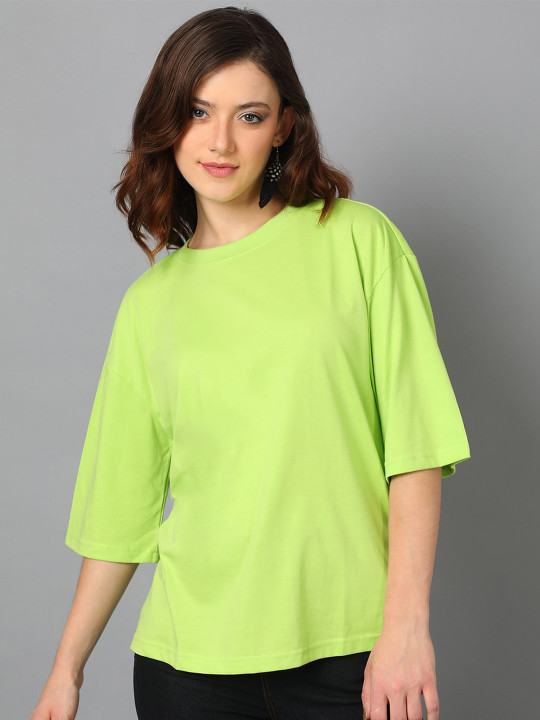
- **Fabric Physics:** The source garment is a medium-weight cotton jersey (knit). It has a matte finish with low reflectivity. It exhibits structural draping characteristic of "oversized" fits—meaning it falls vertically from the shoulders rather than clinging to the curves. Folds should be soft and tubular, not sharp or creased.
- **Key Features:** The specific "drop-shoulder" seam placement must be preserved to maintain the relaxed aesthetic. The ribbed crew neckline, the elbow-length wide sleeves, and the double-stitched bottom hemline are essential details. The solid lime green color must remain uniform but textured.
PHASE 2: FIT & DRAPE SIMULATION
- **Body Mapping:** The user is leaning slightly backward against a railing. The simulation must account for gravity pulling the hemline vertically toward the ground, likely causing the fabric to press against the lower back/railing while hanging slightly away from the lower abdomen. Since the source is oversized and the user's current top is fitted, the new silhouette must be wider at the waist and hips. The new sleeves are shorter (elbow-length) than the current long sleeves, requiring accurate skin generation/inpainting for the user's forearms.
- **Occlusion Handling:** The user has long, dark hair cascading over both shoulders and resting on the upper chest. This hair is a critical occlusion layer and must be segmented and composited *over* the new green t-shirt. The railing behind the user must interact correctly with the back of the shirt (compression of fabric).
PHASE 3: ENVIRONMENT & LIGHTING
- **Light Match:** The target environment is outdoor daylight with dappled sunlight filtering through trees. The lighting is high-contrast with the source coming from overhead. The new garment must shed the flat studio lighting of the source image and adopt high-dynamic-range shading—bright highlights on the shoulders and upper chest, with deeper, sharper shadows in the fabric folds to match the scene's contrast.
- **Color Calibration:** The lime green requires desaturation and tone mapping to match the outdoor color temperature. It should reflect the ambient greenery of the background slightly and accept the hard shadows present in the user image (similar to the shadows on her jeans) rather than the soft shadows of the catalog shot.
PHASE 4: IDENTITY PROTECTION
- **Facial Lock:** Absolute preservation of the user's facial structure, expression, skin tone, and the exact volume and flow of the hair.
- **Body Integrity:** The user's body shape must not be altered or slimmed. The fit of the garment should adapt to her actual dimensions. Crucially, the transition from the new elbow-length sleeve to the user's arm must be realistic, generating natural skin texture where the previous red sleeves covered the arms.