Thinking Process
PHASE 1: VISUAL DECONSTRUCTION
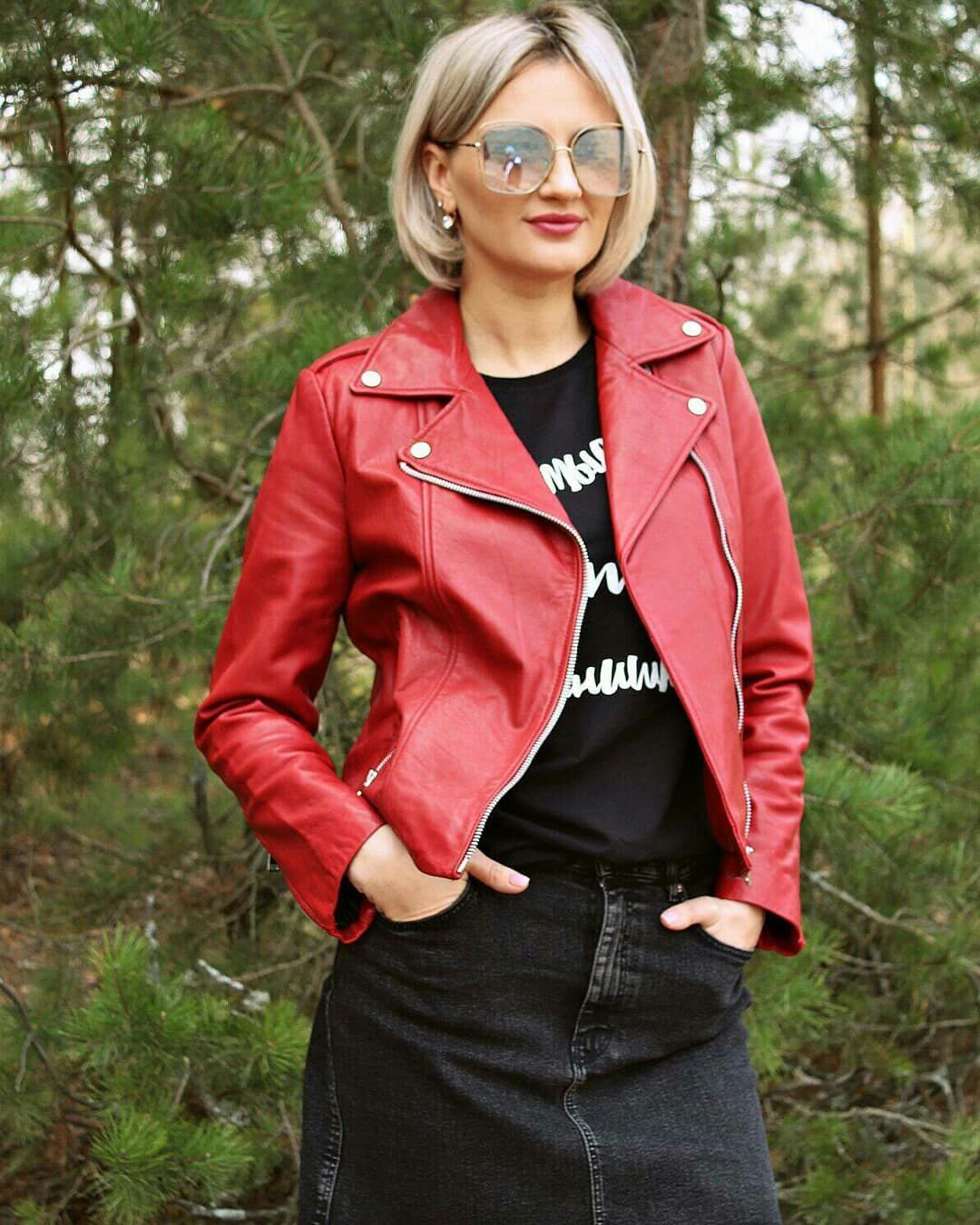
- **Fabric Physics:** The source garment is red leather (or high-quality faux leather). This requires **Anisotropic reflection** handling; the material is stiff, heavy, and possesses high specular highlights. Unlike the target's current soft cotton/poly blend, the leather will not conform tightly to micro-curves but will create angular, structural folds. It has significant thickness (gauge) which must be rendered to avoid a "painted-on" look.
- **Key Features:**
- **Hardware:** Silver metallic zippers on the sleeves and body, and snap buttons on the lapels must retain high-contrast reflectivity.
- **Structure:** The notched lapel collar is stiff and must stand slightly away from the clavicle, not lie flat like fabric.
- **Texture:** Visibly smooth grain with natural creasing at high-stress points (elbows, armpits).
PHASE 2: FIT & DRAPE SIMULATION
- **Body Mapping:**
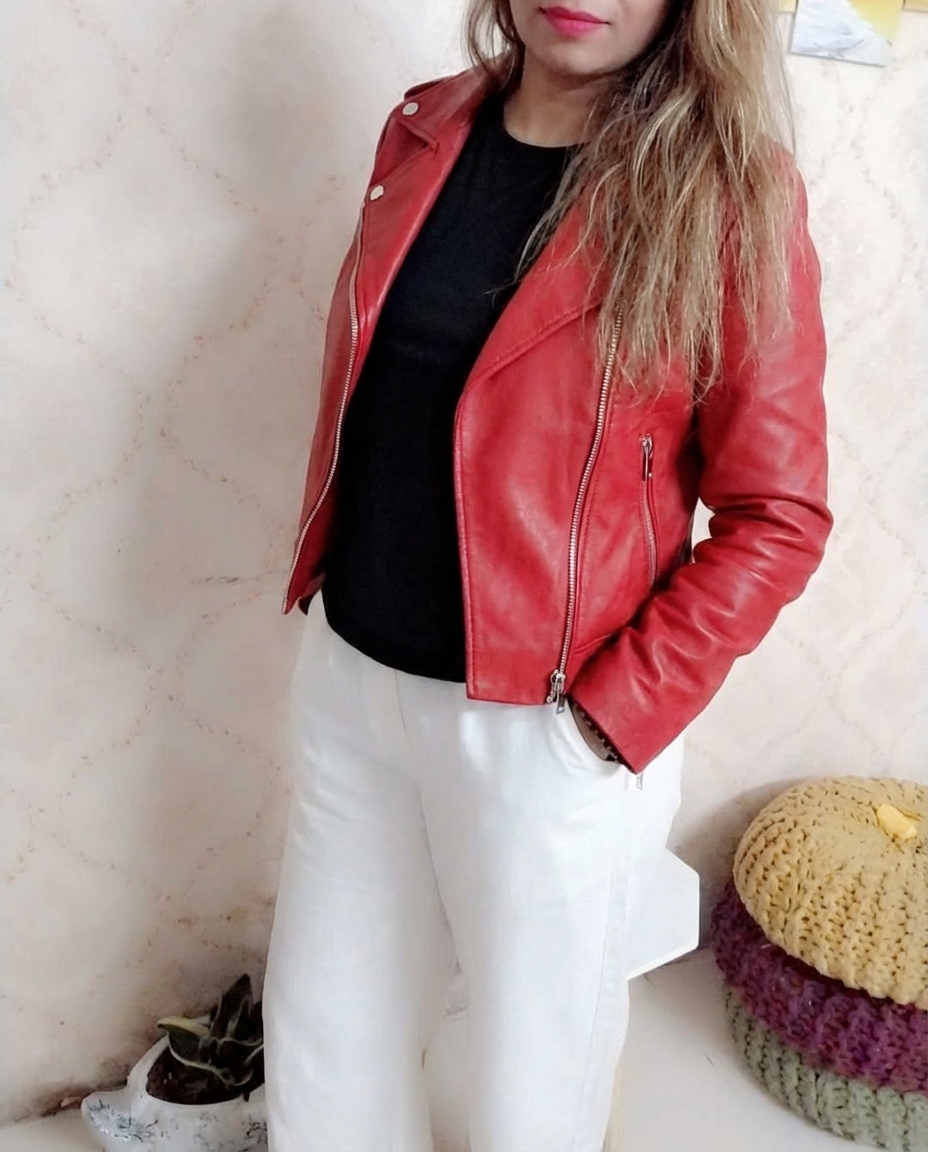
- **Shoulder Alignment:** The jacket has a structured shoulder line which will extend slightly beyond the user's natural shoulder width, correcting the current sloping silhouette.
- **Elbow Articulation:** The user's right arm is bent at an acute angle. The leather must exhibit "honeycomb" creasing at the inner elbow and tension across the outer elbow. The sleeve must ride up slightly at the wrist due to the thickness of the material and the bend.
- **Torso Drape:** Since the source jacket is open, the simulation must render the jacket hanging open on the target. The current floral top must be digitally removed and replaced (ideally with the black tee from the source or a neutral inner layer) to ensure the floral print does not show through the open jacket.
- **Occlusion Handling:**
- **Hair:** The user has long, volumetric blonde/brown hair cascading over both shoulders. This is a critical occlusion layer. The leather collar must sit *behind* the hair, and fine hair strands must be alpha-masked to lay *over* the red leather surface.
- **Hands:** The user's right hand is tucked into the trouser pocket. The jacket sleeve must terminate naturally at the wrist/forearm, ensuring the cuff interacts physically with the pocket entry (bunching slightly above the hand) rather than ghosting through it.
PHASE 3: ENVIRONMENT & LIGHTING
- **Light Match:** The target environment has soft, diffuse indoor lighting, likely from a window to the viewer's left. The source image has high-contrast outdoor daylight. The jacket's specular highlights must be re-mapped: remove the sharp outdoor sun reflections and replace them with softer, broader rectangular window reflections consistent with the target room. Shadows should cast softly to the right and rear of the user.
- **Color Calibration:** The source red is highly saturated. To match the slightly desaturated, cool-toned indoor environment of the user image, the red channel of the jacket should be slightly cooled (gamma correction) to prevent it from looking like a superimposed "sticker." The brightness of the black inner shirt (if transferred) must be lifted slightly to match the indoor shadow levels.
PHASE 4: IDENTITY PROTECTION
- **Facial Lock:** The user's facial structure, skin tone, makeup, and specific head tilt must remain pixel-perfectly frozen. The hairline boundary is the strict "no-edit" zone.
- **Body Integrity:** The user's waist and hip dimensions (defined by the white trousers) must be preserved. The jacket adds bulk; therefore, the final silhouette should look slightly broader at the torso than the original image. **Under no circumstances** should the waist be artificially cinched to fit the jacket; the jacket must warp to fit the user's natural standing posture.