Thinking Process
PHASE 1: VISUAL DECONSTRUCTION
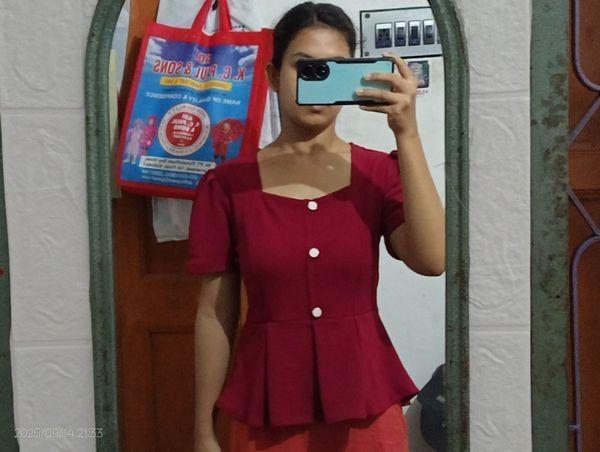
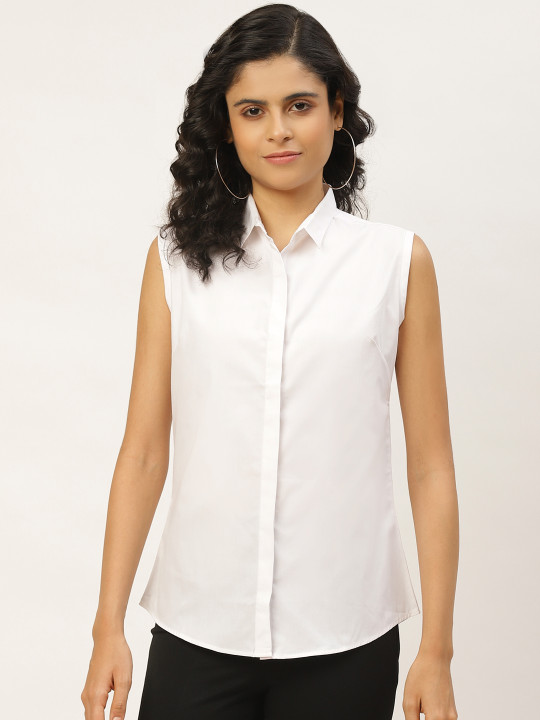
- **Fabric Physics:** The source garment is a crisp, woven cotton or cotton-poplin blend. It possesses medium stiffness with low elasticity. Unlike the user's current knit or crepe material, the new shirt should not cling tightly to the torso. It requires structured creases around the button placket and collar, diffusing light with a matte finish rather than a glossy sheen.
- **Key Features:** The sharp, structured shirt collar and the sleeveless armhole cuts are critical. The central button placket must remain vertically aligned (accounting for body twist). The curved "shirttail" hemline and the side darts providing the tailored shape must be preserved.
PHASE 2: FIT & DRAPE SIMULATION
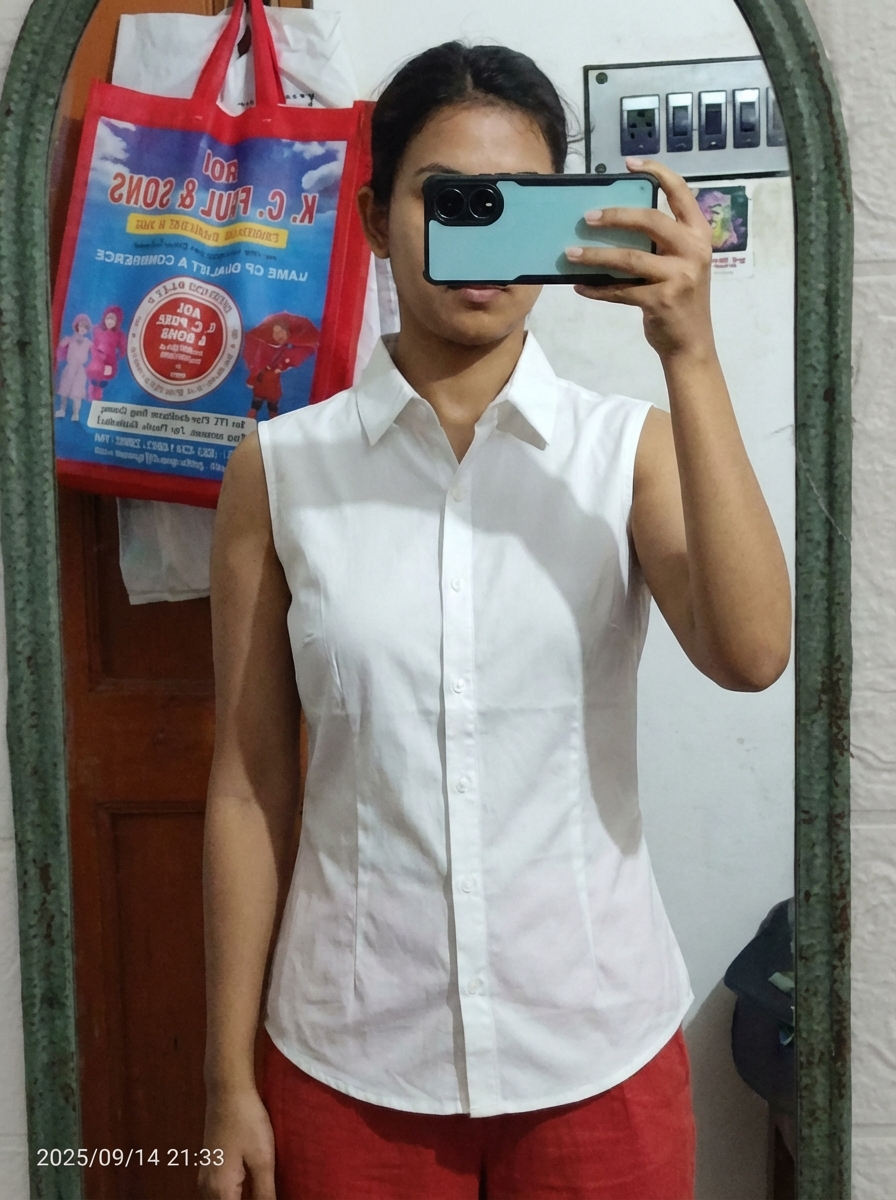
- **Body Mapping:** Due to the user's raised left arm (holding the phone), the left armhole of the sleeveless shirt must sit higher and closer to the armpit compared to the right side. The fabric across the chest needs to stretch slightly diagonally toward the raised shoulder. The collar must sit naturally around the neck, replacing the current square neckline. *Critical Note:* The simulation must generate natural skin texture for the user's upper arms, as the current garment has sleeves while the source garment is sleeveless.
- **Occlusion Handling:** The user's left hand and the smartphone are positioned in front of the upper chest/neck area. The new garment must be rendered strictly *behind* the hand and phone. The necklace (if visible below the new collar) should be preserved or properly masked.
PHASE 3: ENVIRONMENT & LIGHTING
- **Light Match:** The user's environment features overhead, somewhat harsh artificial lighting, creating a flash reflection on the phone. The white shirt must lose its "studio brightness" and adopt the slightly grainy, lower-contrast lighting of the mirror selfie. Shadows should be cast downwards from the collar and breast pocket area.
- **Color Calibration:** The pure white of the source cloth must be temperature-adjusted to match the slightly cool/cyan cast of the room. A subtle noise layer must be applied to the white fabric to match the ISO grain of the target photo, preventing the shirt from looking like a synthetic sticker.
PHASE 4: IDENTITY PROTECTION
- **Facial Lock:** The forehead, visible hair, ears, and the specific grip of the hand on the phone must remain pixel-perfect. The phone itself acts as a rigid mask that cannot be warped.
- **Body Integrity:** The user's shoulder width and waist circumference must be respected. Do not slim the user to match the model's physique. The shirt should fit the user's current volume, meaning it will appear slightly more fitted on the user than on the source model.