Thinking Process
PHASE 1: VISUAL DECONSTRUCTION
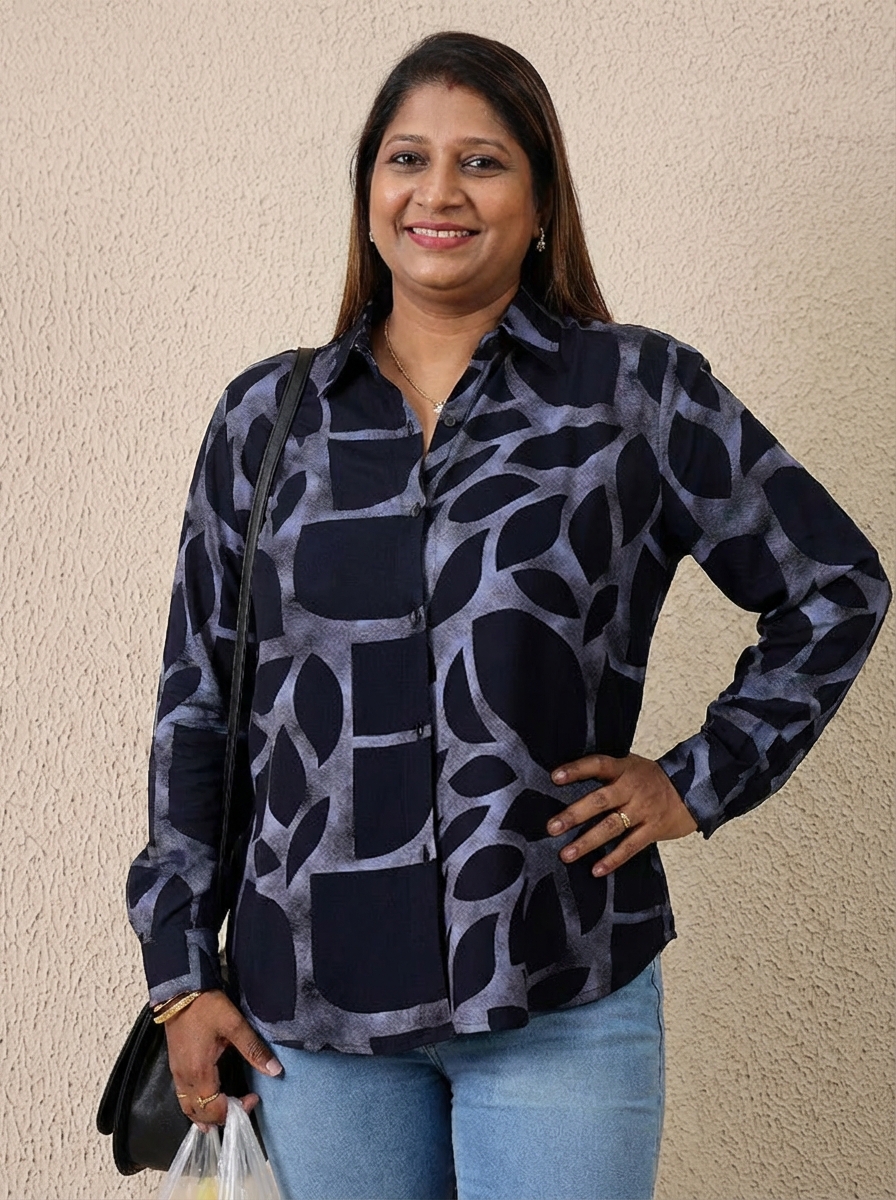
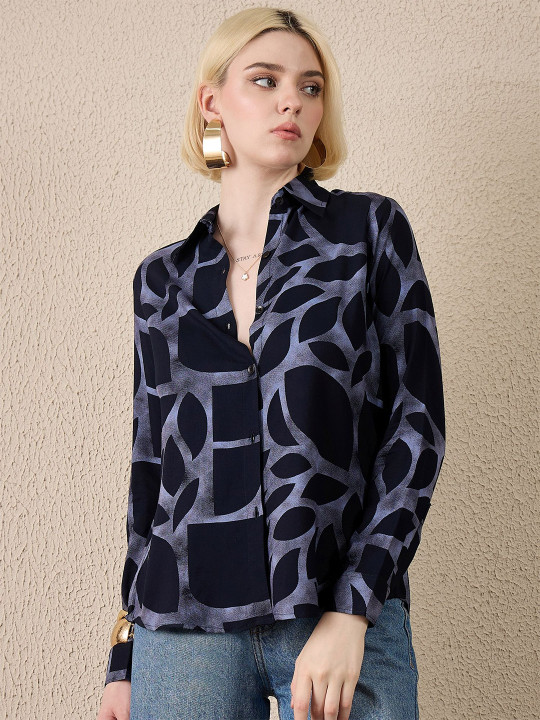
- **Fabric Physics:** The source garment appears to be a lightweight Viscose or Rayon blend. It exhibits low structural rigidity and high drapeability. The simulation must render a "soft sheen" (anisotropic reflection), meaning it is not matte like cotton nor highly specular like silk, but reflects light gently along the fold crests.
- **Key Features:**
- The distinct abstract leaf/geometric print (muted blue-grey on navy/black).
- The central button placket (must align with the user's centerline).
- The classic shirt collar (pointed lapels).
- Long sleeves with cuffs (the source is cuffed; the target simulation must account for full arm coverage).
PHASE 2: FIT & DRAPE SIMULATION
- **Body Mapping:**
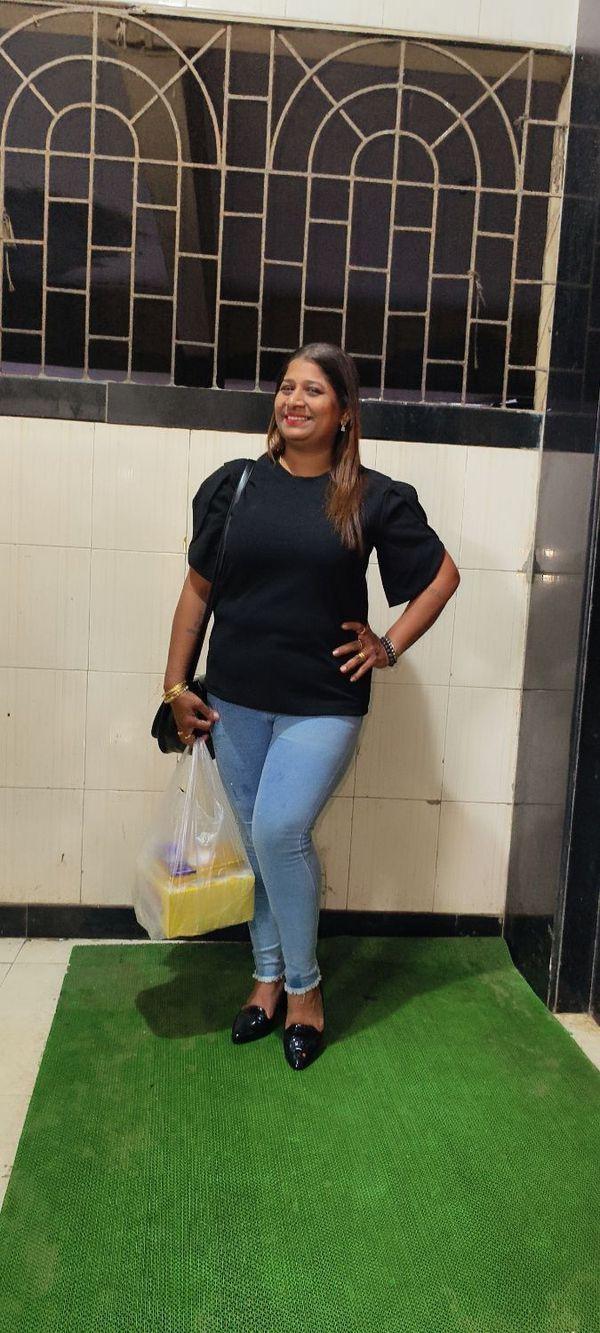
- **Left Arm (Akimbo Pose):** Since the user's left hand is on her hip, the fabric physics engine must simulate tension across the left deltoid and significant bunching/creasing at the inner left elbow. The sleeve cuff should retreat slightly up the forearm due to the bend.
- **Right Arm (Extended):** The right sleeve should hang straight with gravity, exhibiting vertical drapery folds.
- **Torso Interaction:** The source shirt is a relaxed fit. Unlike the user's current tight top, the new garment should *not* cling to the midsection but rather drape vertically from the bust line, creating a looser silhouette around the waist.
- **Occlusion Handling:**
- **Cross-Body Strap:** The user is wearing a bag with a strap crossing from the right shoulder to the left hip. The new garment must be rendered *underneath* this strap, showing compression and localized wrinkling where the strap presses into the fabric.
- **Hair:** The user's long hair falls over her right shoulder/chest. This hair volume must be segmented and layered *over* the new collar and upper chest area of the shirt.
- **Left Hand:** The fingers resting on the hip/waist must occlude the hem of the shirt.
PHASE 3: ENVIRONMENT & LIGHTING
- **Light Match:** The user is in an environment with diffuse, top-down lighting (likely fluorescent or ambient daylight), creating soft shadows behind her on the tiled wall. The new garment must not have the high-contrast studio lighting of the source; instead, it requires softer occlusion shadows in the armpits and fold crevices.
- **Color Calibration:** The user image has a slightly cooler/greenish cast due to the green floor mat and tiles. The source shirt's "studio warm" tones must be desaturated slightly and temperature-shifted cool to blend naturally with the ambient light bouncing off the green mat.
PHASE 4: IDENTITY PROTECTION
- **Facial Lock:** Absolute pixel preservation required for the entire head region above the neck seam, including the jawline, chin, and facial expression.
- **Body Integrity:** Strictly prohibit any warping or "slimming" of the user's torso or arm width. The garment must conform to the user's existing volumetric dimensions (bust, waist, hips), preserving her natural body type while applying the looser cut of the source shirt.